Last modified:
This post could be summarized with a single Bible verse:
“The first one to plead his cause seems right, Until his neighbor comes and examines him.” (Proverbs 18:17 NKJV)
Or, if we go by the Syriac OT: “Innocent is a son of man in his judgment, and when ever comes his neighbor, he examines him.” (Glenn David Bauscher’s Interlinear translation, punctuation and capitalization mine) Notice that Bauscher’s translation portrays the proverb with considerably weaker phrasing than the original Hebrew: “Just is the first one in his dispute; and then comes his neighbor, and he will have thoroughly examined him.” (my right-to-left translation of the Masoretic Text) This example alone should give you a taste of how many rigorous points can be brought out of the Hebrew or Greek phrasing of a passage that are left ambiguous in the Peshitta (pronounced “puh-SHEE-tuh”)! And, get this, Tartaria & Biblical Research RELOADED (hereafter T&BRR) claims that Bauscher’s translation is “the most solid translation from Aramaic to English” {Italics in original.}.
Why am I bringing this up? Because T&BRR believes that the Syriac Peshitta version of the NT is the original, and that the Greek texts are a translation–exactly the opposite of the scholarly consensus! The case T&BRR makes for this is available on Telegram here (don’t worry, you don’t need the app to view it!), and it’s easily the most comprehensive one I’ve seen. But as you probably guessed from the Scripture I opened this post with, it only seems convincing to someone who’s hearing his case and nobody else’s! You see, making a solid case doesn’t just require you to lay out all the arguments that seem to support your position; you must also acknowledge the arguments that are presented against it and attempt to refute them. T&BRR does the first of these, but not the latter two. As I’m sure you’ve gathered from reading my previous posts, I do all three. This is important because counterarguments often force us to consider whether we’ve overlooked something, and as we work our way through those arguments and consider their merits and demerits, we often acquire a more nuanced position that adequately accounts for the evidence used by both sides.
While the idea that the Peshitta version of the NT is the version that was written first is a fringe enough theory that few scholars have written much about it, I’m thankful to report that there are still a few who have {keep clicking “load older messages” at the top until every message is loaded} (including one by a professional Aramaic translator and another by a professional linguist). So, let’s spend this post going through T&BRR’s claims, one-by-one, calling out the more pervasive fallacies along the way (i.e., the ones that Peshitta Primacists make the most often).
The Alleged Inferiority of the Greek New Testament
I was tempted to skip the Introduction to T&BRR’s series arguing that the Peshitta version of the NT is the original, since he doesn’t really make any substantial arguments in it. However, he leads in with the first Aramaic word to appear in the Bible, “Jegarsahadutha” in Genesis 31:47–which is actually punctuated as two words in the Masoretic Text: יְגַר שָׂהֲדוּתָא (Yegar Sahadutha); ironically, Bauscher’s Interlinear translation of the Peshitta OT also phrases it as two words: “(of the Testimony) דסהדותא (Mound) יגרא”, or Yagara deSahadutha. In fact, this phrase literally means “The Mound of The Testimony”; take note of those two extra letters (the א at the end of Yegar, meaning “the” and the ד at the beginning of Sahadutha, meaning “of”)–they’ll be important very soon! Yet, T&BRR says it means “A Heap of Witnesses” (ignoring the definite article the Syriac attached to both words!), and explains the context and implications as follows:
Jacob’s father-in-law Laban spoke Aramaic, and Jacob understood it. Their covenant in Gilead was sealed in ancient times, not with pen and parchment, but with stones gathered into a heap. This alone places both Hebrew and Aramaic as living covenant languages reaching back to the times long before Christ was manifested in the flesh. The word Jegarsahadutha carries the same meaning as the Hebrew Galeed [the first half of this compound word, גַּל, means “heap”, while the second half, עֵד, could mean “witness” or “testimony”], a testimony that both tongues were present from ancient times. Indeed, the Old Testament itself bears this witness: most of it written in Hebrew, but with sections in Aramaic, such as three chapters of Ezra and half of Daniel, where chapters two through seven are fully Aramaic.
{Italics in original. Content in brackets mine.}
So far, so good. But then he gets to the stuff I take issue with:
And when we pass into the New Covenant writings, the same testimony continues, because the New Testament was undoubtedly originally written in Aramaic, which is exactly what this series will be about.
As for the “Heap of Witness”, it was not just a single stone that gave it weight, but many, each laid one upon another until the witness could not be ignored, and so it will be with the testimony we are about to consider; in this series we will gather witnesses, not of stone, but of history, of language, and of Scripture itself. Each one may seem small when taken alone, but together they rise as a pillar, a heap of witnesses which truly cannot be dismissed. They speak with one voice, declaring that the New Testament we have received in Aramaic is not a translation of Greek, but that is in fact, the other way around.
{Boldface mine.}
We’ll see about that. Now let’s move on to each post of T&BRR’s series.
“Why The Greek Cannot Be The Original”
In the first post of his series, T&BRR claims:
The Greek New Testament carries all the marks of translation, and the Peshitta carries the voice of an original.
Rev. David Bauscher (who, in our opinion, has created the most solid translation from Aramaic to English) writes: “There are hundreds of places in which the Greek reads as if it were a poor translation from Aramaic, with errors that can be traced to confusion of similar-looking Aramaic letters written in the Dead Sea Scrolls hand.” This is not conjecture, it’s the confession of the Greek text itself! Where Greek strains and stumbles, Aramaic flows. Where Greek collapses into awkward phrasing, the Peshitta preserves coherence ever so beautifully.
{Italics in original.}
Care to give any examples of places in the NT where the “Greek strains and stumbles, [but the] Aramaic flows”? Or where the “Greek collapses into awkward phrasing, [but] the Peshitta preserves coherence ever so beautifully”? No? No concrete illustrations of either of these contrasts? Okay, then. I guess I can’t blame him, though; the two claims I just quoted in my questions are blatantly subjective. However, experts in ancient Greek have pointed out that if you’re looking for Biblical Greek that “collapses into awkward phrasing”, you should look in the Septuagint!
We do have an example, in the Septuagint, of what it looks like when ancient writers translate large chunks of material from Hebrew and Aramaic into Greek, and the results are pretty distinctive. The Greek text is, in all sorts of ways, unnatural Greek, and you can see the underlying Semitic texts through it. But this is not how the Greek New Testament looks; virtually no one in the scholarly world sees those traces of translation in the New Testament.
And this is understandable, since the Septuagint was one of the first attempts in all of history to translate an entire collection of books into another language! At least ancient bilingual inscriptions like the Rosetta Stone (which contained the same message in two languages and three scripts) had the benefit of the author of the original still being alive to ensure the translation conveys the exact sense intended by the original! The LXX was essentially a first attempt at translating God’s word into another language without the benefit of the original authors being alive, so of course the result would sound less-than-natural to native speakers of that second language! In fact, the varied writing style among the Greek NT documents underscores the fact that it didn’t all come from a single source–like, say, an earlier work it was being translated from!
Another issue is that the Greek of the NT is not translation Greek. Nor is it consistent Greek. Luke varies between highly educated Greek and Greek that has Semitisms and is influenced by the LXX. There is no set basis of Greek. This reveals evidence of various source materials and ranging influence of rewriting the sources to meet the author’s Greek style, not a singular translation of an Aramaic vorlage. Semitisms do not reveal and [sic] underlying different language for a text but may reflect a multi-lingual reality.
{Boldface mine.}
But to his credit, T&BRR does try to present a bunch of examples that he thinks illustrate Bauscher’s claim (both here and over the bulk of his series):
The evidence begins with the script. In older Aramaic hands, the dalath (ܕ) and resh (ܪ) were nearly indistinguishable. A scribe mistaking one for the other produced a different word altogether. Greek readings often look bizarre until the correct Aramaic consonant is restored. The same is true for yodh (ܝ) and waw (ܘ), two tiny marks that easily confuse an eye.
{Boldface in original.}
These are issues with the Hebrew alphabet, as well (daleth ד vs resh ר & yodh י vs waw ו), and even show up in the Septuagint {scroll to the second paragraph under “Differences in Hebrew Consonantal Text” on p. 3 of the PDF} and copyist errors in the MT (e.g., 2 Kings 25:8 having “seventh”, instead of “tenth” as seen in the parallel passage in Jeremiah 52:12; back when the numbers were expressed as Hebrew numerals instead of spelled-out words, the scribe copying 2 Kings 25:8 accidentally added a downstroke to the י [yodh, 10], turning it into a ז [zayin, 7] {HIDMF, p. 660 Fn 1153}). But as these examples demonstrate, these kinds of mistakes are pretty easy to spot with a little detective work, and the original text can be reconstructed based on the insight gleaned. So let’s look at T&BRR’s examples that supposedly show the direction of translation was from Syriac to Greek, and see if they hold any water.
The Greek contains clumsy phrases born of these errors, but the Peshitta reads smoothly, showing it was not the copy but the original source indeed.
This degradation shows itself most clearly in Matthew 14:27, where the Peshitta has Yeshua say: “Take heart; I AM THE LIVING GOD; do not be afraid.” The divine formula ena na (“I AM”) echoes the covenant Name revealed in the Torah. The Greek weakens it into: “Take heart; it is I.” A translator, confronted with holy words, softened them to suit a Hellenistic audience, and in the process erased a direct declaration of divinity. Bauscher concludes plainly: “The Greek gospels are translations from Aramaic originals and suffer degradation in translation.”
{Boldface, italics, and all-caps in original.}
First off, the phrase “THE LIVING GOD” was added to the text by Bauscher. Granted, he has a justification for doing this:
אנא אנא “Ena Na” is an idiom which 97% of the time indicates speech from The Deity in The Old Testament Peshitta text (144 of 148 times in five O.T. books). It is equivalent to the Hebrew “Ahiah Asher High”, in Exodus 3:14- “I AM WHO I AM”. Lamsa translates this “Ahiah Asher High” in Exodus 3:14 as “I Am The Living God”, which I have chosen as a translation for this phrase where it indicates Divine speech.
{Italics, boldface, and purple text in original.}
The Hebrew phrase is actually “Ahiah Asher Ahiah”, not “Ahiah Asher High”. But more to the point, notice that he’s admitting he’s rendering the phrase for “I am” this way specifically because it indicates divine speech (or, more accurately, “the divine name”) in the context. I’d just leave that to context and maybe a note in brackets, but every translator has their own priorities. Hence, the phrase Ena Ena could simply be rendered “I AM” instead of “I AM THE LIVING GOD”, and it would still get the point across to an audience familiar with OT usage of the phrase (as most of the earliest Christians would have been, as James pointed out in Acts 15:21).
As for the claim that the Greek “softened” this rendering, that’s not true at all. In reality, it’s English translations that, more often than not, have “erased a direct declaration of divinity”. The Greek literally reads “ἐγώ εἰμι”. This is the nominative singular 1st-person personal pronoun, followed by the present active indicative 1st-person singular form of the verb for “to be”. In short: “I AM”! And since the words after it are the particle of negation of the thought of something, followed by the present middle imperative 2nd-person plural verb for “fear” (indeed, it’s the verb φοβέω–phobeō, G5399–whose noun form gave rise to the English word “phobia”)–implying none of it applies to the speaker, there’s no object for the verb εἰμι; that is, it’s not “I am [insert adjective or substantive here]”, it’s just “I AM”. Moreover, this is true of not only Matthew 14:27, but also the parallel passages in Mark 6:50 and John 6:20. All of them have ἐγώ εἰμι μὴ φοβεῖσθε–“I AM. Don’t even think about fearing.” In contrast, the particle of negation in the Peshitta of Matthew 14:27, לא, could be used for {look at the box under “Strongs”} the Greek μή (G3361, which, again, negates the thought of something) or the Greek οὐ (G3756, which negates the thing itself)–this means the Peshitta is ambiguous on whether Jesus was saying “Fear not” or the much stronger “Don’t even think about fearing”, but the Greek is clear that the latter was meant. So, while Bauscher claims that “The Greek gospels are translations from Aramaic originals and suffer degradation in translation”, and T&BRR calls Matthew 14:27 the place “This degradation shows itself most clearly”, this very example actually suggests that it’s the other way around!
But it is not only single words or letter slips. There are patterns in the text that make no sense if Aramaic were a translation of Greek. They only make sense the other way around:
In Luke’s Gospel, the name Yeshua appears 176 times in the Peshitta, seventy-eight more than in the Greek Luke!
Across the New Testament, the Peshitta contains 138 more verses with the name Yeshua than the Byzantine Greek.
If Aramaic were translating from Greek, a scribe would have had to invent the name of the Savior more than a hundred times out of thin air. Think about it; translators omit words, they do not manufacture them.
Bauscher remarks: “It is highly unlikely that a translator would be adding words… omission is far more common”, and even those who work in a secular translation industry know this to be true. The only logical conclusion is that the Greek dropped what the Aramaic preserved.
{Boldface and italics in original.}
Really? Because I have yet to translate a single Biblical passage into English where the English translation had fewer words than the Hebrew, Aramaic, or Greek! Moreover, consider this exchange between a certain Bohuslav Slovák and Steve Caruso, a professional Aramaic translator, where Bohuslav argued in the opposite direction as T&BRR to reach the same conclusion!
Steve,
I think, the verse “Matthew 26:52” is evidence to Peschitta Primacy too.
In this verse (Matthew 26:52) has Peshitta 14 words and Greek translation 21 words. Greek translators, scribes add 7 words.
And added words in later Greek translated version is not only this one verse. There are dozens or hundreds verses in New Testament. This is very clear evidence to Aramic Primacy!
…
Bohuslav,
Very few languages have 1:1 parity with the number of words to express a concept. With simple sentences, Aramaic tends to be more compact word-wise compared to Greek as in Aramaic things like personal pronouns and different prepositions tend to be prefixes and suffixes where in Greek they are separate words. As such, I’m not sure that this can be construed as evidence of originality in either direction.
{Spelling and grammar errors in original. Boldface added.}
My initial response to both T&BRR and Bohuslav’s arguments here would’ve been the same: “Tell me you have an abysmal understanding of linguistics without telling me.”
Clearly, whether the translation has more or less words than the original depends on the language on each end of the translation process. And that turns out to be the case regarding the extra instances of Yeshua in the Peshitta, too. As Richard A. Taylor explains when reviewing P. J. Williams’ book “Early Syriac Translation Technique and the Textual Criticism of the Greek Gospels”:
Following a brief introduction that describes the Syriac versions and their use by New Testament scholars over the past century, chapter two deals with Syriac proper nouns, common nouns, and pronouns. In numerous examples Williams shows the importance of proper linguistic analysis as a corrective to faulty text-critical assumptions. One example must suffice here. In their use of the name “Jesus” neither the Old Syriac gospels nor the Peshitta consistently imitates the use or nonuse of this name in their Greek Vorlage. While the Peshitta shows a tendency to add the name, the Old Syriac gospels sometimes add the name and other times omit it, depending on the requirements of Syriac idiom. Consequently to cite these versions as supporting the presence or absence of this name in the Greek text is misleading, since the translators on occasion may have used the name or avoided it regardless of whether it was present in their Greek Vorlage.
{Italics and underlining mine.}
In fact, one of the quirks of Syriac (and Aramaic in general, for that matter) is that it had a greater tendency than most languages to replace pronouns with the proper name(s) corresponding to them, for the sake of clarity or rhythm. So for example, the English sentence “Karl went to the store, and he scanned the aisles, and he decided to try a new snack, so he grabbed it and bought it”, might’ve been translated into Syriac (or another Aramaic dialect, for that matter) with a sentence that literally (even down to the order of parts of speech, prefixes, and suffixes!) means “Went Karl to store the, and scanned Karl aisles the, and decided Karl to grab a snack new, so grabbed Karl that snack and bought he it”. Where my name shows up just once in the English sentence, it could show up 4 times in the Syriac! Yet would you take that as evidence that I originally wrote this paragraph in Syriac, and the English text you’re reading is just a translation?!
Finally…
The same is true for the divine Name. The Peshitta New Testament contains the sacred title MarYah (“Lord Yahweh”) 239 times, applying it to Yeshua some thirty-two times. The Greek has none of this. It substitutes the generic word Kyrios (“lord”) in every place. If the Aramaic were a translation of Greek, the translator would have had to insert the divine Name hundreds of times and apply it to Christ where it never stood in Greek. That is not the footprint of a translation. That is the footprint of the original, faithfully preserving the Name that the Greek text erased.
{Boldface and italics in original.}
Or… the Greek NT authors were simply following the precedent set in the Septuagint, where the Tetragrammaton was consistently replaced with Kurios out of the Jewish translators’ well-known superstitious avoidance of the Divine Name (also remember that Christianity was originally considered a sect of Judaism, which is why the Romans were initially willing to tolerate them, rather than declare their new religion illegal; the early Jewish Christians wouldn’t have wanted to forfeit that by being off-putting to their fellow Jews who would’ve had objections to uttering or even writing the divine name!). On the other hand, by the time the Peshitta NT was translated, Christendom at large had abandoned its Jewish roots to the point where the Syrian church would’ve been considerably less superstitious about it, to the point where they were willing to use MarYah in their own translation.
“When The Greek Text Declares Itself A Translation”
In the second post, he gets into another line of reasoning:
What might be the strongest witness against Greek originality is not even external history, but the Greek text itself. Many times, the text pauses to explain Aramaic words with phrases like “which is by interpretation” or “in the Hebrew tongue”. The Peshitta never needs to explain itself, because the words are its own. Let’s start adding some scriptural stones to our heap of witnesses:
MATTHEW 27:46–47
Peshitta: “And toward the ninth hour Yeshua cried with a loud voice and he said, ‘Oh God, oh God! Why have you forsaken me?’ And those people who were standing there, when they had heard, they were saying, ‘This one has called Elijah.’”
Greek: “Eli, Eli, lama sabachthani? that is to say, My God, my God, why hast thou forsaken me? … This man calleth for Elias.”
The mishearing of “Eli, Eli” as “Eliyah” (Elijah) makes sense only in Aramaic. In Greek (Theos mou), it does not.
{Italics and boldface in original.}
He goes on to list Revelation 9:11 (where the Peshitta replaces “but in the Greek tongue his name Apollyon” with “and in Aramaic his name is Shara”), John 19:17, Luke 23:38 (where the Peshitta has “Aramaic, Greek, and Latin”, but the Greek has “Greek, and Latin, and Hebrew”), John 1:38, John 1:41, John 1:42, John 9:7, Acts 9:36, Mark 5:41, Mark 15:22, & Mark 14:36 (his order, not mine) as additional examples where the Peshitta doesn’t bother explaining what the Aramaic word means (as the Greek does), replaces “Hebrew” or “Greek” with “Aramaic”, or replaces Greek phrases like “the place of a skull” with their Aramaic equivalent (“Qaraqpatha”). He then concludes:
The pattern is undeniable! The Greek text is full of pauses, glosses, and explanations, because it is constantly wrestling with Aramaic words it has borrowed as loanwords. The Peshitta never stumbles like this, as it speaks in its own tongue without apology. Where the Greek must stop and interpret, the Aramaic simply lives in the text. These stones bear their witness: the Greek is the translation, and the Peshitta is the original.
{Italics in original.}
This is a prime example of why I used the phrase “One-Sided Discussion” in the present post’s title: He gives you plenty of examples where the Greek uses Aramaic loanwords and/or goes on to explain them, while ignoring the examples where the Peshitta does the same! While he claims “The pattern is undeniable” right after quoting Mark 5:41, 14:36, & 15:22, the pattern in question IS BLATANTLY BROKEN just a few verses later! If I may format this example the way he formats all of his:
MARK 15:34
Peshitta: “And at the ninth hour, Jesus cried with a loud voice, and said: Il, Il, lemono shebakthone; that is: My God, my God; why hast thou forsaken me ?” [Murdock’s English Peshitta Translation, italics and underlining added]
Greek: “and at the ninth hour Jesus cried with a great voice, saying, ‘Eloi, Eloi, lamma sabachthani?’ which is, being interpreted, ‘My God, my God, why didst Thou forsake me?’” [YLT, italics added]
And just for good measure, let’s look at Bauscher’s translation:

That’s right: ALL Peshitta manuscripts containing Mark 15:34 explain what the Aramaic phrase means, in Aramaic—to Aramaic readers! Moreover, while the misinterpretation of “Eloi” as “Eli(jah) would be understandable in Mishnaic Hebrew and Galilean Aramaic, it doesn’t make sense for Syriac, the dialect of Aramaic that the Peshitta was actually written in. As Jonathan Andrew Brown explains:
If Aramaic were the original language, why would the text need to explain an Aramaic phrase in Aramaic? Why would it have the parenthetical addition of “that is” if it were already original?
Aramaic Primacists respond that the text transitions between spoken and written dialects, necessitating explanation. They note “Eloi” (or “Eli”) represents Hebrew for “My God,” while Syriac uses אלהי (Alahi). But this causes other issues. We are told in the Gospels that bystanders mistakenly thought Yeshua called for Elijah (Eliyahu), which is plausible with “Eli” but less so with “Alahi.” This itself provides evidence that the vernacular in Judea was not Syriac.
{Scroll to “Loan Words”. Italics in original.}
At the same time, there are examples of the Peshitta text utilizing Greek loanwords! Brown gives an example of this just before his discussion of Mark 15:34.
The presence of Aramaic words in the Greek New Testament fails to prove originality either way. Modern English writing frequently incorporates foreign terms without suggesting original composition in those languages.
While numerous Aramaic words appear in the Greek New Testament, Greek loan-words abound in the Syriac texts. The Greek term νομος (nomos, “law”) enters Syriac as נמוסא (n’musa), despite Aramaic possessing אוריתא (ora’iyta), a word that most typically refers to the Torah. Curiously, the Peshitta inconsistently employs ora’iyta three times (Matthew 11:13; 12:5; 22:40) while using the Greek-derived term elsewhere, even when clearly referencing Torah. By the same logic, this would suggest the Syriac derives from Greek.
Other Greek and Latin words appear in the Peshitta, just as the Hebrew Tanakh [a.k.a. the Old Testament] incorporates Akkadian and Egyptian terms without compromising its Hebrew origin.
{Italics and content in parentheses in original. Content in brackets mine.}
Indeed, in my earlier quote from Taylor’s review of Williams’ book, “Vorlage” is a German loanword, meaning “template” or “model” in German. But I doubt you took that as evidence that Taylor originally wrote his review in German! The reality of the situation is that Biblical scholarship was dominated by German academics from the late 18th century to the early 20th century, and modern Biblical scholarship retains quite a bit of their German terminology.
He goes on to give additional examples {scroll to “Internal Evidence”}, like when the Peshitta text refers to Peter as פטרוס (“Petros”, his Greek name Πέτρος) in Acts 1:13 and 1 Peter 1:1, despite calling him כאפא (“Kepha”, his Aramaic name, rendered in Greek as Κηφᾶς; e.g., see 1 Corinthians 15:5 in most English translations) elsewhere (well, mostly elsewhere; the Peshitta of 2 Peter 1:1 has him calling himself שׁמעון פטרוס–Shimeon Petros, as Bauscher renders it; i.e., “Simon Peter”; I haven’t checked whether there’s any more examples beyond this!). Now, I find one of Brown’s examples extremely telling:
In textual criticism, readings that best explain subsequent variations typically represent originals. Consider the term “Eucharist,” derived from Greek for “giving thanks” but later denoting communion elements. 1 Corinthians 11:24 in Greek uses εὐχαριστήσας (eucharistesas, “having given thanks”), while the Syriac employs ברך (b’arek, “blessed”), consistent with expectations for an Aramaic document.
However, Acts 2:42 presents a puzzling scenario:
“They were continually devoting themselves to the apostles’ teaching and to fellowship, to the breaking of bread and to prayer.” (NASB95)
Greek renders “to the breaking of bread” as τη κλάσει του αρτου, while the Murdock Peshitta reads: “And they persevered in the doctrine of the legates; and were associated together in prayer, and in breaking the eucharist.”
The Peshitta phrase “breaking the eucharist” (ובקציא דאוכרסטיא) contains w’bqatsaya (“and in breaking,” used only for breaking bread) and eukarristiya—a Greek transliteration. Why would an original Aramaic text employ this Greek term? It likely reflects later Christian terminology substituted during translation from Greek. Conversely, if Syriac preceded Greek, why wouldn’t the Greek maintain this usage?
{Italics in original. Boldface mine.}
The parsimonious explanation is obvious: the Peshitta version of Acts post-dates “Eucharist” becoming a technical term within Christendom, while the Greek version of Acts pre-dates it—and hence, pre-dates the Peshitta version.
Yet, the question remains: why would the Greek originals have bothered incorporating Aramaic terms and giving translations of them, rather than simply presenting their Greek equivalents? Tim Warner gives the following answer in a Note on Mark 5:41.
Jesus was bilingual. He spoke both Aramaic (the language unique to the middle-east) and Greek (the language of trade throughout the Roman Empire). While Mark recorded many of Jesus’ words, only on rare occasions did he record that Jesus spoke in Aramaic. He did this by first transliterating the Aramaic phonetic sounds using Greek equivalent-sounding letters, and then immediately providing a translation of the meaning in the Greek language. If Jesus always spoke Aramaic (as some falsely claim), this distinction would be meaningless (cf. Mark 15:22,34). By first transliterating the Aramaic and then translating it, Mark shows that his intended audience included those who spoke Greek and did not understand the Aramaic language unique to the middle-east (cf. Acts 2:5-11). Mark’s intent was to distinguish an unusual situation which deviated from Jesus’ normal manner of speaking. If Jesus normally spoke Aramaic, and not Greek, no distinction would be made when He spoke Aramaic. Everything would have been translated without distinction. This is a very important observation so as not to be deceived by the “Sacred Name” movement which attempts to create division by insisting that Christians must use “Hebrew” names and titles for God and Jesus, or deceived by those who attempt to reverse-engineer the Greek Gospels into Aramaic (then claiming their creations as the “originals,” then translating these into English. This is a false claim, and is overthrown by the above facts.
{Scroll to p. 12-13 in the PDF. Lack of closing parenthesis in original. Boldface mine.}
Since all of T&BRR’s other examples (aside from Revelation 9:11) occur in the Gospels, it’s safe to assume this convention was being followed by Luke & John, as well. Why do I omit Matthew here? Well, we do have several claims from early Church Fathers that Matthew originally wrote his Gospel in Hebraisti (which some ancient sources used for Hebrew alone, and others for Hebrew and/or Aramaic), so the clarifications of Aramaic terms (e.g. Matthew 1:23c) were probably added when it was translated into Greek–personally, I have no problem with the idea that Matthew translated it into Greek himself or had one of his own disciples do so.
Peshitta Primacists can’t legitimately take statements that the Church Fathers made with reference to Matthew specifically, and extrapolate them to the entire New Testament.
And lest Peshitta Primacy advocates suggest that the Peshitta version of Matthew is the “Aramaic Matthew” that’s otherwise considered lost: a handful of quotations from Aramaic Matthew have been preserved by early Church Fathers, and at least one disagrees with what we see in the Peshitta. In his Ante-Nicene works, Eusebius quoted multiple times from Matthew 28:19 in the Aramaic version that was available to him at the library in Caesarea–and never once with the baptismal formula we see in all extant versions {scroll to p. 10-15 in the PDF} (including the Peshitta). Instead, Eusebius’ fullest quotation of Matthew 28:19-20a goes as follows: “Go, and make disciples of all the nations in My Name, teaching them to observe all things whatsoever I have commanded you” {Eusebius. “Demonstratio Evangelica”. Book 3, Chapter 6. Boldface mine.}. And lest you think he was embellishing, he goes on to state quite emphatically that “in My Name” was in the text he was reading: “For He did not bid them simply and indefinitely make disciples of all nations, but with the necessary addition of ‘In my Name.’” {Ibid. Chapter 7. Boldface mine.} In fact, the following passage from “Theophania” not only repeats that last line almost verbatim, but gives us a couple more key details:
But observe of Him, who availed himself of nothing either human or mortal, how, in reality, He again put forth the word of God in the precept, which He gave to these His powerless Disciples, (viz.) “Go ye and make Disciples of all nations!” It is likely too, His Disciples would thus address their Lord, by way of answer: How can we do this ? For, How can we preach to the Romans ? And, How can we discourse with the Egyptians? What diction can we use against the Greeks; being brought up in the Syrian language only ? How can we persuade the Persians, the Armenians, the Chaldeans, the Scythians, the Hindoos, and other nations called Barbarians, to desert the gods of their forefathers, and to worship the one Creator of all things? And, upon What superiority of words can we rely, that we shall succeed in this ? Or. How can we hope, that we shall prevail in the things attempted ? (viz.) that we shall legislate for all nations, in direct opposition to the laws laid down from ancient times, (and this) against their gods ? And, What power have we upon which to trust, that we shall succeed in this enterprise ? These things therefore, the Disciples of our Saviour would either have thought, or said. But He who was their Lord solved, by one additional word, the aggregate of the things of which they doubted, (and) pledged them by saying, ” Ye shall conquer in my name.” For it was not that He commanded them, simply and indiscriminately, to go and make Disciples of all nations; but with this excellent addition which He delivered, (viz): “In my name.” Since it was by the power of His name that all this came to pass ; as the Apostle has said, “God has given Him a name, which is superior to every name: that, at the name of Jesus, every knee should bow which is in heaven, and which is in earth, and which is beneath the earth.” It is likely therefore, that He would shew forth the excellency of the unseen power, which was hidden from the many, by His name; and, (accordingly) He made the addition, “In my name.”
{Eusebius. “Theophania”. Book 5, Chapter 46. Translated by Samuel Lee. Capitalization, italics, and words in parentheses added by Lee. Boldface mine.}
Whether the copy of Matthew Eusebius was using was written in Mishnaic Hebrew or Galilean Aramaic (although it seems it must have been the latter, in light of Eusebius saying the disciples had been raised with “the Syrian language”–Greek Syriaken glottan, which survives in the Syriac translation of “Theophania” as ܒܠܫܢܐ ܣܘܪܝܝܐ —b-leššānā sūryāyā, “in the Syrian tongue”; remember, Suristi was used instead of Hebraisti when the author wished to distinguish Aramaic from Hebrew!), the English phrase “in my name” would indeed have been represented by a single word: בשמי (beshmi).
Hence, the “O.G.” Aramaic version of Matthew Eusebius was utilizing WASN’T the Peshitta! (And we should assume that any portions of Aramaic Matthew that haven’t been recovered line up with extant phrasings, meaning we still have the original phrasing available among what has been preserved; otherwise, God would’ve seen fit to preserve the entire Aramaic original to the present day.)
As for Revelation 9:11, what good would it have done for Syrian Christians to know what the angel’s Hebrew and Greek names were, but not know what they meant in Syriac? We, living all these centuries later, can simply consult commentaries or lexicons to know that those names meant “Destroyer” in their languages of origin (well, technically, the Syriac word Shara means “Undoer” or “Dissolver”), but that’s a luxury the early Syrian Christians didn’t have!
“The Literary Genocide Of The Aramaens”
Sorry for the typo; I’m consistently using the titles given on this page; T&BRR manages to use the correct spelling, “ARAMAEANS” (including the 4th “A”) at the top of the third post. As a self-proclaimed “spelling nazi”, I felt obligated to include this one extra nitpick!
Anyway, in the third post, he starts getting conspiratorial:
Paul’s words in Romans still stand in the Aramaic text:
“For I am not ashamed of the Gospel, because it is the power of God for the life of all who believe in it, whether of the Judeans first, or of the Aramaeans.”
ROMANS 1:16 (PESHITTA)
In the Greek translations, this is altered into: “to the Jew first, and also to the Greek.” The covenantal identity of the Aramaean peoples is erased with a single substitution and that which the Spirit declared as Judean and Aramaean, the Greek scribes rebranded as “Jew and Greek”.
Dear reader, this is not an isolated mistranslation. We have come to understand that it is most certainly done systematically, as you too are about to see. The Peshitta uses the word Aramaya (Aramaean), twenty times across the New Testament, and in nineteen of those places, the Greek copies replace it with Hellēn (Greek). Acts 6:1 describes the complaint of the Aramaeans against the Judeans over the daily distribution to widows. The Greek versions turn this into “Hellenists.” We also see this in Colossians 3:1, where the Peshitta makes the dividing line between Judean and Aramaean; the Greek text changes it into Jew and Greek once again!
Reverend David Bauscher calls this what it is, a literary genocide of Aramaeans. It is truly a cultural purge, in which the original Semitic witness was recast into Hellenistic dress, so that the New Testament could be made to look like a Greek document for a Greek audience. In his words: “Aramaeans might as well not have existed. It appears to have been a culturally purged Gospel, thoroughly Hellenized and reculturated to suit a Greek audience. This is a literary genocide I had not encountered prior to this discovery.”
{Italics, boldface, and capitalization in original.}
Well, consider what “pastor, programmer, [and] writer” {scroll to the “About frankluke” box at the bottom of the page, and note the profile picture} Frank Luke {same profile pic!} said in response to a related argument by a Mr. “Konway” about “Timothy and Titus being Aramean Gentiles”: “He calls the father an Aramaen [ארמיא (Armaya) in the Peshitta of Acts 16:1]. … However, why does his repeated claim of this indicate Peshitta Primacy? He says it shows that the Greeks replaced Aramoya with ellen [“Greek”]. It could just as easily have been the other way around.” {Boldface and content in brackets mine.} And indeed, there’s good historical reason for thinking it was the other way around:
The name Aramaic by which the language was known in Aram and Babylonia, did not find favour with the Jews of Palestine, probably because it seemed to them to connote paganism. They sometimes called it the profane language in opposition to the sacred Biblical Hebrew. Syriac and Syro-Chaldaic are only later designations.…
The names Aram, Aramaeans and Aramaic, were changed in course of time, into Syria, Syrians and Syriac. The Greeks were responsible for such a change, and the Aramaean Christians gradually became reconciled with this change of names.
…In the original Hebrew books of the Old Testament, the name Aram is invariably used. The name Syria is not found even in the Hebrew Old Testament books, written after the Babylonian Exile. The first Book of Paralipomenon, written during the later part of the Persian period (i.e. about 350 B. C., or more probably during the Hellenistic period, i. e. about 200 B. C.), uses the name Aram and not Syria or Mesopotamia (I Paralip. XIX, 6).
During the period between B. C. 250 and 100, the Hebrew Bible was translated into Greek by the Greek speaking Jews of Alexandria in Egypt. This version, called the Septuagint, adopted the name “Syria”, used by the Greeks in the place of the original Aramaic name Aram.
Though the Greek and Roman governments of Aram, designated it as “Syria”, the Aramaeans accepted the name “Syria” only much later. The Aramaic (Syriac) version of the Old Testament, called Pshitta, begun at least about the first century. A. D. [sic] and completed before the fourth century, uses only the names [REDACTED] Aram, (Num. XXIII, 7), [REDACTED] Aramaean (Gen. XXV, 20), and [REDACTED] in Aramaic (IV Kings, XVIII, 26; Isa. XXXVI, 11; I Esdras. IV, 7; and Dan. II, 4). Even in the Aramaic (Syriac) translation of the Second Book of Machabees, originally written in Greek in the second century B. C., the term [REDACTED] Aramaean language (II Mach., XV, 36), is used in the place of “Syrian language.”
The change of ‘Aram’, ‘Aramaean’ and ‘Aramaic’, into ‘Syria’, ‘Syrian’ and ‘Syriac’, came into vogue among the Aramaeans in the period between the second and sixth centuries A. D. Instead of [REDACTED] (Aram), found in the Syriac Pshitha version of the Old Testament, made about the first or second century A.D., the name “Syria” is found in the Syriac Pshitha version of the New Testament, made about the fifth century A. D. St. Luke (II, 2) uses the name “Syria” [REDACTED] though in IV. 27, he designates Naaman the Syrian as [REDACTED] (Naamnn the Aramaean).
The occasion for the Aramaeans to accept the names ‘Syria’, ‘Syrian’, and ‘Syriac’, in the place of the pristine names ‘Aram’, ‘Aramaean’ and ‘Aramaic’, was their conversion to Christianity. As already mentioned, the name “Aramaean” was not popular among the Aramaic speaking Jews. To them it connoted heathenism. Hence they used the term “Aramaean” as a synonym for “non-Jew” or “unbeliever”. The converted Aramaeans also began to entertain a similar feeling. Christianity was introduced into the Aramaean kingdom of Osrhoene at least as early as the second century A. D. With the conversion of its king, Abgar, Osrhoene became a Christian kingdom. “The dialect of Edessa, its famous capital, became the literary and liturgical language of the Aramaic Christians; most of them gave up their name “Aramaeans” and called themselves “Syrians” and their language “Syriac” or “Syrian”, to distinguish themselves from the reputedly heathen “Aramaeans” (Vander Ploeg, in his Introduction to Fr. T. Arayathinal’s “Aramaic Grammar”).
The term “Aramaean” [REDACTED], thus became equivalent to the Syriac word [REDACTED] which means “heathen”. In the Greek original of the New Testament, the term “Greek” is used to denote a heathen as distinguished from a Jew (Rom. I, 16; II, 9-10; III, 9; X, 12; I Cor. I, 22-24; Gal. III, 28). In the Syriac version of the Acts, XVIII, 4, the term “Greek”, used in the sense of “heathen” is translated by the word [the native Syriac word for “heathen”]. But in the several other passages, referred to above, the term “Greek” is translated by the Syriac term [REDACTED] (Armaya, Aramaean). Both [REDACTED] and [REDACTED] originally signify the same (“Syrian”), as Dr. Smith says in his Syriac Latin Dictionary. In I Cor., I, 22-24, where St. Paul speaks of the wisdom of the heathen, the Syriac Pshitta version uses the term [REDACTED, meaning “Syrian”] to translate the term “Greek”.
…With the change of the name “Aramic” [sic] into “Syriac”, certain progressive changes took place in the language. The form of the letters of the alphabet was modified, uniformity and fixity in the pronunciation of words by the common people, was secured by the introduction of signs to represent the vowels, improvements were effected in certain grammatical forms, and above all, through the efforts of numerous Christian writers, Syriac developed into a great literary language. The Aramaic speaking peoples of Syria, Babylonia and Assyria, who had already become Christians, welcomed the above developments in the language.
{“Syro-Chaldiac (Aramaic) Grammar: 5th Edition.” Fr. Gabriel of St. Joseph. Revised by Fr. Emmanuel. 1961. Mannanam, Kerala, India: The St. Joseph’s Press. ix-xii. Italics and content in parentheses in original. Boldface, underlining, and content in brackets mine. Syriac lettering redacted because I can’t figure out how to type it, LOL.}
So, for the early Syrian Christians, “Aramaean” became a synonym for “Gentile” (i.e., “Non-Jew”)! This explanation for all the switches from “Jew and Greek” to “Jew and Aramaean” has far better historical support than “a literary genocide of Aramaeans” as an explanation for switches from “Jew and Aramaean” to “Jew and Greek”! Also take note of those remarks about “Osrhoene” and “The dialect of Edessa, its famous capital”–these will come up again later. Also, the boldfaced statements in that last paragraph I quoted may help explain why the Peshitta has a remarkably high degree of consistency among its 350+ NT manuscripts and 250+ OT manuscripts: the consistency was enforced on a kingdom level (in contrast to the copying of the 5800+ Greek NT manuscripts we’ve catalogued, which was a decentralized operation; not to mention the Western Text, manuscripts of which are characterized by a vastly greater amount of paraphrase, thus doing a fair amount of the heavy lifting with the variant count for Greek NT manuscripts)! T&BRR continues:
Judeans and Aramaeans together were the first objects of the Gospel’s power. These were the peoples dwelling across Syria, Assyria, Mesopotamia, Persia, and beyond, all of whom spoke Aramaic and received the New Covenant in their tongue. To replace them with “Greeks” is not only inaccurate; it is a distortion of the original order of salvation history!
Woah! Where does he get the idea that Persia was included here?! The only mention of Persia in the New Testament (even the Peshitta version) is in Acts 2:9, where we’re told that some of the Jews who were in Jerusalem for the Feast of Pentecost were “Elamites” (Peshitta Alanoyee–ܘܰܐܠܰܢܳܝܶܐ in the Syriac script, or אלניא in the Hebrew/Aramaic alphabet; Greek Ἐλαμῖται–Elamitai {scroll to “Greek Inflections of Ἐλαμίτης”}).
He seems to be identifying “the first objects of the Gospel’s power” with the devout Jews who were gathered in Jerusalem for the Mosaic Spring Feasts (including Pentecost) in A.D. 30, and began hearing the Apostles’ disciples speaking in the languages of their home countries:
8 And how do we hear each of us his own dialect in which we were born – 9 Parthians, and Medes, and Elamites, and those dwelling in Mesopotamia, Judea, besides also Cappadocia, Pontus, and Asia, 10 Phrygia, besides also Pamphylia, Egypt, and the parts of Libya around Cyrene, and the repatriated Romans, both Judeans besides also proselytes, 11 Cretans and Arabs – we hear them speaking with our own languages the wondrous [things] of God! (Acts 2:8-11 LGV, boldface added)
Of all the places listed here, only the boldfaced ones had any dialect of Aramaic as one of their prominent languages. So, how do the other ones fit into T&BRR’s understanding of “Judeans and Aramaeans”? As we saw above, the truth is that “Judeans and Aramaeans” had the same meaning in Syrian Christian parlance as “Jews and Greeks” or “Jews and Gentiles” had in Greek parlance: “Jews and Non-Jews”.
“The Greek Cover-Up”
In the fourth post, he simply reiterates Romans 1:16 as an example where the Peshitta has “Jew(s) and Aramaean(s)” instead of “Greek(s)” or “Gentile(s)” as seen in the Greek NT, then offers several other examples in Paul’s writings. These are entirely explained by what I said above about “Aramaean” becoming a synonym for “Gentile”, “pagan” or “non-Jew” as Christianity spread in Syria. However, notice that a couple of the verses he cites (Romans 1:16, 2:9-10) mention “The Judean(s) first, [and] the Aramaean(s)”, just as the Greek text has “to the Jew first, and also to the Greek”. This is consistent with what we see in the book of Acts as a whole: that Salvation came first to Jews, and then to Non-Jews. Remember, the people from all the places listed in Acts 2:9-11 were ethnic Israelites whose ancestors had been scattered to those areas during the Assyrian and Babylonian Exiles, yet still returned to Jerusalem three times a year to observe the Mosaic Feasts. So, the fact that the Peshitta has the gospel coming to “The Judeans first, [then] the Aramaeans” would seem to rule out T&BRR’s understanding that “Judeans and Aramaeans together were the first objects of the Gospel’s power” {boldface added}.
“Yoseph, Son Of Heli Or Son Of Yaqob?”
In the fifth post, T&BRR opens by rehashing the usual freethought canards about Jesus’ genealogies in Matthew 1 & Luke 3, erroneously insisting (like the freethinkers) that there’s no possible way for the Greek text to make sense:
Critics often point to the genealogies of Yeshua in Matthew and Luke and claim the Bible contradicts itself. Even within the pages of the King James Bible we are presented with two different lineages, two different fathers, and two different Josephs. One genealogy descends through Solomon, the other through Nathan, yet both are applied to the husband of Mary. How can this be? This clash has led skeptics to say scripture is with error and has left Christians scrambling to invent theories to patch up this inconsistency, which is honestly, clear as day.
“And Jacob begat Joseph the husband of Mary, of whom was born Jesus, who is called Christ.”
MATTHEW 1:16 (GREEK/KJV)
“And Jesus himself began to be about thirty years of age, being (as was supposed) the son of Joseph, which was the son of Heli.”
LUKE 3:23 (GREEK/KJV)
At face value these verses disagree, and naturally, many questions do arise, such as:
Was Joseph the son of Jacob, or was he the son of Heli? And if both are true, how can two contradictory genealogies both be inspired? Didn’t God Himself write these scriptures through the Holy Spirit? How could He mix up the genealogies regarding His own Son?!
To that we say, “For God is true, and every person lies…” (Rom. 3:4). Let’s look into this problem in depth, in order to showcase how God is indeed true and how the Greek translators have erred in their translation of the Aramaic Parent Text.
It’s interesting how the problem actually deepens in the Greek manuscripts themselves. In Matthew 1, two kings are misnamed: Asa is corrupted into Asaph, and Amon into Amos. In Luke 3, a non-existent “second Cainan” is inserted into the line, a name absent from Genesis and foreign to the Hebrew records. Even the famous count of “fourteen generations” in Matthew refuses to add up when read in Greek. The very passages that are supposed to establish our Messiah’s lineage instead are giving nothing but suspicion and debate!
{Italics, boldface, and all-caps in original.}
I could’ve jumped in about ¾ of the way through the first paragraph there, but I figured I’d do T&BRR the courtesy of letting him get through a decent amount of his buildup before I butt in to start trashing it. The question presented in the first paragraph is more-or-less addressed in the second half of this post. To briefly answer the italicized questions in the fourth paragraph based on it: Joseph was the son of Jacob, while Mary was the eldest daughter of Heli (a man who had no sons, so the husband of his eldest daughter would be regarded as his heir); they’re both inspired and not contradictory because they’re giving the biological line through Mary and the royal line he was adopted into through Joseph; yes, God did indeed write these scriptures Himself through the Holy Spirit; He didn’t mix up the genealogies–he simply let Luke provide information Matthew left out, and vice versa.
Did the Greek translators (or writers) err here? We’ll see soon enough.
Regarding Asa and Asaph, Amon and Amos–does T&BRR realize that standardized spelling wasn’t a thing in the ancient world? Numerous Biblical names had alternate spellings (e.g., Nebuchadnezzar and Nebuchadrezzar; Jehoiachin and Jeconiah; Joseph and Joses; Simeon and Simon); they’re not “corruptions”, just different spellings of the same name! Even in English, standardized spelling was never a thing until the late 18th century; the biggest step toward that was when the British started checking their spellings of words against Samuel Johnson’s “Dictionary of the English Language” (published in 1755), and the Americans against Noah Webster’s “American Spelling Book” (published in 1783) and subsequent “American Dictionary of the English Language” (published in 1828).
As for the infamous “second Cainan”, that’s so obviously an early addition to the text that T&BRR’s treating it as an authentic part of the Greek text is disingenuous and misleading–or else shows that T&BRR didn’t even try to do any research into the matter. As Warner explained when calling out the late Leslie McFall’s use of the “second Cainan” as evidence that Moses skipped some generations in the genealogies of Genesis 5 & 11:
Dr. McFall’s argument carries very little weight in establishing dogmatic assertions that Moses cannot be relied on for constructing a chronology. The only attempt that he made at showing that Moses actually omitted a name in a genealogy was the extra Cainan in Luke’s genealogy. There are two possible solutions to this apparent discrepancy:
-
- Moses did indeed omit this particular person. In support of Dr. McFall’s theory is the fact that some late copies of the Septuagint also have this second Cainan in both Genesis 11 and 1 Chron. 1 (but earlier copies do not), and it is found in the Book of Jubilees, written by a Pharisee shortly before Christ. Yet, even if Moses omitted a second Cainan, this does not necessarily change a chronology based on his numbers. There is enough time (35 years) allowed in a chronological reading of Moses’ genealogy from Arphaxad to Selah for two generations. This, of course, assumes that in the clause, “Arphaxad lived thirty-five years, and begot Salah,” the verb “begot” refers to Saleh’s actual birth rather than to Arphaxad’s fathering this alleged second Cainan according to Dr. McFall’s ‘seed emission’ theory. I am not claiming this as the solution, only pointing out the possibility, which necessarily makes Dr. McFall’s assertion less than conclusive even if there was another Cainan.
- Our copies of Luke’s Gospel have a copy error, the second Cainan having been added by an early scribe. In support of this occurring accidentally, Dr. Jonathan Sarfati offers a convincing argument of how this could have easily occurred if the mistake originated exclusively during a copying of Luke’s Gospel. He also argues (but does not prove) that the copies of the LXX that contain this reading post-date Luke and are likely Christian copies influenced by the corrupted copies of Luke. The problem with Dr. Sarfati’s argument, however, is that it does not account for the inclusion of this name in the Book of Jubilees, which almost certainly predates Luke. It is very difficult to argue for a Luke-influenced correction of copies of Jubilees because of its internal dating system based on Jubilee cycles that will not permit any generational omissions.
I think the most likely scenario is this: The original addition of Cainan to the genealogical record was made by the Jewish author of the Book of Jubilees himself. This is to my knowledge the earliest mention of a “Cainan” as the son of Arphaxad. His purpose was to try to convince his readers to adopt a new lunar calendar calculation method rather than relying on the sighting of the new moon each month. The new moon must be sighted from Jerusalem. Therefore, those still living in foreign lands could not calculate the festivals in advance from their location. A new calculation method would have been useful for predicting future feast days, and thus release the Jews still living in foreign lands from the need to constantly receive calendar updates from Jerusalem.
The Book of Jubilees seeks to do what I have done in my chronology – harmonize Moses’ genealogies with a continuous cycle of Jubilee years beginning with creation. The major difference in that author’s work and mine is the use of a 49-year cycle instead of the true God-ordained 50-year cycle. The Book of Jubilees contains historical myths that have no substance in Israel’s historical primary sources and for which the author was highly unlikely to have had any accurate historical data that was not derived from Moses. While the author tried to follow Moses’ chronology as much as possible, he also adjusted his Jubilee chronology to make it appear that it supported his new proposed calendar. Using an incorrect 49-year Jubilee cycle, however, seriously marred his work. Perhaps he needed an extra undefined generation. Whether or not the author originated the second Cainan, or got it from some other source, it was not part of the official record of Israel’s history.
The additional Cainan from the Book of Jubilees was probably added to copies of the Septuagint by scribes who believed the mythology in Jubilees and consequently “corrected” their Greek copies of Genesis (and sometimes 1 Chron. 1:18) to conform to the chronology in the Book of Jubilees. Or, perhaps the “correction” to LXX copies were made by the author of Jubilees himself. Eventually, an early Christian copying Luke’s Gospel, who had at his disposal both the Book of Jubilees and corrupted copies of the LXX that contained this erroneous reading, thought that it must be true since he found it in both of his available sources. So he corrected what he thought was an omission in his exemplar of Luke. From this “corrected” version of Luke our extant copies have descended.
Josephus was familiar with the Book of Jubilees and therefore its mythological second Cainan between Arphaxad and Selah. Yet, his history has Arphaxad as the immediate father of Saleh. Josephus’ motivation was an official and accurate record of Israel’s history for Roman consumption. He was motivated to make sure that his record agreed with the commonly extant official records available to his readers (including the LXX). A missing second Cainan in Josephus’ record would have been grounds for challenging his historical accuracy if a second Cainan in the genealogical record had any official sanction in his day. No one can accuse Josephus of trying to validate Jesus’ family history.
An early fifth-century Greek copy of Luke, codex Bezae, does not contain the second Cainan. That there were much earlier copies of Luke circulating without the second Cainan can also be deduced from the third-century chronology of Julius Africanus of Alexandria (the recognized father of Christian chronological scholarship). His sources were both Luke’s Gospel and the Septuagint. Yet, he did not include the second Cainan in his chronology. “And after the flood, Sem begot Arphaxad. Arphaxad, when 135 years old, begets Sala in the year 2397.” It is fair to say that he did not find the second Cainan in either his Greek copy of Genesis or in his Greek copy of Luke, because his math does not allow for an intervening generation. In my opinion, this is the most satisfactory explanation that takes into account all of the known evidence, yet keeps Luke’s own integrity as a faithful scribe. It completely removes the necessity for any gap in Moses’ genealogy.
{Scroll to p. 4-7 in the PDF. Italics in original. Boldface mine. See also footnotes therein.}
For that matter, the Peshitta also has ܒܪ ܩܝܢܢ (בר קינן; bar Qaynan; “son of Kainan”). So, why didn’t T&BRR think this particular criticism would also apply to the Peshitta text? After all, John Gill pointed this out in his famous commentary on this passage:
This Cainan is not mentioned by Moses in ( Genesis 11:12 ) nor has he ever appeared in any Hebrew copy of the Old Testament, nor in the Samaritan version, nor in the Targum; nor is he mentioned by Josephus, nor in ( 1 Chronicles 1:24 ) where the genealogy is repeated; nor is it in Beza’s most ancient Greek copy of Luke: it indeed stands in the present copies of the Septuagint, but was not originally there; and therefore could not be taken by Luke from thence, but seems to be owing to some early negligent transcriber of Luke’s Gospel, and since put into the Septuagint to give it authority: I say “early”, because it is in many Greek copies, and in the Vulgate Latin, and all the Oriental versions, even in the Syriac, the oldest of them; but ought not to stand neither in the text, nor in any version: for certain it is, there never was such a Cainan, the son of Arphaxad, for Salah was his son; and with him the next words should be connected
{Scroll to “Which was the son of Cainan“. Boldface in original. Italics and underlining mine.}
Ironically, Syriac Sinaiticus (a palimpsest whose Old Syriac text for the Gospels is held by mainstream scholarship to pre-date the Peshitta) deviates from the Peshitta here with the reading ܒܪ ܥܝܠܡ (בר עילם; bar ʿIylam; “son of Ilam”)–apparently, the scribe responsible for that Old Syriac copy of Luke placed Arphaxad’s brother Elam (Hebrew עֵילָם–same consonantal spelling!) between him and Shalach (שָׁלַח; rendered “Shelah” in most English translations)! It seems to me that T&BRR just heard this argument presented against the Greek text somewhere, and didn’t even bother to check whether the Peshitta has the same problem!
And is it true that “the famous count of ‘fourteen generations’ in Matthew refuses to add up when read in Greek”? Let’s look again at the phrasing in Greek Matthew: “All the generations, therefore, from Abraham unto David are fourteen generations, and from David unto the Babylonian removal fourteen generations, and from the Babylonian removal unto the Christ, fourteen generations.” (Matthew 1:17 YLT, boldface and underlining added). The underlined phrase is “the Babylonian removal” (τῆς μετοικεσίας Βαβυλῶνος—“the change of abode of Babylon”)–not “Jeconiah”. Note that the middle word means “change of abode”; this refers to the action prompting a change of location, not the state of being in the new location. Hence, this phrase in Matthew 1 refers to the deportation to Babylon, not the entire exile in Babylon! Indeed, when we look back at verses 11-12: “and Josiah begat Jeconiah and his brethren, at [better, “around the time of”] the Babylonian removal. And after the Babylonian removal, Jeconiah begat Shealtiel, and Shealtiel begat Zerubbabel” (YLT, boldface added), we see that Jeconiah is mentioned before and after the deportation! Finally, looking back at all the passages that mention who was exiled with Jeconiah/Jehoiachin (2 Kings 24:12,14-16; Jeremiah 24:1, 27:20, 28:4, 29:1-2), there’s never any mention of his “sons” being brought out with him, suggesting he didn’t have any yet (the word rendered “princes” in the KJV of 2 Kings 24:12,14 and Jeremiah 24:1 & 29:2 properly refers to a “head person” or “ruler”; so these statements merely referred to officials, not sons of the king)! Hence, Jeconiah is being counted as both the last person of the second set of 14 and the first person of the third set.
So, what problem with the Greek text remains to be solved here?
But now, we present how the Aramaic Peshitta solidly closes the case. In the Peshitta, Matthew reads:
“Yaqob begot Yoseph, the guardian of Maryam, her from whom was begotten Yeshua, who is called The Messiah.”
MATTHEW 1:16 (PESHITTA)
Notice the difference? In Matthew 1:16, the Joseph mentioned is not presented as the biological begetter of The Messiah, but as the “guardian” of Maryam (or Mary). The Aramaic grammar highlights Mary explicitly as the one “from whom” Yeshua was begotten. This preserves the male register expected in Semitic records, while at the same time centering the virgin birth, and marking this Joseph with a different role. Modern Aramaic speakers confirm this rendering, where the term carries the sense of guardian or caretaker, not strictly husband. This points to Mary’s own father, also named Yoseph, who served as her guardian. Thus Matthew’s line culminates in Mary as the vessel of divine conception, with her father Joseph named only in his protective role.
Luke’s account, however, is describing a different Joseph, which is “Joseph, the husband of Mary”.
But Yeshua was about thirty years old, and it was considered that he was the son of Yoseph, the son of Heli…
LUKE 3:23 (PESHITTA)
Here the Aramaic uses the word bar (meaning “son of”) seventy-six times in this genealogy. It states simply and clearly: Yoseph bar Heli. This is Mary’s husband Joseph, identified as the son of Heli, whose paternal line is traced back through Nathan the son of David. There is no need to twist the grammar into “son-in-law of Heli” or to relocate the subject onto Mary. The genealogy is a straightforward and truthful register of Joseph’s descent.
{Boldface, italics, and all-caps in original.}
Notice his appeal to “Modern Aramaic speakers” as support for the rendering “guardian”. Let’s see what Caruso (again, a professional Aramaic translator) has to say about extending this logic to ancient Syriac:
There are also a number of other arguments that are floating around on the Internet that claim that a number of textual errors can be resolved by looking at how the Peshitta renders a particular verse. Some of these seem rather compelling, but many are based upon mistakes, half truths, or outright fabrications.…
Now within the Peshitta Primacy movement, the argument goes that in the Syriac Peshitta, the word for “husband” or [Wordpress won’t let me paste the image of the Syriac word, unfortunately] gavrā can also mean “guardian,” and therefore the Joseph listed here is Mary’s father or legal guardian. This would make Mary the next generation on the list, and round out the third set of 14 evenly.
Unfortunately gavrā has no such meaning.
There is not a single ancient lexicographer in any dialect of Aramaic that attests to this, nor a single ancient Syriac-speaking theologian who brought this possibility up, nor a single modern lexicographer that attests to this meaning either. However, plenty of ancient sources attest to the fact that gavrā — in the relational context of a genealogy — exclusively means “husband” (just like the word ἄνδρα andra does in Greek).
{Scroll to “Mistaken Information”. Image, italics, boldface, underlining, and centered text in original.}
Hence, the apparent difficulty is just as real for the Peshitta NT as it is for the Greek NT, so this doesn’t prove or disprove originality in either direction. However, if T&BRR’s quotation of how the Peshitta of Luke 3:23 reads is, in fact, an accurate translation, then the apparent difficulty is easier to solve in the Greek NT, as you’ll see in the next section.
“Greek Translations Be Like…”
In the sixth post, he just posts a meme, as if that somehow does anything to reinforce his case:
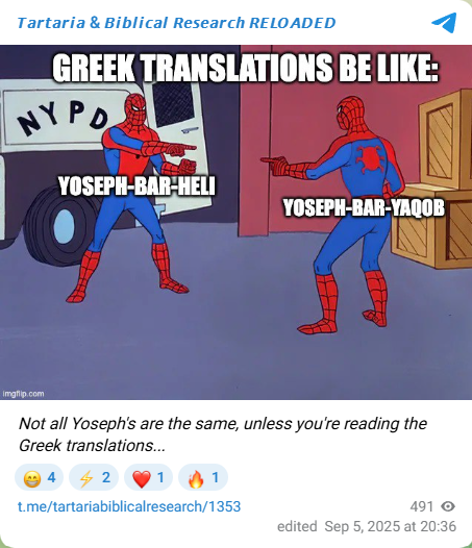
However, a careful examination of the Greek text of Luke 3:23 reveals that it actually doesn’t call Joseph the son of Heli: the Critical Greek Text ends that verse with ὢν υἱός ὡς ἐνομίζετο Ἰωσὴφ τοῦ Ἠλὶ–“being son, as was deemed by Joseph, from Heli”. Notice that “Heli” has a definite article before it, but “Joseph” doesn’t. All the names later in the genealogy are also preceded by τοῦ. This implies that Joseph isn’t being included in the genealogy Luke is giving! Rather, the Greek sentence should actually be rendered into English as follows: “being son (as was held by custom, of Joseph) of Heli…”; the Greek verb could mean “deem”, “regard”, or “hold by custom or usage”. That part about “as was held by custom” harks back to the point I brought up earlier that we’re never told that Mary had a brother, so the husband of Heli’s eldest daughter would’ve been regarded as his heir. The LGV brings it all together with the rendering “being (although legally a son of Joseph) from Heli” {scroll to p. 10 in the PDF} (placing “son” within the parenthetical phrase, as seen in the Textus Receptus reading ὢν (ὡς ἐνομίζετο υἱός Ἰωσὴφ) τοῦ Ἠλὶ; parentheses added), along with the following Note on “legally”:
While Matthew gave Jesus’ royal (legal) ancestry from His adoptive father Joseph who was a descendant of David through Solomon, Luke gave his actual maternal genealogy from David’s son, Nathan, from whom Mary’s father, Heli, descended. Luke supplied what Matthew omitted, showing that Jesus was indeed from David’s own loins as the Davidic Covenant requires (cf. 1 Chron. 17:11; Psalm 132:11; Acts 2:30).
“Matthew’s Misquotes”
In the seventh post, T&BRR tries to explain how the Peshitta handles two passages in Matthew that skeptics have pounced on.
Critics often accuse Matthew of mishandling prophecy. They point to two prime examples that, in the Greek (and thus also in the King James Bible), appear as blatant mistakes:
-
- The prophecy of the thirty pieces of silver (Matthew 27:9).
- The claim that “He shall be called a Nazarene” (Matthew 2:23).
{Italics in original. Indentation on the numbered list forced on me by WordPress, LOL.}
Okay, but the operative phrase here is “appear as”. Are these “blatant mistakes”? Or have these passages simply been misunderstood by those who lack certain Jewish background knowledge? We’ll see soon enough (spoiler: as you may have guessed from my oddly-specific phrasing of the latter question, that’s what’s really going on here).
Was Matthew really just a clumsy silly guy, or is it yet another case of the Greek mistranslating the Aramaic?
Both appear as blatant errors in the Greek/KJV, leading critics to argue Matthew was either careless or deceitful. But to us Christians, who hold the written words of God to be truly authored by God Himself through saved men, it’s an observation that demands close examination! Because to call it a mistake, is to say God authored a mistake and we stand incredibly firm on the truth that God is perfect and does not make mistakes.
{Boldface and italics in original.}
It’s clear to me that T&BRR has some bones to pick with the KJV-Only camp; fair enough. But if he wants to show that the KJV has some problems, this is not a legitimate argument for doing so. It seems to me (and this will become more obvious as we continue) that T&BRR has some preconceived notions that impose limits on what any given passage “could mean” if taken at face value—limits that wouldn’t have existed in the cultures the Biblical documents were written in.1
As I hinted at above, Jewish background knowledge is critical to fully understanding Matthew’s Gospel, because he originally wrote his Gospel for Jews! Hence, Matthew took for granted that his readers already had the necessary Jewish background knowledge to understand the allusions he was making–especially when it wouldn’t have been obvious to a Gentile reader. After all, as Frank Turek once explained on his old website (under his penname, James Patrick Holding):
The Bible was written in what anthropologists call a “high-context” society. In such societies people “presume a broadly shared, well-understood, or ‘high’ knowledge of the context of anything referred to in conversation or in writing.” Readers were required and expected to “fill in the gap” because their background knowledge was a given. Extended explanations were unnecessary.
In contrast, we in modern America are a “low-context” society. We assume little or no knowledge of he [sic] context of a communication.
Malina and Rohrbaugh spell out a problem for sola scriptura extremists as follows: “The obvious problem this creates for reading the biblical writings today is that low-context readers in the United States frequently mistake the biblical writings for low-context documents. They erroneously assume that the author has provided all of the contextual information needed to understand it.”
{Boldface mine.}
T&BRR lives in the Netherlands & Bauscher in the U.S.; they, too, were raised and live in low-context societies, and are therefore prone to making these kinds of mistakes if they don’t take steps against it. As for how this plays into the two passages T&BRR is highlighting here, read on…
JEREMIAH OR ZECHARIAH?
“Then was fulfilled that which was spoken by Jeremy the prophet, saying, And they took the thirty pieces of silver, the price of him that was valued, whom they of the children of Israel did value.”
MATTHEW 27:9 (GREEK/KJV)
The problem should be clear immediately; the wording of this prophecy is not from Jeremiah but from Zechariah 11:12–13! Critics love to jump on this to say Matthew was ignorant of his own prophets, or that the Gospel writers were sloppy in their citations.
But the Aramaic Peshitta shows no such confusion:
“Then was fulfilled what was spoken by the Prophet who said, I took thirty silver coins, the price of the Precious One on which they of the children of Israel had agreed. And I gave them for the potter’s field as THE LORD JEHOVAH commanded me.”
MATTHEW 27:9–10 (PESHITTA)
Notice the difference? The Peshitta does not misname Jeremiah at all, because it simply says “the Prophet” and quotes the passage. The corruption lies in the Greek, not in Matthew’s Spirit-filled hand.
{All-caps, boldface, and italics in original.}
Notice that T&BRR doesn’t even stop to consider whether Jeremiah’s writings were involved at all; he just assumes, right off the bat, that Matthew was discussing something from Zechariah and not Jeremiah. There’s absolutely no reason why Matthew couldn’t have had Jeremiah and Zechariah in mind simultaneously. Rabbis mixed OT passages together all the time, even while only naming one author. Consider what Henry M. Morris, founder of the Institute for Creation Research, had to say about the Greek phrasing:
spoken by Jeremy the prophet. This event seems to be a partial fulfillment of the prophecy in Zechariah 11:13, although the reference is only a general statement, rather than an actual quote. The main point of the reference is to explain the use of the money to buy the potter’s field, a fact not prophesied by Zechariah (see Matthew 27:6-8,10). Jeremiah, however, does mention buying a field for silver (Jeremiah 32:6-9), and Matthew conceivably could have had both passages in mind, giving Jeremiah priority for the general idea, since he was the major prophet of the two. Probably a better explanation, however, is to take literally the statement that this prophecy had been spoken (rather than written) by Jeremiah. Many years later, Zechariah could have adapted some of the same language, handed down from Jeremiah by oral transmission (both men were priests), into his own prophecy concerning the value of the payment price. {Boldface mine.}
But to be fair, the only portion that’s not an exact quote is “the price of him that was valued, whom they of the children of Israel did value”; however, I should point out something the late Richard N. Longenecker, New Testament scholar, pointed out about Old Testament quotations in Matthew’s Gospel that pertains to both of T&BRR’s proof-texts:
[Matthew’s] own eleven fulfillment formula quotations, though mixed in text form, are dominantly Semitic in character, whereas those of Jesus, though also mixed in form (though to a more limited extent), are strongly Septuagintal.…
Four of Matthew’s quotations would have made no sense at all had the LXX text been used (2:15; 4:15-16; 8:17; 27:9), while in six of the evangelist’s other uses the LXX reading would have served satisfactorily, but was not used (1:23; 2:18; 3:3; 12:18-21; 13:35; 21:5). The inability to locate readily the passage in mind in Matt 2:23, ‘he will be called a Ναζωραος,’ only emphasizes the extent of textual variation in Matthew’s usage.
{“Biblical Exegesis in the Apostolic Period: 2nd Edition”. Longenecker, Richard N. 1999. Grand Rapids, MI: William B. Eerdmans Publishing Co. 48, 121. Content in parentheses by Longenecker.}
In other words, whenever Matthew is quoting Old Testament prophecy on the lips of Jesus, the phrasing is closer to what we read in the Septuagint (lining up nicely with what we already saw Warner point out: Jesus spoke and taught in Greek most of the time, but whenever his words were in Galilean Aramaic, the Greek text of each Gospel let its original readers know!). But whenever he quotes it on the lips of someone other than Jesus or simply in the course of narration, the phrasing is closer to what we see in Hebrew or Aramaic readings.
Indeed, where the Hebrew of Zechariah 11:13 has “Then the LORD said to me [Zechariah], ‘Throw it to the potter, that magnificent price at which I was valued by them.‘ So I took the thirty shekels of silver and threw them to the potter in the house of the LORD.” (2020 NASB, boldface added–agreeing in essence with Matthew 27:9-10 and the events recorded in verses 6-8), the LXX has “And the Lord said to me, Drop them into the furnace, and I will see if it is good metal, as I was proved for their sakes. And I took the thirty pieces of silver, and cast them into the furnace in the house of the Lord.” (BLXX, boldface added)! This takes the wind out of his implication elsewhere that the Septuagint should be trusted over the Masoretic Text! (I fully intend to address the point he’s trying to use that claim to support in a later post, by the way!)
Indeed, from what I’ve seen, this seems to be an overarching problem with T&BRR’s hermeneutic: he seems to think that determining which manuscript base contains the divinely-inspired reading is an all-or-nothing deal. He seems to think the Peshitta alone should be consulted for the NT, and the Septuagint alone for the OT (thankfully, we’ll see later that this isn’t quite the case). In contrast, I take a more reasonable approach: God entrusted the Israelites to preserve His word to them down through the centuries; we should assume they did that job correctly except where we find good reason to think they didn’t. A related problem is that conspiracy theorists (like those who promote a lot of the ideas that T&BRR’s positions are built on!) have far, far too broad an idea of what constitutes “good reason” (e.g., “it contradicts what we’re saying; therefore, they [whoever “they” are] must have corrupted it”)! As for the NT, over 99.5% of the text is completely identical among all Greek manuscripts, so we’re technically defaulting to the Majority Text, even while we consult alternative readings (Textus Receptus, Alexandrian Text, Patristic Quotations, early versions in other languages–including the Peshitta–etc.) to correct it! Quite simply, T&BRR’s approach to textual criticism is little different than that of the KJV-Onlyists: always relying on the same version, even when it contradicts itself (e.g., see the first half of this article, where I demonstrate that the Epistle to the Hebrews contradicts the Masoretic–and KJV–reading of Zechariah 6:12-13, but not the Septuagint reading)!
I prefer John Gill’s explanation, since it also accounts for the other early versions (as the Syriac doesn’t; remember what was alluded to above, “The reading that best explains the other variants is to be preferred.” {“The New Evidence That Demands A Verdict”. McDowell, Josh. 1999. Nashville, TN: Thomas Nelson. 89. Citing “The Text of the Old Testament: An Introduction to the Biblia Hebraica”. Würthwein, Ernst. Rhodes, Erroll F., Transl. 1979. Grand Rapids, MI: Eerdmans. 80-81.}) and why Jews never called out this inaccurate attribution in the Greek version (remember, the Jewish authorities would’ve pounced on any mistakes in the Gospels if they could discredit Jesus’ Messiahship or his Apostles’ integrity!):
the removing of this difficulty, it might be observed, that the Syriac and Persic versions make no mention of any prophet’s name, only read, “which was spoken by the prophet”; and so may as well be ascribed to Zechariah, as to Jeremy, and better: but it must be owned, that Jeremy is in all the Greek copies, in the Vulgate Latin, Arabic, and Ethiopic versions, and in Munster’s Hebrew Gospel. Various things are said for the reconciling of this matter: some have thought that Zechariah had two names, and that besides Zechariah, he was called Jeremy; but of this there is no proof. Jerom F25 affirms, that in an Hebrew volume, being an apocryphal work of Jeremy, which was shown him by one of the Nazarene sect, he read these words verbatim: so that though they do not stand in the writings of Jeremy, which are canonical Scripture, yet in an apocryphal book of his, and which may as well be referred to, as the book of Maccabees, the traditions of the Jews, the prophecies of Enoch, and the writings of the Heathen poets. Moreover, Mr. Mede F26 has laboured, by various arguments, to prove, that the four last chapters of Zechariah were written by Jeremy, in which this passage stands; and if so, the reason is clear, for the citation in his name. But what seems best to solve this difficulty, is, that the order of the books of the Old Testament is not the same now, as it was formerly: the sacred writings were divided, by the Jews, into three parts: the first was called the law, which contains the five books of Moses; the second, the prophets, which contains the former and the latter prophets; the former prophets began at Joshua, and the latter at Jeremy; the third was called Cetubim, or the Hagiographa, the holy writings, which began with the book of Psalms: now, as this whole third and last part is called the Psalms, ( Luke 24:44 ) , because it began with that book; so all that part which contained the latter prophets, for the same reason, beginning at Jeremy, might be called by his name; hence a passage, standing in the prophecy of Zechariah, who was one of the latter prophets, might be justly cited, under the name of Jeremy. That such was the order of the books of the Old Testament, is evident from the following passage F1
“it is a tradition of our Rabbins, that the order of the prophets is, Joshua and Judges, Samuel and the Kings, Jeremiah and Ezekiel, Isaiah, and the twelve.”
Moreover, it is usual with them to say F2, that the spirit of Jeremiah was in Zechariah; and it is very plain, that the latter prophets have many things from the former; and so might Zechariah have this originally from Jeremy, which now stands in his prophecy: all this would be satisfactory to a Jew: and it is to be observed, that the Jew F3, who objects to everything he could in the evangelist, with any appearance on his side, and even objects to the application of this prophecy; yet finds no fault with him for putting Jeremy for Zechariah.
{Boldface and underlining mine. See also sources cited therein.}
Indeed, at least one of those Rabbinical sources Gill cited has an English translation available:
The Sages taught: The order of the books of the Prophets when they are attached together is as follows: Joshua and Judges, Samuel and Kings, Jeremiah and Ezekiel, and Isaiah and the Twelve Prophets.
{Bava Batra 14b:8, The William Davidson Talmud. Boldface in original. Underlining mine.}
The underlined phrase refers to the “Latter Prophets”; Jeremiah is indeed listed first! Hence, Matthew 27:9-10 was referencing both Zechariah 11 and Jeremiah 32–naming “Jeremiah” because both passages are in the Latter Prophets, which were sometimes referred to with the shorthand “Jeremiah”, after the first and longest book in that section of Scripture (just as the Writings were sometimes called “the Psalms”, after the first and longest book in that section of Scripture).
Ironically, the Peshitta reading “the Prophet” seems to be disqualified as the original reading, precisely because it tries to resolve a difficulty in the Greek original! Just above, I cited Josh McDowell (who in turn was citing Ernst Würthwein & Erroll F. Rhodes) as giving “The reading that best explains the other variants is to be preferred” as one of the major rules for deciding between textual variants. The full list goes as follows:
-
- An older reading is to be preferred, because it is closer to the original.
- The more difficult reading is to be preferred, because scribes were more apt to smooth out difficult readings.
- The shorter reading is to be preferred, because copyists were more apt to insert new material than omit part of the sacred text.
- The reading that best explains the other variants is to be preferred.
- The reading with the widest geographical support is to be preferred, because such manuscripts or versions are less likely to have influenced each other.
- The reading that is most like the author’s usual style is to be preferred.
- The reading that does not reflect a doctrinal bias is to be preferred.
{“The New Evidence That Demands A Verdict”. 89. Boldface mine.}
Oh, the irony. You might wanna bear this list in mind going forward. In fact, here’s a hyperlink directly to the list above, for your convenience: https://apolibrary.com/peshitta-primacy-for-the-new-testament-bringing-balance-to-a-one-sided-discussion/#ChoosingAVariant
Indeed, this point about difficult versus smoothed-out readings can be important enough to trump the ages of the manuscripts, as seen with the Greek text of Luke 6:1. Where the oldest manuscripts have the events occurring ἐν σαββάτῳ (“in the Sabbath”), the majority of manuscripts have them occurring ἐν σαββάτῳ δευτεροπρώτῳ (“in the Sabbath, the second from the first”). The latter reading would seem difficult to a Gentile scribe in Egypt who wasn’t familiar with the 7-Sabbath countdown to Pentecost (Leviticus 23:15-16)! We can tell this is what was meant by comparing with the parallel accounts in Matthew 12:1 & Mark 2:23, which have τοῖς σάββασιν (“in the Sabbaths”, plural)–“the Sabbaths” was a colloquial term for this countdown, and Luke was just being more specific by saying these events happened on the 2nd of the 7 Sabbaths between Firstfruits and Pentecost. As James Earl Snapp, Jr. concludes: “in this case it was Alexandrian copyists [responsible for the oldest manuscripts], rather than Byzantine ones [responsible for the majority of manuscripts], who excised a difficult feature in their exemplars.” {Scroll to “● Luke 6:1“.}
Moving on to his second proof-text, which he has trolled someone in the comment section of a video with by calling it “the nonexistent nazarene [sic] prophecy” (ironically, he follows up with the challenge “What did you find on that to prove that the Greek does answer those errors?”–which is what I’m presenting in this post!):
HE SHALL BE CALLED A NAZARENE
“And he came and dwelt in a city called Nazareth: that it might be fulfilled which was spoken by the prophets, He shall be called a Nazarene.”
MATTHEW 2:23 (GREEK/KJV)
Here again, critics mock Matthew’s Gospel by claiming no such prophecy exists anywhere in the Old Testament. To them, Matthew simply invented a prophecy to make Jesus’ upbringing in Nazareth divinely ordained. And who can blame them? According to the Greek rendition, there is truly no prophecy as such…
But the Aramaic Peshitta reads:
“And he came to dwell in a city that is called Nazareth, so that the thing would be fulfilled which was spoken by the Prophet, “He shall be called The Nazarene.”
MATTHEW 2:23 (PESHITTA)
What we see here is Matthew drawing from Isaiah 11:1 in Aramaic wordplay:
“And there shall come forth a rod out of the stem of Jesse, and a Branch shall grow out of his roots.”
ISAIAH 11:1
The word netzer means “branch”, the Branch, the Netzer, which is The Messiah! And from this we can see that “Nazarene” is not a fabrication, but a prophetic title rooted in Isaiah. In Aramaic, the connection is obvious, but in Greek, the idiom is lost, leaving only confusion.
{All-caps, boldface, and italics in original.}
First off, this is also the explanation given most often by Greek Primacists, so this obviously doesn’t negate the Greek any more than it does the Peshitta. But more importantly, citing Isaiah 11:1 as the prophecy being referenced here creates another problem. Matthew specifically said that the prophecy was fulfilled by Jesus’ parents settling in Nazareth and raising him there. Wordplay isn’t good enough for such a concrete statement of fulfillment!
As such, I prefer another explanation that’s hinted at in Henry M. Morris’ study note on Matthew 2:23.
spoken by the prophets. No one prophet is mentioned here, but rather “the prophets” in general. As far as known, the despised town of Nazareth did not even exist in the days of the prophets, so it may be that this is a generic summary of the teaching of the prophets that the Messiah would be “despised and rejected of men” (Isaiah 53:3). Some have suggested Isaiah 11:1, where He is called a “rod” (Hebrew netzer) out of the “stem” (or, apparently dead stump) of Jesse’s family tree. However, see the note on Zephaniah 1:14, which, slightly modified, would yield a reading very closely akin to Matthew’s quote.
{Boldface and italics in original. Underlining mine.}
Indeed, “the prophets” could’ve been shorthand for “the Twelve Minor Prophets”, which includes Zephaniah. Zephaniah 1:14, in the Masoretic Text, reads as follows (vowel points removed, to show how the text would’ve looked in Matthew’s day):
קרוב יום־יהוה הגּדול קרוב וּמהר מאד קול יום יהוה מר צרח שׁם גּבּור ׃
Or, in English, “At hand is a Day of YHWH, the great one; at hand, and exceedingly swift is a sound of a Day of YHWH. Bitterly roaring there will be a warrior.” (My right-to-left translation)
The “Day of YHWH” refers to the day God judges all nations on earth every single time it occurs in the OT (with the sole exception of Lamentations 2:22, which refers retrospectively to the first destruction of Jerusalem and prophetically to the second–since Judah was the only nation judged at Jerusalem’s first destruction, Lamentations 2:22 prophesied that the same would be true of the second destruction; therefore, these two “Days of YHWH” are distinct from the one being referred to everywhere else in the Bible); Jesus’ return also occurs on that day, per NT references to “the Day of the Lord” (Acts 2:20, 1 Corinthians 5:5, 2 Corinthians 1:14, 1 Thessalonians 5:2, 2 Thessalonians 2:2, 2 Peter 3:10). Hence, the context of this prophecy by Zephaniah is Jesus’ second coming (although contemporary Jews would’ve interpreted these as also occurring at the Messiah’s first coming, since the OT never prophesied the Messiah as having two comings; of course, Jesus clarified this to his disciples in the Olivet Discourse and after his resurrection).
However, the phrase I boldfaced in Zephaniah 1:14 above would’ve fit the flow of the passage so much better at the start of the verse (where it would make for a nice transition from verses 10-13), instead of the end. Plus, the word for “there” is in a grammatically-awkward position: it should be either before the first word of the boldfaced phrase, (in which case it would read “There will be a bitterly roaring warrior”) or at the end of the boldfaced phrase (in which case it would read “A bitterly roaring warrior will be there”)–instead of in the middle of the phrase. In fact, Hebrew scholars Brown, Driver, & Briggs went so far as to say the following in their lexicon entry of the word I’ve rendered “roaring”: “Qal Participle active מַר צֹרֵחַ שָׁם גִּבּוֺר Zephaniah 1:14 bitterly roareth there a hero, but abrupt in context and improbable; Greek (in part after [fancy symbol I can’t seem to copy & paste without making it super-huge2, LOL]) conjectures יִצְרַח כַּגִּבּוֺר קוֺל י׳ (compare Hiph.).” {Scroll to “Brown-Driver-Briggs Lexicon”. Boldface and italics in original. Underlining mine.}. However, consider the similar pen strokes needed to make the letters resh and nun: ר נ. Now consider the similar pen strokes needed to make the letters heth and tav: ח ת. If we swap the first resh and the only heth in the boldfaced phrase with a nun and a tav, respectively, the Hebrew instead reads:
קרוב יום־יהוה הגּדול קרוב וּמהר מאד קול יום יהוה מנצרת שׁם גּבּור ׃
Or, in English, “At hand is a Day of YHWH, the great one; at hand, and exceedingly swift is a sound of a Day of YHWH. From Nazareth—there will be a champion.” (My right-to-left translation)
Please, hear me out. Recall what Morris said above: the town of Nazareth was nonexistent in Zephaniah’s day. In fact, archaeologist Yardenna Alexandre pointed out that
Nazareth is not mentioned in the Old Testament, but according to biblical descriptions of the settlement process in this area, it is associated with the tribal inheritance of Zebulun (Joshua 19:10–15). Neighboring Yafi‘a is mentioned as a border site of Zebulun, and Nazareth was probably a small internal site within Zebulun’s territory. It is also not known whether Nazareth was the ancient name of the Iron Age village. According to the biblical account, at the time of the United Monarchy, the Nazareth hill range was probably an integral part of Solomon’s districts together with the Jezreel Valley and Yoqne’am, and subsequently became part of the northern kingdom of Israel (1 Kings 4:12).
Following Iron IIB, the village of Nazareth seems to have been abandoned and to date, there is no evidence for settlement in Nazareth for over five centuries until the late Hellenistic period (between the late eighth and the mid-second century BCE).
{Scroll to p. 54 in the PDF. Boldface mine.}
Nazareth’s early population had been deported to Assyria by Zephaniah’s day; and for all we know, the town may not have even been called Nazareth until the 2nd century B.C. This makes it very likely that some early scribes would’ve perceived מנצרת as a mistake and “corrected” it to מר צרח. I say “early” because a word for “bitter” occurs in the LXX reading of this verse, implying the Masoretic reading was circulating by 200 B.C. or so. Plus, consistent with the general trend in Matthew’s OT quotations mentioned above, Jerome claimed that the phrase intended by “for he shall be called a Nazarene” came from a Hebrew reading, rather than the Septuagint. And again, the contemporary Jewish authorities would’ve happily called out Matthew if he fabricated evidence for Jesus’ Messiahship; yet they never called him out on this quotation–implying something substantially like this reading existed among the OT manuscripts that were available in the first century.
Long story short: when Matthew wrote in 2:23 that “the Prophets” spoke that “He shall be called a Nazarene”, he was referring to the substance of (remember, Matthew wrote “spoken”, not “written”!) the original, archaic reading of Zephaniah 1:14, which said that the champion of the Day of the Lord, the all-conquering Messiah, would hail from Nazareth.
“Luke’s Divine Commission”
In the eighth post, T&BRR claims that the Greek seems to downplay Luke’s reason for writing his Gospel, compared to the Peshitta. Now, I could counter that the Peshitta could just as well have been trying to play up Luke’s reason for writing his Gospel, but that would leave so much nuance on the table!
The opening of Luke’s Gospel is often read as though it were a casual decision by Luke to write an account. In the King James Bible, Luke sounds uncertain, almost presumptuous, as if he simply thought it would be a good idea to add his own Gospel to those already circulating.
“It seemed good to me also, having had perfect understanding of all things from the very first, to write unto thee in order, most excellent Theophilus, That thou mightest know the certainty of those things, wherein thou hast been instructed.”
LUKE 1:3–4 (GREEK/KJV)
But what inspired writer of God’s Word would ever say, “I thought it seemed good to me to write”?! Would the churches of God have placed such a book alongside the inspired Gospels of Matthew, Mark, and John if Luke were merely rehashing secondhand leftovers? That would make Luke’s testimony a product of intellect, not divine inspiration, yet Western scholarship has too often taken this weak Greek rendering and built an entire misunderstanding of Luke’s authority upon it.
{Italics, boldface, and all-caps in original.}
Well, the KJV may render it with seemingly weak wording, but not the LGV (which does an excellent job of cutting through the translational inertia that keeps so many inaccurate renderings in New Testament translations)!
Since many took in hand to compose a narrative concerning the events which have been fully confirmed among us 2 (just as those who from the beginning delivered them to us2 who were becoming eyewitnesses3 and ministers of the Logos4) 3 it occurred also to me, having fully followed everything accurately from the first,5 to write them sequentially6 for you, most excellent7 Theophilus,8 4 so that you may be assured concerning the accuracy of the words about which you were instructed.9
1 Luke was a physician (Col. 4:14) and Paul’s protégé and companion. His name is of Greek origin, and his writing style uses polished Greek, implying that was his first language. Luke’s Gospel and its sequel (Acts) were written to “most excellent Theophilus” (a Greek name), and were well suited as preludes to Paul’s letters for a Gentile audience.
2 Luke claimed to have received the information from the original Emissaries of Jesus, not merely from Paul.
3 1 John 1:1-3
4 Paul was the first to refer to the Son by the title “the Logos (Word) of God” (Heb. 4:12-16). John’s use of this title in his prologue (John 1:1,14), his first epistle (1 John 1:1-3), and in Revelation (19:13) was meant to support Paul’s earlier teaching.
5 The clause “from the first” refers to the very first announcement by Gabriel concerning the birth of John the Immerser, the forerunner of the Messiah (cf. Mal. 3:1).
6 This is the only Gospel account which claims to place the events of Jesus’ ministry in the sequence in which they occurred.
7 This was a title used of governors and other high-ranking officials (2 Acts 23:26; 2 Acts 24:3; 2 Acts 26:25).
8 1 Acts 1:1
9 Theophilus’ previous instruction in the Christian Faith was almost certainly through Paul’s ministry, as Luke was Paul’s companion in ministry.
{Luke 1:1-4 LGV, notes in original; boldface and underlining added; scroll to p. 1 in the PDF.}
Note the two phrases I underlined in verse 3. “It occurred to me” doesn’t require that Luke “simply thought it would be a good idea”; it’s equally compatible with the thought being planted in his head by the Holy Spirit, in which case divine inspiration is indeed present! Second, the Greek verb rendered “having fully followed” properly means “to follow near” {scroll to “Strong’s Definitions”}, or metaphorically, “to follow up a thing in mind so as to attain to the knowledge of it” {scroll to “Thayer’s Greek Lexicon”; boldface in original}, while the Greek adverb rendered “accurately” means “exactly, accurately, diligently” {scroll to “Thayer’s Greek Lexicon”; boldface in original}. This terminology suggests the kind of intensive research that an eyewitness wouldn’t need to conduct!
The context gives us even more clues, of course. The key phrase in verse 2 is “who were becoming eyewitnesses and ministers of the Logos”; the words for “who”, “were becoming”, “eyewitnesses”, and “ministers” are all in the nominative case. Do these terms refer back to “us” (which is in the dative case; i.e., “to us”) or further back to the nominative-case word “many” in verse 1 (i.e., those who wrote before Luke)? Well, note the connection with 1 John 1:1-3, which makes it clear that the “eyewitnesses” being referred to here were the 12 Apostles (including Paul instead of Judas Iscariot) only–which doesn’t include Luke. Indeed, “those who from the beginning delivered them to us” must be the 11 remaining disciples (after Judas Iscariot’s suicide), since only they were involved in the Apostolic mission from the outset (where Warner used the word “Emissaries” in note 2, that’s the actual English equivalent of the Greek word apostolos, transliterated “Apostle” in most other versions).
In short, just because English translations of the Greek use weak wording, doesn’t mean the Greek itself does!
Note 4 is important because it takes the wind out of Bauscher’s argument that Luke was written after John, which he gives alongside his justification for his rendering of Luke 1:3 in the Peshitta (don’t worry, we’ll get to that shortly!):
If I am right about Luke 1:3, Luke’s Gospel was probably written after John’s Gospel, since Luke refers to The Word as “He”, a Person of Whom the Apostles are “eyewitnesses and servants”. He also “appeared” to Luke. This refers plainly to John 1:1& 14. Luke would probably be the last of the four Gospels written, not John. {Scroll to the bottom of the page. Italics and boldface in original.}
Since Hebrews 4:12 used “Logos” that way before John’s Gospel, this only really proves that Luke was written after Paul received the insight through the Holy Spirit that prompted him to use this title for the Son in Hebrews–consistent with the traditional order of Luke & John, since Hebrews was probably written near the end of Paul’s 2-year house arrest in Rome {scroll to “Philippians and Hebrews” on p. 10-11 in the PDF}, which is the point in Paul’s ministry where the cliffhanger ending of Acts leaves its readers (Acts 28:30-31). In fact, since I’m of the persuasion that Luke himself acted as Paul’s scribe for Hebrews (thus explaining why the book has Paul’s theology, but Luke’s more sophisticated vocabulary), it makes even more sense that both the earliest uses of “Logos” for Jesus in the written New Testament would’ve come from Luke’s pen! On that note, since Luke was Paul’s trusted companion, Luke’s writings carry Apostolic authority on behalf of Paul, not Luke himself–regardless of how he phrased the introduction to his Gospel!
Why did I quote verses 1-4 when T&BRR starts with verse 3? Because he quotes verses 1-4 when presenting the Peshitta’s reading:
Now hear the clarity of the Aramaic Peshitta:
“Because many were willing to write an account of those events of which we are persuaded, like the things which they delivered to us who from the first were eyewitnesses and servants of The Word. He appeared also to me because I had approached all things carefully, that I would write everything in order to you, excellent Theophila. That you may know the truth of the words of which you have been instructed by such.”
LUKE 1:1–4 (PESHITTA)
Do you see it? Luke is not simply saying “it seemed good” at all. He is quite literally declaring that The Lord Yeshua the Messiah appeared to him and authorized him to write this Gospel! This agrees with the way the verb “Ethkhzay” is used elsewhere in the Peshitta and in the Targums, where its natural meaning is “He appeared” or “was seen”. Bauscher emphasizes that this points directly to Divine revelation, because Luke was not writing a secular literary project of his own, but a record given to him by the appearing of Christ Himself.
{Boldface, italics, all-caps, and hyperlink in original.}
This is another case of “tell me you have an abysmal understanding of linguistics without telling me.” In fact, that article he links to from the phrase “the Targums” tacitly admits that he can’t read the original languages!
For us English speaking people that do not speak Greek or Aramaic, who neither have the ability to read other translations in their original context, this [Targum Jonathan and the Palestinian Targum] is the closest we can get to the original versions. On top of that, the Targums are also said to predate the Greek Septuagint by 200 years. {Italics in original. Boldface, underlining, and content in brackets mine.}
This alone explains so much of the garbage T&BRR is peddling! He’s simply quoting authorities who’ve duped him, and whose arguments he’s not qualified to evaluate. (Also, apparently he doesn’t hold to LXX Primacy for the OT after all! What a relief!)
Anyway, Bauscher’s argument hinges on the assumption that the Ethpeal Perfect 3rd-person masculine singular verb at the beginning of verse 3 in the Peshitta should be treated as having a masculine subject, rather than a neuter one–despite the fact that in Aramaic, the same form would’ve been used for both! You see, when a Syriac writer intended a Common (i.e., neuter) subject, they’d default to using the masculine form of the verb! Consistent with this, when you look at all the inflected forms of this verb in the Syriac Electronic Data Retrieval Archive, you’ll see that every 3rd-person inflection (whether singular or plural) is either Masculine or Feminine–it’s NEVER Common. Indeed, you can see at the first page I linked to in this paragraph that Lamsa, Murdock, and Etheridge all rendered the first verb of Luke 1:3 in the neuter (the first uses “these”, the latter two use “it”; that doesn’t surprise me, since I’ve seen Lamsa get more scholarly flack than Murdock or Etheridge)! In fact, you wouldn’t believe how many masculine and feminine terms in the OT I wind up rendering in the neuter when giving my more precise translations, just because the nouns would be treated as neuter in English! For example, in Daniel 2:32, the (Imperial) Aramaic words the KJV renders “image”, “head”, “gold”, “fine”, “breast”, “silver”, “belly”, and “brass” are all masculine, while the words for “arms” and “thighs” are feminine. You see, Semitic languages are much like German, Greek, and Romance languages: certain nouns are grammatically gendered and have corresponding words in the sentence gendered accordingly, regardless of whether it makes sense to English speakers! As I’ve seen it put in a meme:

Hence, while Bauscher’s argument demonstrates that “he appeared” is technically a potential rendering for the Syriac verb at the start of Luke 1:3, “it seemed” is more feasible. So this argument that Luke personally saw Jesus is inconclusive, at best. In fact, once we account for the context and the form of the verb used, Bauscher’s rendering actually stops making any sense. As noted above, the verb at the start of Luke 1:3 in the Peshitta uses the Ethpeal stem, which indicates a passive or reflexive action. “He appeared” would require a stem indicating an active action! Bauscher might respond by offering the alternative rendering “He was seen”, which is passive; but that creates another problem, since the first-person common singular suffix for “me” is attached to the Syriac preposition ܠ, meaning (like its Hebrew counterpart ל) “to, for, unto, into, towards, against…”, rather than ܒ, which (like its Hebrew counterpart ב) is the normal preposition for “in, by, with, among…” (as would be required to render it “He was seen also by me”)–note that this preposition is used at the end of Luke 1:1 with the meaning “with”–ܐܰܝܠܶܝܢ ܕ݁ܰܚܢܰܢ ܡܦ݁ܳܣܺܝܢ ܚ݈ܢܰܢ ܒ݁ܗܽܘܢ–“with which we, having been persuaded ourselves” (my right-to-left translation, highlighting added; “having been persuaded” is a passive participle, not a perfect-tense verb meaning “were persuaded”). The suffix on the preposition here is 3rd-person masculine plural, referring back to the masculine plural noun Murdock and Bauscher both render “events”, rather than to the 1st-person common plural pronouns (as would be required to justify the rendering “by us/ourselves”). Yet notice that Bauscher omitted this preposition and the second 1st-person plural pronoun (which I rendered “ourselves”) from his interlinear translation of Luke 1:1–a translation that, by its very nature, is supposed to show EVERY word in the Syriac text! Wait, did I just find a place where Bauscher fudged the Syriac text in his translation?! How disturbing…). With this consideration taken into account, it would be best to interpret the Ethpeal stem of this verb as indicating a reflexive action, rather than a passive one. As such, I would render the Syriac phrase at the start of Luke 1:3 as: “It was self-evident also to me…”
What Bauscher (and T&BRR) really needs to do is demonstrate that the neuter rendering is complete nonsense in the context, making the masculine rendering more sensible. Until this is done, the overall context supports the view that Luke wasn’t an eyewitness (because he’s claiming to have taken investigative steps an eyewitness wouldn’t have needed or bothered to take), meaning the opening verb of verse 3 should be rendered with the subject “it” rather than “he”.
Verse 2 already confirmed that the other Gospels were written by “eyewitnesses and servants of The Word”. Then, verse 3 adds that the same Word, the Lord Yeshua, also appeared to Luke, commissioning him to write. Without this, Luke would have no right to claim equal standing with the apostolic eyewitnesses. But with this surety given, Luke’s Gospel is sealed with the same Spirit-filled authority: “For at no time was it by the pleasure of man, but holy men of God spoke as they were moved by the Holy Spirit” (2 Peter 1:21). And Bauscher states it plainly: “He was not writing a literary composition here; he was writing from God.”
And verse 4 drives the point home: if Luke had not been an eyewitness of the Lord Yeshua and His words and deeds, he could never confirm the Gospel accounts as true. No amount of research or human ability would be enough to compose an accurate account of Yeshua the Messiah. As Bauscher concludes: “Only Divine revelation can provide the Truth of Him Whose Name is ‘The Truth, The Way, The Life,’ apart from Whom, no one can approach to The Eternal Father.”
{Italics in original.}
Again, this isn’t true at all. Well, granted, the claim that the other Gospels were written by “eyewitnesses and servants of The Word” is true, because not only were Matthew & John among the twelve original disciples, but Mark’s mother owned the house the Last Supper was held in, and so Mark was present for and privy to the events of Jesus’ Passion Week (which is why the last week of Jesus’ life and what came afterward, as recorded in Mark 10-16, is so much more vividly recorded and flows so much more smoothly than Mark 1-9; Mark got the material for the first 9 chapters from Peter’s recollections, but provided much of the material for the last 7 chapters from his own memory)!
We saw above that the Greek phrasing is much stronger than the KJV makes it out to be, and is consistent with Luke being divinely-inspired to write his Gospel; and Luke’s Gospel would have carried “equal standing with the apostolic eyewitnesses” on the grounds that it carried Paul’s Apostolic authority (just as Mark’s Gospel carried Peter’s Apostolic authority). And Paul did meet Jesus personally (in addition to his Damascus Road experience in Acts 9:3-6, Galatians 1:15-18 & Acts 9:19-21 imply that Jesus personally taught Paul in Arabia for 3 years, to put him on equal footing with the rest of the Apostles), and could double-check, under divine inspiration, whether what Luke wrote was accurate. Does T&BRR even know (much less understand) the criteria by which the books of the NT canon were determined? Apparently not, because he seems convinced that writings like the Book of Enoch and one of the Book of Jasher forgeries should’ve been in there, too–despite them utterly failing those criteria {scroll to “Other Publications”}!
The Greek weakens Luke into sounding like a man who simply “thought it seemed good” to compose another account, but the Aramaic reveals the truth: Luke was an eyewitness of the Lord’s appearance, writing not out of presumption but out of revelation. He wrote because Christ Himself authorized him to! {Italics in original.}
This adds nothing of substance to what we’ve seen so far.
And here again lies the uncomfortable truth for those who cling to the King James Bible as “perfect.” {Boldface in original.}
So, KJV-Onlyists, as opposed to people like myself who acknowledge that the KJV used the Textus Receptus as its New Testament manuscript base, which was compiled from the 6 (or perhaps 7 {scroll to “Erasmus’ Textus Receptus”}) Greek manuscripts & 1 Latin manuscript that Erasmus could get his hands on {scroll to “The Printing of the Greek New Testament”} (while, to Erasmus’ credit, often incorporating patristic quotations–many of which pre-date our oldest surviving Biblical manuscripts containing the verse(s) quoted–to correct what his manuscripts got wrong–something the modern Critical Text fails to do all too often {scroll to the bottom of p. 1 in the PDF})? Got it.
The KJV inherits the Greek corruption that strips Luke of his divine commission and makes him sound like a mere historian.
If the KJV were truly perfect, it would not diminish Luke’s authority or obscure the appearing of Yeshua the Messiah.
But it does… And once again, the Peshitta alone preserves the accuracy of God’s Word, showing that the original Gospel record was written and safeguarded in Aramaic, not in Greek.
{Italics in original.}
But this whole line of reasoning assumes that Luke truly was commissioned by Jesus personally, rather than through the Holy Spirit. I already demonstrated above that the preponderance of contextual evidence shows that it was the latter. In fact, there’s hints at this not only in the text of Luke, but even that of Acts, as Frank Luke pointed out to someone named Sarah:
Frank Luke: First, because Luke was Greek. His Greek is flawless after he joins Paul’s party.
Sarah: Can you clarify that
what would make the difference
before or after he joins Paul’s party
Frank Luke: Prior to the {sic} his joining up, there are oddities in the text. He uses Greek translations of semitisms. For example, in the story of the Prodigal Son, Luke writes in Greek, “he gave a ring upon his finger.”
That’s odd Greek. However, that exact usage of the Hebrew verb natan is seen in the Septuagint.
Sarah: What would have happened upon his joining Paul that would alter that?
Frank Luke: natan means “give.”
Before he joined up, Luke had to rely on the testimony of others, oral and written.
After he joins up, he can write what he has observed himself.
Sarah: Why could he not have witnessed it himself?
Frank Luke: He wasn’t there. The events in Luke’s Gospel took place in Judea. Luke was from a Greek city near Macedonia. Same with Acts until he joined. He was elsewhere, going about the rest of his life until he heard the message.
Sarah: The text says he was Greek?
Frank Luke: In Luke 1:1-4 he tells us that he has interviewed eyewitnesses and examined prior writings of the life of Jesus.
In Acts 16:11, we see he joined up in Troas, a Greek city (“they” went in. “we” came out.).
And he takes a very strong interest in showing gentiles getting the message.
Also, regarding vested interest, we can see that Luke was able to put aside his bias because he records some very strong words from enemies of the Gospel. They say things like, “they teach strange demon teachings.” Luke lets them speak for themself.
Sarah: There seems to be a great deal of room for broad interpretation in any of that!
@FrankLuke I am not sure what you speak of here.
I understand what you said, just not where you are going with it.
Wecome @Marian
Frank Luke: That Luke is able to put aside his biases (for the Gospel) enough to let the enemies say what they will.
Also, regarding his gentileness, Col. 4:10-15 strongly suggests that Luke was a Gentile. Verse 11 concludes the greetings from those of the circumcision, this is, {sic} Jewish believers. A new list, which probably consists of Gentiles, begins with v. 12. Luke is included in the new list
Sarah: @FrankLuke This is in regard to which point you were making, that he was Greek?
@FrankLuke do we know this was the same Luke?
Frank Luke: @Sarah Yes. Also in Luke-Acts, Luke will refer to “their [Jewish] leaders”.
@Sarah There is no other Luke that was known to travel with Paul.
Sarah: As an other different from him
Frank Luke: Right. Luke also does something that no other Gospel writer (the Jewish writers) does.
He writes in the style of Greek historians: Herodotus, Thucydides, Polybius, and others.
…
Frank Luke: @Sarah Let me clarify this: That’s odd Greek. However, that exact usage of the Hebrew verb natan is seen in the Septuagint.
should be “That’s odd Greek. However, that exact Greek word is used to translate the Hebre {sic} word natan in the Septuagint. In Hebrew, natan can mean either give or put.
{Boldface, italics, content in parentheses, and content in brackets in original. Underlining and content in curly brackets mine.}
So, there you have it: the author of the book of Acts (Luke) outs himself as not an eyewitness to events he records prior to joining up with the Apostle Paul! And any attempt to claim there were two “Luke”s is more speculative than the alternative.
“Yeshua Or Iesous?”
In the ninth post, he brings up an argument that’s hilariously self-refuting with just a little bit of reflection. See if you can spot how this argument refutes itself:
When the angel Gabriel appeared to Maryam, he did not give her a random sound or a title for her Son. He gave her a Name with meaning, a Name tied directly to the mission of the Messiah.
“And she shall bring forth a son, and thou shalt call his name JESUS: for he shall save his people from their sins.”
MATTHEW 1:21 (GREEK/KJV)
At first glance the verse looks fine, but step closer and the problem appears… In Greek, the name given is “Iesous”. That name has no actual meaning in Greek. It’s only a sound, an adaptation for Greek letters. The explanation “for he shall save” no longer fits, because Iesous does not mean salvation, and therefore the entire prophecy is gutted when it comes to this specific name.
Now hear it in the Aramaic Peshitta:
“She shall bring forth a son, and you shall call his name Yeshua, for he shall save his people from their sins.”
MATTHEW 1:21 (PESHITTA)
In Aramaic the Name carries the meaning. “Yeshua” comes from the root yoshia, salvation. The angel’s words only make sense in the Aramaic language! The Name itself testifies of the mission: the One who saves. Interestingly enough, the prophets had already prepared this witness:
“Behold, God is my salvation; I will trust, and not be afraid: for the Lord JEHOVAH is my strength and my song; he also is become my salvation.”
ISAIAH 12:2
In Hebrew, the word used here for salvation is “yeshua“. The very Name Gabriel gave to Mary was the Name of God’s saving work foretold by the prophet. What the Greek loses, the Aramaic preserves in full. And this alone is another clear witness for an Aramaic original, from which the faulty Greek translations descended. Logically, if the Greek had been the original, the prophecy would demand a Greek word that actually means salvation. But it does not, and instead the Greek text leaves the verse without sense, while the Aramaic keeps it whole, as it does time and time again.
{Italics, all-caps, and boldface in original.}
Set aside the fact that T&BRR’s discussion here is dangerously akin to something we saw Warner call out in his note on Mark 5:41: “the ‘Sacred Name’ movement which attempts to create division by insisting that Christians must use ‘Hebrew’ names and titles for God and Jesus”.
By T&BRR’s own logic, his own claim that the word “Yeshua” means “salvation” is false–because he wrote “Yeshua” using the Latin alphabet! It’s called “transliteration”, and it was commonplace in 1st-century Israel because everyone spoke at least two languages–Greek (used for commerce purposes) and Galilean Aramaic and/or Mishnaic Hebrew {scroll to “Mishnaic Hebrew as a Common Person’s Language in the Land”; see also the sections following for additional hard evidence of this} (depending on where in Israel they were raised and by whom)! In this case, either (a) the angels spoke to Mary and Joseph in Greek and said “Iesous” (which they understood as the Greek transliteration of the Hebrew/Aramaic name “Yeshua”, which they, being devout Jews, already understood in turn to carry the meaning of the Hebrew and Aramaic noun yoshia, or (b) they spoke to them in Galilean Aramaic and said “Yeshua”, and Matthew (or the translator of Aramaic Matthew, assuming it wasn’t Matthew himself) & Luke transliterated it into Greek as “Iesous”. Either way, the point would’ve gotten across to Mary and Joseph; and since the earliest Gentile Christians were also attending synagogues to get the OT background necessary to properly understand many of the Apostles’ teachings (Acts 15:19-21), they would’ve learned the significance of the name “Yeshua”–and by implication, “Iesous”–there.
In fact, this is an excellent time to bring up some super-critical points that T&BRR never once deals with. First off, by the first century, the Aramaic language family had branched off into western and eastern dialects. Galilean Aramaic, the dialect of Aramaic that Jesus and his Apostles would’ve actually spoken, was a western dialect. If the logic is that the NT was originally written in Aramaic because that’s what Jesus and his Disciples spoke, then why would they have originally written the New Testament in Syriac, an eastern dialect?! I HAVE YET TO SEE A PESHITTA PRIMACIST WHO EVEN ATTEMPTS TO ANSWER THIS QUESTION. Is T&BRR up to the task?
Maybe he’d try to claim that Syriac was also spoken in Judea. Yet the tomb of Queen Helena of Adiabene forcefully demonstrates otherwise. Remember how I told you when discussing T&BRR’s third post to take note of “‘Osrhoene’ and ‘The dialect of Edessa, its famous capital’”? That was the setup; now comes the payoff. Per Caruso:
Since Syriac was such a prolific dialect, would Jesus have encountered Syriac where he taught and preached? As we’ve already established previously, if he were to come across it, it would have been Old Syriac. Where was Old Syriac spoken?
The kingdom-provence [sic] of Osroene, with Edessa as its capitol [sic] was some 350 miles to the north of Galilee and 400 miles from Jerusalem. It is this kingdom that was the cradle of the Syriac dialect and here it was primarily spoken.
Was it ever in Jerusalem or Galilee in the 1st century?
Yes it was. But as a novelty.
 {Image available at https://web.archive.org/web/20170711102517im_/http://aramaicnt.org/wp-content/uploads/2012/10/Queen-Helena-1024×803.jpg}
Out of all Aramaic inscriptions in Jerusalem in the 1st century, there is only one that was written in Syriac, on the Tomb of Queen Helena of Adiabene, a convert to Judaism, whose Jewish name was 
 .
.
When she died around 56 CE and was buried, her name was carved into the side of her tomb in her native Old Syriac Aramaic. However, it seems that Old Syriac was such a problem to read, someone scratched in a translation (reforming the name in Western Aramaic orthography and phonology, rather than a straight transcription – this points to how certain final vowels were nazalized [sic; it should be “nasalized”] in Galilean) right below it in larger letters than the original inscription so that the common person could make it out.
Written Old Syriac proved difficult to understand among first century Jews.
{Scroll to “Syriac Was Foreign in Galilee and Jerusalem”. Images, boldface, and centered lines in original.}
Speaking of which, Caruso also discusses a distinctive grammatical feature of the Syriac used in the Peshitta:
If the Peshitta was written right after Jesus’ lifetime, one would expect the dialect to match up with other inscriptions from the first few centuries. This particular dialect of Syriac is known as Old Syriac, and is attested in about 80 different inscriptions. So when we compare the two what do we find are [sic] some very curious and telling differences.
All verbs in Aramaic start out as a “root” of (usually) 3 letters that express a particular concept. From there, prefixes, suffixes, and vowels are added to indicate the tense, person, number, gender, etc. of the verb and place it in context. For the “Perfect” (think of it roughly as the past tense) the defining feature is suffixes, where for the Imperfect (think of it roughly as the future tense) the defining feature is prefixes.
In Classical Syriac, to express the 3rd person masculine Imperfect (“he will X”) one adds on the prefix – /n-/. For example,
[k-t-b becomes nektub]
This is one of the major defining features of the Classical Syriac dialect, it is ubiquitous and exclusively used in the Peshitta, and virtually every other dialect of Aramaic outside of the Syriac family makes use of a different prefix. For example, in Judean, Galilean, and Samaritan Aramaic that prefix is  /y-/. For example:
[k-t-b becomes yiktob. In fact, the imperfect and perfect tense forms in Hebrew are technically called the yiqtol and the qatal, from their corresponding forms for the Hebrew word for “finish” (in the sense of “kill” or “complete”; the latter is clearly intended, in light of the grammatical function of these forms–the perfect tense indicates a completed action, while the imperfect tense indicates an action that’s not yet complete). The verb root would be q-t-l; putting it in the 3rd-person masculine singular perfect tense makes it qatal, while prefixing the yodh makes it the 3rd-person masculine singular imperfect-tense yiqtol.]
So what is the significance of this prefix? The Syriac dialect, like other Aramaic dialects, originally used /y-/ for its Imperfect verbs. We have a large number of examples of this in the Old Syriac corpus:
From an inscription at Birecik Kalesi (6 AD) we find:
[See original article for examples]
From an inscription at Serrîn (73 AD) we see:
[See original article for examples]
From an inscription at Sumatar Harbesi (~150 AD) we see:
[See original article for examples]
From an inscription at Sumatar (~150 AD) we find:
[See original article for examples]
Each and every one of these examples makes use of /y-/.
It’s only until [sic] around the turn of the third century we start seeing examples of /n-/ in the Imperfect regularly mixed in with /y-/, and by about the 4th century it had completely replaced /y-/ as the preferred prefix with not a single further documented example. By the dawn of the golden age of Classical Syriac literature (around the 5th century) /y-/ was absolutely nowhere to be found.
In other words the Peshitta, at the earliest, represents fourth century Syriac.
It cannot be from the first or second centuries AD as some proponents claim.
{Scroll to “The Wrong Language”. Italics, boldface, Syriac letter images, and centered lines in original.}
The Peshitta Primacists are really batting zero on historical and archaeological support for their claims, aren’t they? No wonder T&BRR resorts to conspiracy theories that let him rewrite whatever history he finds inconvenient for his views!
Back to T&BRR’s post:
Dear reader, this is no small matter. There are some who have said the Name Yeshua is Babylonian or corrupted, but to make that claim is to accuse Gabriel himself of deception, because he was the one who delivered it to her. Would the angel of the Lord give Maryam a name bound to idolatry or witchcraft? To that we say “God forbid”! The Name Yeshua is holy, anchored in the prophets, and fulfilled in The Messiah who came to save His people.
{Italics in original.}
Fair enough, but why shouldn’t that also apply to its Greek transliteration Ἰησοῦς (Iēsous), just like T&BRR seems to admit it does to its English/Latin transliteration Yeshua? Does T&BRR seriously expect us to write יֵשׁוּעַ (Yeshua; H3442), or its lengthened form יְהוֹשׁוּעַ (Yehoshua; H3091, properly meaning “YHWH-saved” or “YHWH is Salvation”), without transliteration, no matter what language we’re writing the rest of the text in? Good luck getting non-Hebrew speakers to go along with that (and unfortunately for T&BRR, I don’t believe in luck)!
The Greek, and thus also the KJV, strip the prophecy of its force. Iesous is an empty form with no meaning, leaving Matthew 1:21 as a sentence without logic.
If the Greek texts were the original, and the King James Bible were truly perfect, it would not erase the very meaning of the Name that the angel himself gave.
But it does… And once again, the Aramaic Peshitta alone preserves the truth: the Messiah’s Name is Yeshua, Salvation itself.
{Boldface and italics in original.}
As we’ve seen, the Greek text strips nothing from the Messiah’s name, since Joseph and Mary were devout Jews who already knew the meaning of the Mishnaic Hebrew/Galilean Aramaic (not Old Syriac, let alone the Classical Syriac of the Peshitta, as we saw above!) word behind it.
“What Kind Of Soldier Will You Be?”
In his tenth post, T&BRR attempts to present an example of a passage where the Greek NT teaches the exact opposite of the Peshitta NT!
One stone may not stand out, but a heap of stones cannot be ignored. The same is true of the differences between the Greek text and the Aramaic Peshitta. By themselves, some might seem small, but stacked together, they form a witness that cannot be denied. A heap that changes the very shape of how the Christian life is understood
Let’s consider Paul’s writings to Timothy:
“No man that warreth entangleth himself with the affairs of this life; that he may please him who hath chosen him to be a soldier.”
2 TIMOTHY 2:4 (GREEK/KJV)
The Greek/KJV makes Paul sound as though the Christian soldier must cut himself off entirely from the world, retreating from its affairs in order to be holy. This reading has led many to think the Christian life is one of escape, hiding from society, pulling away from responsibility, and shutting oneself off from the world.
{Italics, boldface, and all-caps in original.}
Any Christian who reaches that conclusion has misunderstood Paul’s metaphor. Paul was pointing out that when someone is at war, they don’t have time to involve themselves with other aspects of their life (or any civilians’ lives, for that matter), because they’re too busy following orders! If anything, “retreat” in that situation amounts to disobeying orders–something that’s met with harsh discipline in any military!
Moreover, the interpretation T&BRR is insinuating for the Greek text only works if one ignores other passages that teach against it, thereby yielding the more balanced position Paul intended. For example, Paul had written the following years earlier:
I wrote to you in my letter not to associate with sexually immoral people— 10 not at all meaning the sexually immoral of this world, or the greedy and swindlers, or idolaters, since then you would need to go out of the world. 11 But now I am writing to you not to associate with anyone who bears the name of brother if he is guilty of sexual immorality or greed, or is an idolater, reviler, drunkard, or swindler—not even to eat with such a one. 12 For what have I to do with judging outsiders? Is it not those inside the church [“the church” added by the ESV translators, but that was clearly the intended sense, in light of the context] whom you are to judge? 13 God judges those outside. “Purge the evil person from among you.” [Quoting Deuteronomy 17:7c LXX] (1 Corinthians 5:9-13 ESV, boldface and underlining added)
The phrases I’ve emphasized throughout this quote make it clear that Paul was saying that Christians’ obligation to not associate with immoral people was limited to those within the church (because they were defiling the assembly by being unrepentant); this passage is discussing church discipline, and not discipline of those outside the church. Hence, the command here to not associate with immoral people doesn’t apply to “the world”; this is why Paul said “since then you would need to go out of the world” as if that wasn’t an option.
And what about this passage Paul wrote about how Christians should act leading up to the Great Tribulation? (Remember, at the time Paul wrote 1 Corinthians, the doctrine of Chiliasm—which placed the return of Jesus a minimum of ~450 years (assuming the chronological figures in the LXX are correct) and a maximum of ~1,977 years (assuming the chronological figures in the Masoretic Text are correct) after Hebrews was written–hadn’t been revealed yet, so he was still operating under the assumption that it could happen within his readers’ lifetimes.)
But this I say, brethren, the time has been shortened, so that from now on [literally, “the time having been shortened is the remainder, so that”; “the time having been shortened” is a reference to Matthew 24:22 & Mark 13:20—both of which occur in Jesus’ discussion of the Great Tribulation in the Olivet Discourse] those who have wives should be as though they had none; 30 and those who weep, as though they did not weep; and those who rejoice, as though they did not rejoice; and those who buy, as though they did not possess; 31 and those who use the world, as though they did not make full use of it; for the form of this world is passing away. (1 Corinthians 7:29-31 1995 NASB, boldface and underlining added)
Bear in mind that this was near the end of Paul’s instructions to Christians regarding marriage, divorce, and remarriage; hence, when Paul said “those who…”, he meant “those among Christians who…”. The Greek verb the 1995 NASB rendered “make full use of it” properly meant “to use much or excessively or ill”; hence, the KJV rendering “abusing” is actually more accurate in this case. Paul was telling Christians to use the world (which would require them to interact with it!), but not to abuse it.
After Paul’s death, John reinforced Paul’s teachings with his own writings. And this teaching of Paul was reinforced in the prayer John recorded Jesus as praying on behalf of his followers:
I have given to them Thy word, and the world did hate them, because they are not of the world, as I am not of the world; 15 I do not ask that Thou mayest take them out of the world, but that Thou mayest keep them out of the evil [LGV “I am not asking so that You would take them out of the world, but so that You might guard them out from among the wicked.” {Boldface added. Scroll to p. 51 in the PDF.}]. 16 ‘Of the world they are not, as I of the world am not; (John 17:14-16 YLT, boldface added)
Warner justifies the rendering “You might guard them out from among the wicked” as follows:
325 Rev. 3:10 uses the same clause, “guard … out from among,” implying safely escorting them out from within the object of the preposition.
326 ἐκ τοῦ πονηρου – the KJV has “from the evil.” Other translations have “from the evil/wicked one,” referring to the Adversary. Either translation is possible. However, the preposition ἐκ implies a presence within or among the object. It is hard to imagine Jesus’ asking for His followers to be preserved out from within the Adversary. Compare Psalm 37. It most likely refers to presence among the wicked as a class of people.
{Scroll to p. 51 in the PDF. Italics in original. Boldface and underlining mine.}
By all accounts, Christians are to engage the world, without letting the world overcome them!
But the Aramaic Peshitta says something entirely different:
“Is not a Soldier bound in matters of the world to please him who has chosen him?”
2 TIMOTHY 2:4 (PESHITTA)
Here Paul says the soldier is in fact bound in worldly matters. He must march on the roads, divide the rations, handle the supplies, and make use of the world’s systems. His calling does not pull him away from the world, but instead, much deeper into it. Though it is always with the aim of pleasing the one who enlisted him. The issue is not avoidance, but loyalty. He is bound, but bound only to his Commander.
And see how the very next verse confirms this:
“And if a man competes, he is not crowned if he does not compete by the rules.”
2 TIMOTHY 2:5 (PESHITTA)
The comparison is perfect in the Aramaic Peshitta! Just as the soldier engages with the world but must remain faithful to his Commander, an athlete enters the contest but must play by the rules. Neither picture teaches retreat in any way, instead both teach disciplined involvement and obedience.
{Boldface, italics, and all-caps in original.}
As we saw above, the comparison is perfect in the Greek, too! A soldier who retreats of his own accord is punished for disobeying his marching orders, just as an Olympic athlete (the ancient Olympics were the “competition” being referenced here) who cheats is disqualified for it! And just to reinforce how the “comparison” is actually structured better in the Greek than what T&BRR is claiming for the Peshitta:
4 No one engaging in warfare is involved in the business of livelihood, so that he may satisfy the one calling up the army. 5 Also, if anyone competes [in the games] he is not awarded the wreath unless he should compete lawfully. (2 Timothy 2:4-5 LGV; content in brackets in original)
Also notice that he called it the “Aramaic Peshitta”, rather than the “Syriac” Peshitta. We saw earlier that this is extremely misleading, since Judea and Samaria spoke totally different dialects of Aramaic than the Classical Syriac in which the Peshitta was written!
David Bauscher explains that the Aramaic verb overturns the Greek/KJV’s misreading. Paul is not commanding believers to flee the world, but to fight in it without being enslaved to it. The soldier is bound in worldly matters, yet not owned by them. The athlete competes under rules, yet not lawlessly. The Aramaic preserves the balance Paul intended, whereas the Greek simply does not.
Actually, the issue isn’t with the verb at all. It’s with the negative particle at the beginning of the Syriac sentence. Checking the entry for the Syriac word in J. Payne Smith’s “A Compendious Syriac Dictionary” reveals that it could indicate simple negation or an interrogative negative! While Lamsa, Murdock, and Etheridge all rendered it as a simple negation (“No man serving as a soldier…”–my right-to-left translation) in 2 Timothy 2:4, Bauscher chose to render it as an interrogative instead (“Is not a Soldier…?”–notice that Bauscher omitted the noun for “man”, but retained the participle for “serving as a soldier” (the “as a soldier” part is within the verb’s range of meanings). Is there a way to tell which was intended? Yes, there is: by examining what words are used alongside it. The word used at the beginning of the Syriac sentence is ܠܳܐ (lā). Had the Syriac text used ܕܰܠܡܳܐ (dalmā), before a negative verb, it would mean “Lest…” or “Unless…?”; this setup is seen in 1 Corinthians 9:8, which Murdock rendered “Is it as a man, I say these things? Behold, the law also saith them.” (boldface added). Had the text used ܠܡܳܐ (lmā), it would introduce a question expecting a negative response (like the one Bauscher offered as a translation here); this setup is seen in Matthew 26:22, where Lamsa rendered it “And they felt very sad, and began to say to him one by one, Why, is it I, my Lord?” (boldface added; this occurred just after Jesus predicted one of his disciples would betray him, so each disciple asking this was hoping the answer was “no”!). Neither of these interrogative markers are present in the Syriac of this verse, so the sentence should be understood as a declaration of fact (as Lamsa, Murdock, and Etheridge rightly rendered it, and as the Greek text presented it), rather than a rhetorical question (as Bauscher wrongly rendered it).
The Greek/KJV miscasts Paul’s exhortation into a doctrine that could easily be understood as a doctrine of retreat and escape, but the Peshitta keeps it true: the Christian soldier is not told to flee the world, but to live in it faithfully, bound in its matters only for the sake of the Commander who chose him.
{Italics in original.}
Again, the Greek says the same thing, especially in light of verse 5! In reality, it’s Bauscher who’s miscasting Paul’s negative statement of fact (“No man serving…”) as a rhetorical question (“Is not a Soldier…?”)!
If the Greek text was truly the original, and the King James Bible were truly perfect, it would not reduce Paul’s words into an illogical escape clause.
But it does… And once again, the Peshitta alone preserves the inspired teaching.
{Italics in original.}
Some of T&BRR’s earlier opponents may have claimed the King James Bible was “truly perfect”, but I don’t! And the Greek text contains no such “escape clause”, as I demonstrated above. Notice that earlier I mentioned the structure that “T&BRR is claiming for the Peshitta”. When you look directly at the Greek text and the Syriac text of this passage (not just reading English translations of them and closing the case there!), it becomes clear that they actually agree with each other. Just as with Luke 1:3, the problem is with Bauscher’s handling of the first word in the Syriac sentence!
“The Great Omission”
In his eleventh post, T&BRR attempts to reinforce a claim I already shot down when discussing his first post. But first, he recaps what he’s presented so far and teases at what he’ll deal with for the next few posts:
Now we’ve walked through the genealogies, the so-called misquotes, Luke’s commission, the soldier and athlete, and even the very Name of our Messiah, it’s so clear to see that every single time the Greek stumbled, the Aramaic Peshitta stood firm. And with this baseline established, you are now ready for the next stage: The “Aramaic Code”, the true divine signature within the New Testament that God wrote, which we will unfold in the posts to come.
One stone might be explained away, but a heap cannot be ignored. And now the heap speaks for itself: the original New Testament was undoubtedly written in Aramaic, the language of Yeshua and His apostles!
{Boldface and italics in original.}
As we’ve seen in all the earlier discussions in this post, not a single one of his “stones” is really anything more than a clump of sand that falls apart at the slightest disturbance. And again, why does he keep saying “Aramaic” when the Peshitta New Testament he’s trying to argue for as the original was written in Classical Syriac? It’s super misleading! Nonetheless, I’m really looking forward to his next few posts, for reasons I’ll explain once we start dealing with his primary source for the claims in them!
Now take a look at this…
Total omissions of the Name “Yeshua” in the Greek (replaced by pronouns):
Matthew: 9 times
Mark: 42 times
Luke: 78 times
John: 49 times
Acts: 87 times
Romans: 14 times
1 Corinthians: 27 times
2 Corinthians: 14 times
Galatians: 4 times
Ephesians: 2 times
Philippians: 4 times
Colossians: 3 times
1 Thessalonians: 1 time
2 Thessalonians: 1 time
1 Timothy: 1 time
2 Timothy: 3 times
Hebrews: 2 times
1 Peter: 1 time
1 John: 2 times
Revelation: 15 times
Yes, you’re seeing it correctly… The Greek scribes dropped the Name of Yeshua 358 times! And of course, the Peshitta never does.
{Italics and boldface in original.}
T&BRR just gave the explanation for his own evidence: “replaced by pronouns”! I already explained this: Syriac had a higher propensity than most other languages for repeating nouns, rather than replacing them with pronouns! It’s not that the Greek replaced Jesus’ name with pronouns, it’s that the Syriac replaced pronouns corresponding to Jesus with his name!
This leads us to ask, not just with a smile, but also with all seriousness:
… Will the real translation please stand up?!
{Boldface and italics in original.}
Well, one thing’s for sure: the argument he just presented won’t do anything to help settle that question! After all, that propensity I just brought back to your attention wouldn’t just apply to the New Testament: for any given document that’s available in Greek and Syriac, we should EXPECT the Syriac version to use a person’s name rather than swapping it with a pronoun more often than the Greek version does—regardless of what language the document was originally written in!
“The Aramaic Code”
In his twelfth post, T&BRR gives an introductory discussion of the phenomenon he’ll be discussing for the next several posts: Equidistant Letter Sequences in the Peshitta New Testament.
Now we’ve walked through manuscripts, contradictions, and historical arguments, we have seen the Greek expose itself as a translation. Through this, we have also seen the Aramaic dissolve the genealogical clash and restore clarity to misquoted prophecies. All in all, we have shown why the Peshitta alone makes sense as the original text of God.
{Italics in original.}
Well, every last argument T&BRR has presented so far was inconclusive, bogus, or ignored contrary evidence, and the Greek text does have a reasonable explanation for everything he claims it doesn’t. So, can he give us anything better?
But now we come to something deeper… We’re moving from defense to discovery. What follows is not grammar, not history and not commentary. This here, is a hidden witness inside the very letters of the Aramaic New Testament. Not speculation or coincidence, but something scientific, statistical, and unexplainable apart from the very hand of God.
This is… The Discovery of The New Testament that God wrote!
{Italics and boldface in original.}
Well, looking ahead at his other posts, you learn that he’s getting all his examples of the phenomenon we’re about to deal with from a book by Glenn David Bauscher (surprise, surprise!) titled “The Discovery of The New Testament that God Wrote” {the page is written in Urdu, apparently; if you don’t have a browser with an automatic translation function, just click on the button labeled “PDF, 2.89 MB”}. Yet he doesn’t cite it in the post we’re dealing with right now, so I’m not sure whether that counts as plagiarism; for now, I’ll give him the benefit of the doubt. Moving on to the rest of his explanation:
WHAT IS THE ARAMAIC CODE?
The phenomenon is called Equidistant Letter Sequences (ELS). The name sounds technical, but the idea is simple if you walk through it slowly:
First, you choose a starting letter in the Aramaic text.
After, you count forward a fixed number of letters.
Then, you write down the next letter you land on.
And after that, you keep counting forward using the very same interval and record each letter you land on each time.
Most of the time this produces nothing but scattered characters without meaning. It’s exactly what we would expect in any ordinary book, but in the preserved Aramaic New Testament there are places where those skip letters assemble themselves into full sentences. And no, they are not simple stray syllables or accidental acronyms. They are complete, coherent, poetic statements that proclaim the very Gospel the plain reading already declares!
HOW IT WORKS: STEP BY STEP
If this concept is new to you, take it in by repetition, because clarity here is everything. Start at a letter, count forward the same number each time, gather the letters you land on, and see what they spell. No reshuffling, no fumbling with words, and no changing of the interval once you begin. If a sentence appears, it must appear under the single constraint you chose at the start. Either the letters are there or they are not, and the only way they can be there is if the underlying text has been preserved with exactness down to the very letter positions.
DISTINGUISHING ELS FROM NUMEROLOGY AND KABBALAH [An Esoteric school of thought within Jewish Mysticism]
Because we live in a world where words like “code” and “hidden” are often twisted, we must be very clear on what this is not. This is not numerology, nor gematria, and it’s most definitely not kabbalah. Those things are games men play with numbers to dress guesswork in mystery.
What we are describing is not a number game at all. It’s letters in fixed positions forming full sentences at ‘equidistant steps‘. The test is not how clever the interpreter is, rather yet, the test is whether the letters are there and whether the probability of their being there by accident is anything less than absurd.
{Boldface, all-caps, and italics in original. Content in brackets mine.}
Sorry to interrupt, but there’s actually something important he should add to that last sentence: “The test is not how clever the interpreter is, rather yet, the test is whether the letters are there, whether the probability of their being there by accident is anything less than absurd, and whether the words formed by this process don’t have any alternate spellings that allow for fudging.” As soon as a word in the final “Code” has an alternate spelling, that allows “wiggle room” to try the other spelling if one of them fails–increasing the probability that it could “be[] there by accident” and requiring “how clever the interpreter is” to become a factor! I’ll talk more about this later.
Also, ELS’s are actually very similar to Numerology, Gematria, and Kabbalah. The methodology and mechanics are different, but the intended result is the same: to use an esoteric method to uncover a hidden “extra layer” of meaning in the text. If anything, ELS’s are modern replacements for these practices, appealing to a modern audience with a more western mindset! Remember how Solomon said “there is nothing new under the sun” (Ecclesiastes 1:9 NKJV), yet Paul mentioned that some wicked people are “inventors of evil” (Romans 1:30 ESV)? This is a prime example of how both can be true at once.
WHY SHORT ‘CODES’ DON’T COUNT
There is a reason short examples impress no one. You could take an English paragraph and find the word ‘LORD’ by skipping every three letters if you look long enough, and if you do find it, that would tell you nothing. It would be like flipping a coin twice and getting heads twice. Basically, it happens all the time. But there is another world of difficulty when you begin to speak of entire sentences…
Imagine finding a chain of twenty or thirty or even forty letters that must appear in the right order when you skip a fixed distance over and over without a single break. That’s not like flipping a coin twice. This would be more like flipping a coin sixty times and having it land on heads every single time! The difference between a three letter coincidence and a thirty letter testimony is the difference between breathing and bench pressing an entire mountain. Short finds are statistical noise, but long sentences are like statistical thunder that drowns out every other sound. The difference is truly of a scale this large!
{Boldface, all-caps, and italics in original.}
I agree with the logic behind short examples being unimpressive. However, the longer chains will be equally unimpressive if the “fixed distance” has to be made ridiculously long to compensate for it! And we’ll see soon enough that this is exactly what Bauscher does!
The “Bible Codes” Redux: A Critique of Bauscher’s Book
I’m starting a separate section here because T&BRR’s next few posts in a row fixate on examples of this phenomenon occurring in the Peshitta. Unfortunately, he omits some important details from them; but fortunately, they’re all cited as coming from Bauscher’s book (without giving the page numbers, by the way–seriously, does T&BRR follow any standards of scholarship?) I mentioned in the previous section, so we can just go straight to the source to get the details we need for proper assessment of the claims. So, while this post is intended to be a one-stop-shop regarding T&BRR’s claims about Peshitta Primacy, let’s consider his examples in the order the author of his source, Bauscher, presents them. But first, some introductory remarks–from Bauscher and myself (but not in that order).
Now, in case you haven’t heard, similar arguments were being made from the mid-1980s to the early 2000s (and are still being made in a handful of circles) about the Hebrew Old Testament. This phenomenon was called “Bible Codes” back then, which is presumably why T&BRR branded his examples as “Aramaic Codes” in the title of his introductory post on the topic. In fact, Bauscher himself admits his familiarity with the most influential “Bible Code” sources from the mid-1990s to the early-2000s, the book “The Bible Code” by Michael Drosnin and the two “Omega Code” documentaries. {“The Discovery of The New Testament that God Wrote”. Bauscher, Glenn David. 2006. Lulu Publishing. 12.}
Now, full disclosure: reading up on the Bible Codes was the most fun part of my research for typing this post! For readers who don’t know my background: I have a Bachelor of Science in Applied Mathematics from Illinois Institute of Technology. AP Statistics was one of my favorite math classes in high school. In middle school and high school, I would read about math and mathematical curiosities for fun. And wordsearches have long been one of my favorite activities when I want to do something mindless–ever since I’d fill them out in my grandmother’s Penny Press puzzle books as a little kid. If I’d never been exposed to apologetics, stuff like this would be my jam! Over the days and weeks I spent researching this stuff, I felt like I was temporarily brought back to my childhood!
Between all that and my understanding of Hebrew/Aramaic/Syriac syntax, I am overwhelmingly qualified to attest that the Syriac Codes Bauscher is promoting here are just as mathematically valid as the Codes in the Hebrew Bible that were promoted back in the 80s and 90s–which is to say: NOT VALID AT ALL!
Quote-Mining Josephus
I’d like to first deal with his arguments that Greek wasn’t used by Jews in 1st-century Judea that haven’t already been addressed above.
I knew that Aramaic was the language of Jesus and his disciples but I also “knew” (by conventional Biblical scholarship) that Greek was the language of the original New Testament.
{Ibid. 9.}
Right off the bat, I must make a clarification: Galilean Aramaic (not Old Syriac, much less the Classical Syriac seen in the Peshitta!) was the native language of Jesus and his disciples.
Then I read the following from Josephus, the famous first century Jewish historian of the nation of Israel, certainly one of the most highly educated men of his time:
“I have also taken a great deal of pains to obtain the learning of the Greeks, and to understand the elements of the Greek language, although I have so accustomed myself to speak our own tongue, that I cannot pronounce Greek with sufficient exactness. For our nation does not encourage those that learn the language of many nations. On this account, as there have been many who have done their endeavors, with great patience, to obtain the Greek learning, there have hardly been two or three who have succeeding [sic] herein, who were immediately rewarded for their pains.” – Antiquities XX, XI 2. (published circa A.D. 93)
The above quote from Josephus shows three things:
1. The language of the Jews of first century Israel was not Greek; it was not even a second language, as it had to be studied to be understood.
2. Very few of Josephus’ countrymen had studied Greek enough to become fluent in that language and to find it profitable.
3. Greek education was not encouraged in Israel.
{Ibid. 9. Italics, boldface, and underlining in original. Content in brackets and punctuation corrections mine.}
Sorry for the spoiler in the section title, but Bauscher has quote-mined Josephus here. And I don’t just mean the fact that he omitted the ellipsis he should’ve added where he skipped some of the text between “learn the language[s; Whiston rendered this word in the plural, despite Bauscher making it singular in his quotation] of many nations” and “on [which; following Whiston–admittedly, the Greek word used here, τοῦτο, properly means “this”] account”. In fact, this omission is pretty damning in its own right. Watch what happens when we reinsert what Bauscher cut without notifying his readers with an ellipsis (the orange text):
I have also taken a great deal of pains to obtain the learning of the Greeks, and understand the elements of the Greek language, although I have so long accustomed myself to speak our own tongue, that I cannot pronounce Greek with sufficient exactness; for our nation does not encourage those that learn the languages of many nations, and so adorn their discourses with the smoothness of their periods; because they look upon this sort of accomplishment as common, not only to all sorts of free-men, but to as many of the servants as please to learn them. But they give him the testimony of being a wise man who is fully acquainted with our laws, and is able to interpret their meaning; on which account, as there have been many who have done their endeavors with great patience to obtain this learning, there have yet hardly been so many as two or three that have succeeded therein, who were immediately well rewarded for their pains.
{Josephus, Flavius. “Antiquities of the Jews”. Book 20, Chapter 11, Section 2. Boldface, underlining, and text coloration mine. William Whiston’s translation of this book is available here.}
Notice that where Bauscher offered a rendering of Josephus’ words that has the last sentence speaking of “the Greek learning”, Whiston rendered it as “this learning”, harking back into the portion Bauscher omitted and referring to “our laws”—the Torah! If Whiston got this right, then the last sentence is saying “there have yet hardly been so many as two or three” Gentiles who’d become as well-versed in the Torah as the Rabbis! But for the sake of argument, let’s take the quote as Bauscher presented it for the rest of this discussion:
First off, the Greek word here rendered “learning”, παιδεία (G3809), doesn’t refer to learning, period—it more specifically referred to formal instruction; in Biblical usage, this word was used for parents training their children (Ephesians 6:4, rendered “nurture” in the KJV), chastening kids to “help them learn their lesson” (rendered “chastening” in Hebrews 12:5,7,11 KJV and “chastisement” in Hebrews 12:8 KJV), and formal instruction in the Scriptures (2 Timothy 3:16, where the KJV renders it “instruction”). Hence, Josephus was saying that he had “taken a great deal of pain to obtain” a classical education in Attic grammar, rhetoric, philosophy, etc.! Using Greek for trade, for communications with their Roman overlords or other Gentiles, or on the street wouldn’t have required this degree of training, so Bauscher’s claim in the first of his “three things” that “Greek… was not even a second language, as it had to be studied to be understood” extracts more from Josephus’ phrasing than is warranted.
Second, notice Josephus said “although I have so accustomed myself to speak our own tongue, that I cannot pronounce Greek with sufficient exactness”. Josephus was talking about his ability to speak Greek like a native, not his ability to read or write Greek.
Third, the reason so few Jews had undertaken formal education from the Greeks (much less profited from it), and why it wasn’t encouraged to do so, was because ancient Jews strongly resisted adopting the cultures of the pagans they lived among. Learning Greek philosophy or rhetoric was seen as an assimilation tactic, so they’d avoid formal schooling in such things. (It’s similar to all the Christian parents in our day who refuse to send their young adult children to secular colleges because they know too many of the professors have an anti-Biblical agenda and are hoping to take their children off the straight-and-narrow–a phrase that comes from Matthew 7:13-14, by the way!) This in no way implies that learning Greek at a less-formal level was frowned upon. (Plus, Paul’s extensive uses of rhetoric show evidence that he had some of that training!)
In A.D. 77, Josephus wrote his Jewish Wars in Aramaic and translated it into Greek for the Greek- speaking Roman citizens. Even his later Antiquities , quoted above, shows that Josephus was not fluent enough in Greek to compose his several volumes in that language. The Jewish rabbis of that time forbade the teaching of pagan tongues to their young men. They taught that it was preferable to feed one’s son the flesh of swine than to teach him Greek. {Ibid. p. 9. Italics, underlining, and punctuation errors in original.}
We saw above that his claims about those statements at the end of “Antiquities” are bogus. Besides, doesn’t Bauscher contradict himself here by saying Josephus translated “Jewish Wars” into Greek, but then later wasn’t fluent enough to compose “Antiquities” in that language?! Finally, it would’ve been nice for him to cite a Jewish source for that last sentence. Here are the three closest things I could find:
During the war with Vespasian they decreed against crowns worn by bridegrooms and against the bell. During the war with Quietus they decreed against crowns worn by brides and that nobody should teach their child Greek. During the final war they decreed that a bride should not go out in a palanquin inside the city, but our rabbis decreed that a bride may go out in a palanquin inside the city.
(Mishnah Sotah 9:14, Sefaria Community Translation, boldface and underlining mine)
A certain elderly man was there, in Jerusalem, who was familiar with Greek wisdom. He communicated to those on the outside by using words understood only by those proficient in Greek wisdom. The elderly man said to them: As long as they are engaged with the Temple service, they will not be delivered into your hands. Upon hearing this, on the following day, when they lowered dinars in a box, they sent up a pig to them. Once the pig reached halfway up the wall, it inserted its hooves into the wall and Eretz Yisrael [“The Land of Israel”] shuddered four hundred parasangs by four hundred parasangs [a parasang was an ancient Persian unit of length, equivalent to roughly 6 kilometers; hence, this is saying an earthquake was felt over an area of 2400 km by 2400 km centered on Israel].
When the Sages saw this, they said at that time: Cursed is he who raises pigs, and cursed is he who teaches his son Greek wisdom. And it is with regard to that time of civil war, in which the land was destroyed, that we learned: An incident occurred in which the omer, the measure of barley brought as a communal offering on the sixteenth of Nisan, came from Gaggot Tzerifim, and the two loaves offered on Shavuot came from the valley of Ein Sokher.
(Menachot 64b:6-7, The William Davidson Talmud, boldface in original; underlining and content in brackets mine)
The first of these prohibitions was obviously limited to the time when a specific war was going on, and makes no mention of swine whatsoever. The second seems closer in sentiment, but it seems to put raising pigs and teaching one’s son Greek wisdom on par with one another. What’s the third passage? It’s a parallel account of the second, but with some insightful Rabbinical commentary immediately afterward:
The mishna teaches that one may not raise pigs anywhere. The Sages taught in a baraita the background for this halakha: When the members of the house of Hasmonean monarchy were at war with each other, Hyrcanus, one of the parties to this war, was inside the besieged Jerusalem, while his brother Aristobulus, the other contender to the throne, was on the outside. {This war between Hyrcanus II and Aristobulus II took place in 67-63 B.C.} And every day the people inside would lower down money in a box from the Temple walls, to purchase sheep to sacrifice, and those on other side would take the money and send up sheep to them over the wall for the daily offerings.
There was a certain elder there who was familiar with Greek wisdom, and he said to those besieging Jerusalem: As long as they occupy themselves with the Temple service, they will not be delivered into your hands. The next day they lowered down money in a box as usual, but this time they sent up to them a pig. When the pig reached to the midpoint of the Temple wall it stuck its hooves into the wall, and Eretz Yisrael quaked over an area of four hundred parasangs by four hundred parasangs.
At that time the Sages said: Cursed be the man who raises pigs, and cursed be the man who teaches his son Greek wisdom. And it was concerning that time of siege that we learned in a mishna: There was an incident in which the barley for the omer offering came from the gardens of Tzerifin, far from Jerusalem, and the wheat for the two loaves of Shavuot was brought from the valley of Ein Sokher. Barley and wheat could not be brought from any nearer because the besiegers had destroyed all the produce around Jerusalem. This concludes the baraita.
The Gemara asks a question with regard to this baraita: And is it really prohibited to study Greek wisdom? But isn’t it taught in a baraita: Rabbi Yehuda HaNasi said: In Eretz Yisrael, why would one speak the Syriac [Sursi] language? One should speak either the sacred tongue, Hebrew, or the Greek language. And Rabbi Yosei said similarly: In Babylonia, why would one speak the Aramaic language? One should speak either the sacred tongue or the Persian language. At any rate, Rabbi Yehuda HaNasi’s statement indicates that there is nothing wrong with learning and speaking Greek. The Sages say in response: The Greek language is discrete, and Greek wisdom is discrete. In other words, these are two separate issues; only Greek wisdom is prohibited, not the Greek language.
The Gemara further pursues this line of inquiry: And is Greek wisdom itself actually prohibited? But doesn’t Rav Yehuda say that Shmuel says in the name of Rabban Shimon ben Gamliel: It is written: “My eye affected my soul, because of all the daughters of my city” (Lamentations 3:51). Rabban Shimon ben Gamliel applied this verse to a personal tragedy: There were a thousand children in the household of my father, Rabban Gamliel; five hundred of them studied the Torah, and five hundred of them studied Greek wisdom. All of them were killed by the Romans; and the only ones that remain of them are I, who is here, and the son of my father’s brother, who is in Asia Minor [Asya]. Rabban Shimon ben Gamliel’s statement indicates that it is permitted to study Greek wisdom.
The Sages say in response: The household of Rabban Gamliel is different, as they held close ties with the government. Since knowledge of Greek wisdom was crucial for the members of this family, the Sages exempted them from the general decree, as it is taught in a baraita: With regard to one who cuts his hair in the fashion of komi, a certain haircut favored by the Romans, this is considered one of the ways of the Amorites, i.e., a gentile practice prohibited by the Torah (Leviticus 18:3). Despite this, the Sages permitted Avtolmos bar Reuven to cut his hair in the fashion of komi, because he had close ties with the government. Likewise, they permitted the members of the household of Rabban Gamliel to discuss matters of Greek wisdom, because they had close ties with the government.
(Bava Kamma 82b:16-83a:3, The William Davidson Talmud, boldface, italics, and content in brackets in original; underlining and content in curly brackets mine.)
This passage agrees perfectly with everything we’ve seen so far–and shows that Bauscher’s conclusions about what languages were spoken in Judea during the Second Temple Period couldn’t be more wrong! Heck, it outright implies that there was no reason to speak Syriac in Israel! But hold on, Bauscher’s not done with Josephus yet:
Josephus also published the following in AD 77:
-
- 1) Whereas the war which the Jews made with the Romans hath been the greatest of all those, not only that have been in our times, but, in a manner, of those that ever were heard of; both of those wherein cities have fought against cities, or nations against nations; while some men who were not concerned in the affairs themselves have gotten together vain and contradictory stories by hearsay, and have written them down after a sophistical manner; and while those that were there present have given false accounts of things, and this either out of a humor of flattery to the Romans, or of hatred towards the Jews; and while their writings contain sometimes accusations, and sometimes encomiums, but no where the accurate truth of the facts; I have proposed to myself, for the sake of such as live under the government of the Romans, to translate those books into the Greek tongue, which I formerly composed in the language of our country, and sent to the Upper Barbarians; (2) Joseph, the son of Matthias, by birth a Hebrew, a priest also, and one who at first fought against the Romans myself, and was forced to be present at what was done afterwards, [am the author of this work].
In the above Prelude to His “Wars of The Jews”, Josephus informs the reader that his works were not composed in Greek, but translated into Greek from “the language of our country”, and that the original language text was sent “to the upper barbarians”, which is generally accepted as a description of the Aramaic speaking Babylonians, Persians, Syrians and Mesopotamians.
This testimony of Josephus also establishes three things:
-
- Greek was not the language of his country, Israel.
- Hebrew was not the language of his country. The Barbarians did not speak Hebrew; they did speak Aramaic. Aramaic had been the lingua franca (common tongue) of the Middle East and Asia Minor for many centuries and would continue so for may {sic} more.
- Aramaic was the language of Israel at the time.
If The Jews in Israel spoke and read Greek, why would he say, “I have composed the books in the language of our country and proposed to translate them into Greek”?
Would it not have made sense to simply write the original in Greek? Everyone would have been able to read his works, both Jews and Gentiles of Rome. Obviously, Josephus testifies that Greek was not the language of Israel and that Hebrew was not the language of Israel. He also testifies of Israel as monolingual, not bilingual- “The language of our country”, not “one of two languages of our country”.
{“The Discovery of The New Testament that God Wrote”. 9-10. Numbering, boldface, underlining, red text, content in brackets, and blue text in original. Content in curly brackets mine. Punctuation errors corrected by me.}
Superficially, this looks pretty solid. But just a little bit of research reveals what’s really going on with this quote.
First off, “our language” and “the language of our country” refers to a nation’s ancestral, native language. It’s no different than a modern Irishman calling Irish Gaelic “the language of our country”, even though the vast majority of Ireland speaks English in their day-to-day life.
Second, as is often the case, the nuances to what Josephus records become more clear once you consider the political background to his statements. In this case, Josephus said that he wrote his first edition to the Upper Barbarians. This referred more specifically to Jewish populations in the Parthian Empire. Bauscher mentioned that Aramaic was the lingua franca of many Middle Eastern countries for centuries on either side of the 1st century, and the Parthian Empire was one of the reasons for that continued widespread use. While the Roman Empire was the great world superpower to the west, the Parthian Empire was the great world superpower to the east. Many Jews in Judea had been hoping that their brethren in the Parthian Empire would aid them in their revolt against Rome. Once the Romans freed Josephus from being a prisoner-of-war to work for them, he wrote his first edition of “Wars of the Jews” to tell the Jews of the Parthian Empire what happened when they revolted against Rome, hoping to spare them from making the same mistake. That’s why Josephus wrote his first edition in Aramaic: his first edition was intended for Jews in the Parthian Empire, where Aramaic actually was the lingua franca. He then translated it into Greek for consumption within the Roman Empire–for the same reason.
Finally, “the language of our country” is never actually named here, so how does that phrasing rule out contemporary Jews from speaking Hebrew? After all, some ancient sources used Ἑβραϊστί (Hebraisti; G1447) for both Hebrew and Aramaic (the word literally means “the language of the Hebrews”, and the Hebrews of Judea spoke both Mishnaic Hebrew and Galilean Aramaic in the 1st century), while other ancient sources distinguished them by using Hebraisti for Mishnaic Hebrew and Συριστί (Suristi) for Aramaic (e.g., see Daniel 2:4 LXX).
So now that I’ve called out Bauscher’s mangling of Josephus’ statements about his formal Greek education and his publication strategy for “Wars of the Jews”, it’s time to move on to the “Codes” of his that T&BRR actually utilizes (or, depending on how specific you think a source citation should be, “plagiarizes”) in his own series.
Syriac Codes, Bible Codes, Same Difference
So now let’s get into the actual examples of “Codes” Bauscher offers. I can’t be bothered to copy, paste, and reformat everything, so you’ll have to settle for screenshots (which you should, in turn, be able to copy the text from if you want to for some reason, thanks to the wonders of AI!).
Code #1
{Ibid. 16-18.}
Any mathematician, statistician, or probability theorist should see some major problems with Bauscher’s probability calculations. The formula he’s using, p=[number of letters in the text’s alphabet]^-[number of letters in the ELS] assumes that every letter in the text is completely independent of every other letter in the text. After all, in any math textbook that has at least a chapter on probability, this is one of the first things brought up in the discussion: “Two events A and B are independent if and only if P(A∩B)=P(A)P(B).” {Italics in original.} One mathematical implication of the phrase “if and only if” is that you can switch the statements on either side of it, and it’ll still be true. So, the formula Bauscher’s using,
P(this ELS occurs in the Peshitta by coincidence) =
P(ל occurs in some position X)∙P(כ occurs in position X+17921)∙P(ד occurs in position X+35842)∙…
would be correct if and only if the probabilities to the right of the equals sign are all independent of one another.
But that would be utterly false for any text written in an actual language! (But it would be true for any text where every successive letter was generated totally at random. This means even a text written in a real, written language and then having all the letters mixed up at random–like the “scrambled Peshitta” Bauscher used as his control–doesn’t truly meet this criterion. Hence, even the text Bauscher used as a control text can’t legitimately serve that purpose!)
Every language on Earth has certain syntactical features that make certain letters more likely to occur alongside some letters than others. For example, in my second year of undergraduate study, my Introduction to Computational Mathematics course (which was one of my least favorite math classes, for the record!) had a homework assignment one week where we had to run an algorithm on different texts to determine the frequency with which certain letters occurred before or after vowels or consonants within them. Here’s the discussion given in the exercise:
In English, and in many other languages, vowels are usually followed by consonants and consonants are usually followed by vowels. This fact is revealed by a principal component analysis of the digraph frequency matrix for a sample of text. English text uses 26 letters, so the digraph frequency matrix is a 26-by-26 matrix, A, with counts of pairs of letters. Blanks and all other punctuation are removed from the text and the entire sample is thought of as circular or periodic, so the first letter follows the last letter. The matrix entry ai,j is the number of times the ith letter is followed by the jth letter in the text. The row and column sums of A are the same; they count the number of times individual letters occur in the sample. So the fifth row and fifth column usually have the largest sums because the fifth letter, which is “E,” is usually the most frequent.
A principal component analysis of A produces a first component,
A ≈ σ1u1v1T,
that reflects the individual letter frequencies. The first right- and left-singular vectors, u1 and v1, have elements that are all of the same sign and that are roughly proportional to the corresponding frequencies. We are primarily interested in the second principal component,
A ≈ σ1u1v1T + σ2u2v2T.
The second term has positive entries in vowel-consonant and consonant-vowel positions and negative entries in vowel-vowel and consonant-consonant positions. The NCM collection contains a function digraph.m that carries out this analysis. Figure 10.14 shows the output produced by analyzing Lincoln’s Gettysburg Address with
digraph(’gettysburg.txt’)
The ith letter of the alphabet is plotted at coordinates (ui,2, vi,2). The distance of each letter from the origin is roughly proportional to its frequency, and the sign patterns cause the vowels to be plotted in one quadrant and the consonants to be plotted in the opposite quadrant. There is more detail. The letter “N” is usually preceded by a vowel and often followed by another consonant, like “D” or “G,” and so it shows up in a quadrant pretty much by itself. On the other hand, “H” is often preceded by another consonant, namely “T,” and followed by a vowel, “E,” so it also gets its own quadrant.
{Italics, subscripts, and superscripts in original. Boldface mine. Scroll to Exercise 10.14. on p. 36 in the PDF.}
You may have noticed that “U” was in the same quadrant as “N” in this example. That’s because in the Gettysburg address, the letter “u” occurs 21 times, 3 of which are in the letter combination “our” (“Four”, “our”), 2 in “oug” (“brought”, “fought”), 1 in “oul” (“should”), 1 in “oun” (“ground”), 1 in “eun” (“the unfinished”), 1 in “eus” (“before us”), and 1 in “aus” (“cause”), plus 1 in “qua” (“equal”). This amounts to 10 instances where “U” is both preceded and followed by a consonant, 10 where “U” is preceded by a vowel and followed by a consonant, and 1 where “U” is preceded by a consonant and followed by a vowel; since the exceptions to the trend above are in the slim majority, “U” just barely makes it into a different quadrant than the rest of the vowels.
One portion of the exercise asked whether we could “find any text with at least several hundred characters that does not show the typical behavior” {Ibid. 37.}, and the then-current draft of my still-unpublished novel bucked the pattern shown above by having the letter “K” in the upper-right quadrant. I wish I could scrounge up enough competence with MATLAB to reproduce that graph with the up-to-date version, but I’m pretty darn sure that outlier would still be there in the final version, because I know what caused my novel to have “K” appearing after a consonant but before a vowel so often, and that the factor responsible hasn’t changed in the last 15 years: skateboarding is a major part of the book’s plot! (And believe it or not, even this quirk is going to come back to bite Bauscher later!)
In fact, consider this list of tips for breaking “simple codes” (where “codes” here means “encrypted messages”):
If a given letter always appears as the same letter (or symbol) in the code, then the codebreaker has a place to start — even if he has no idea of the content of the message. Here are ten tips to get you started:
E is the most common letter in the English language, so the most frequent symbol in the encrypted text is likely to be E.
The next most-often used letters are: A, S, I, N, T, O, and R.
A three-letter word ending in E is probably “THE.” If so, this gives you all the Ts and the Hs in the message.
The most frequently paired letters are TH, HE, AN, IN, and ER.
The most frequent short words are, in descending order: THE, OF, AND, TO, IN, THAT, and IS.
A single symbol is usually A or I.
Words rarely end in A, C, I, J, O, Q, U, or V.
Q is nearly always followed by U.
Almost every word has a vowel.
All of the above rules can lead you astray if you follow them blindly.
{“Reader’s Digest Book of Puzzles & Brain Teasers”. Editors of Reader’s Digest. Pleasantville, NY: The Reader’s Digest Association. 127. Punctuation and capitalization in original. Boldface mine.}
This may explain why the scientific and mathematical papers that have been published on Bible Codes occasionally mention cryptography as a field relevant to the topic.
While the points I brought out above don’t apply as written to Semitic languages (where consonants do the vast majority of the “heavy lifting”), Semitic languages have quirks of their own. For instance, we saw above that whenever 3rd-person masculine imperfect verbs show up, most Semitic languages will have a yodh in that word, while the Peshitta will have a nun; this means that the letter nun plays a key role in a significant part of speech, and that affects the frequency with which it will show up in the Peshitta (or any other Classical Syriac) text.
Likewise, the letter waw is used so often in so many ways in Syriac that it’s practically a Swiss Army knife for Bauscher’s potential to find cogent sentences. Depending on what letters it occurs alongside in an ELS (and thus, what parts of speech it could be used with), the letter waw can function as: the conjunction “and”, a masculine pronominal suffix, the consonants “w” or “v”, or the vowels “o” or “u”—nothing in Bauscher’s methodology (or that of the earlier Bible Codes) restricts him from picking-and-choosing, on a case-by-case basis, the role that makes the rest of the sentence as coherent as possible! It’s arbitrary and relies on judgment calls–exactly the opposite of an objective method! No wonder he was able to find as many as 7 of these “Codes”!
In short, the formula Bauscher is using to calculate the astronomical chances against his sentence being found by the mechanism he found it is completely inappropriate to use on written text, and drastically overstates how astronomical the odds really are! Moreover, he’s trying to calculate the chance a posteriori–that is, after the event whose odds he’s trying to calculate has already occurred! To help you understand the problems that arise from that, consider the following results I got from simulating 30 flips of a fair coin:
Heads, Tails, Tails, Tails, Tails, Heads, Heads, Heads, Tails, Heads, Heads, Tails, Tails, Heads, Tails, Tails, Heads, Heads, Heads, Tails, Tails, Tails, Tails, Heads, Heads, Tails, Tails, Heads, Tails, Heads
There was only a 1 in 1,073,741,824 chance of me getting that exact sequence of coin toss results, yet I got it!
…So why aren’t you particularly impressed by me having gotten this sequence? Well, because there’s nothing particularly significant about this sequence of heads and tails, each of the other 1,073,741,823 possible sequences of thirty coin flips (including 30 heads in a row and 30 tails in a row) have the exact same chance of occurring, and–most importantly for our discussion–I didn’t specify the sequence until after I’d already gotten it! Had I specified a sequence of 30 “heads” and/or “tails” in this post and livestreamed myself getting that exact sequence, first try, a week after publication (without having edited the post since the video was uploaded), I bet you’d either (a) be impressed beyond words or (b) accuse me of doctoring the footage or otherwise cheating!
Dr. Barry Simon, professor of mathematics and physics, and an orthodox Jew, offers an anecdote from theoretical physicist Eugene Wigner to drive home this point after bringing up the coin toss example I just gave (without specifying a sequence):
If someone tries a number of different trials looking for something and only reports the successes, the calculations of the a priori probabilities of those successes is meaningless.
In his autobiography, Eugene Wigner (one of the great theoretical physicists of the [20th] century) tells about a class he had with Einstein in 1928: “He told us once: ‘Life is finite. Time is infinite. The probability that I am alive today is zero. In spite of this, I am now alive. Now how is that?’ None of his students had an answer. After a pause, Einstein said, ‘Well, after the fact, one should not ask for probabilities.'” While neither modern science nor Jewish tradition would agree with the assertion of Einstein’s example that time is infinite, his basic point remains: it is dangerous to rely on probabilities after the fact.
{Content in brackets mine. Scroll to “Probabilities Before or After the Fact”}
There are more problems, but I’d like to let Bauscher give another example first to make them more obvious and/or easier to explain.
Code #2
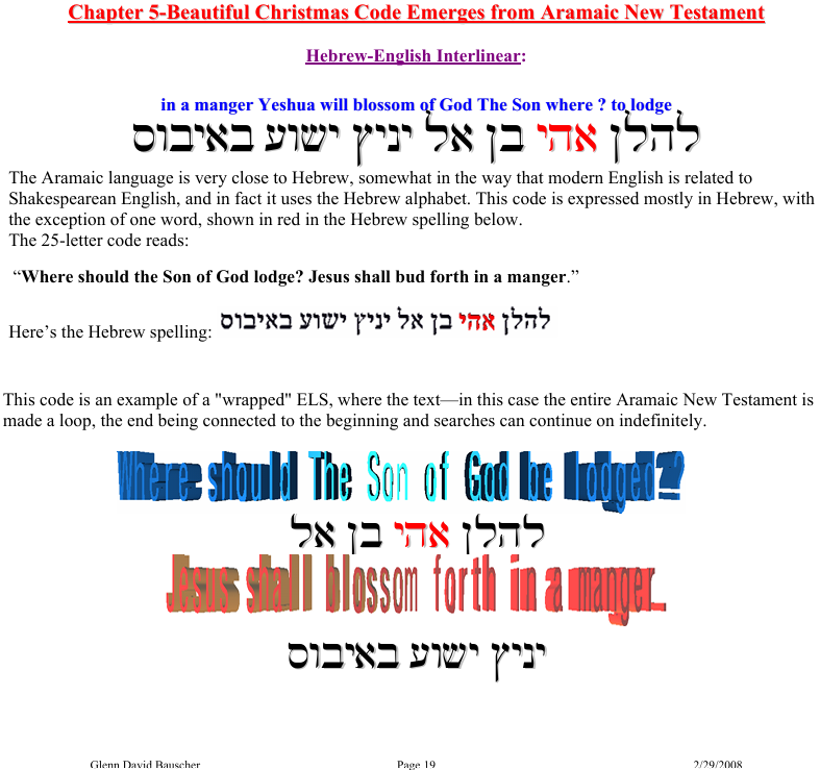
{“The Discovery of The New Testament that God Wrote”. 19.}
Before we get into the “vital statistics” on this ELS, consider the sheer sloppiness of the sentence “The Aramaic language is very close to Hebrew, somewhat in the way that modern English is related to Shakespearean English, and in fact it uses the Hebrew alphabet.” This shows that he’s confusing Syriac and Aramaic, since Aramaic (in general) uses the same alphabet as Hebrew, but Syriac (the particular dialect of Aramaic that the Peshitta was written in) doesn’t! Only if he meant what sounds are represented by each of the 22 letters within each script would his claim be… more accurate, but still not entirely accurate. The progression from Shakespearean English to Modern English is more akin to the progression from Imperial Aramaic to Old Syriac, not from Hebrew to Aramaic. Shakespeare’s works influenced the development of Early Modern English, which went on to develop into Modern English; likewise, Imperial Aramaic (of which Daniel 2:4b-7:28 is a flawless specimen {Scroll to the first paragraph under “Historical” in the second Answer, the one by Frank Luke.}) influenced Eastern Aramaic, one dialect of which developed into Old Syriac–and ultimately, the Classical Syriac seen in the Peshitta.
In fact, Genesis 10:21-24 makes it clear that while Aramaic and Hebrew are both Semitic languages, their common root is the Tower of Babel incident, not ancient Hebrew! The descendants of Shem’s son Aram (verse 22) spoke proto-Aramaic; the descendants of Eber, the grandson of Aram’s older brother Arphaxad (verses 22 & 24), spoke proto-Hebrew. Actually, “Arphaxad” is a direct transliteration of the LXX rendering Ἀρφαξάδ; it would be אַרְפַּכְשַׁד (Arpachshad) in the original Hebrew. See how much harder it is for English speakers to pronounce the letter combination “chsh” than to simply pronounce the sound of the letter “x”? This is a prime example of why translators are willing to adapt Biblical names into other languages!
I seriously find it concerning that he keeps saying “Aramaic” instead of “Syriac”. It’s difficult to tell (from this work on its own) whether he’s deliberately trying to pull bait-and-switch tactics all over the place by conflating Syriac with Aramaic, or if he’s just too ignorant to understand that these two terms mean different things; but in light of the fact that he seems to know enough about the Syriac seen in the Peshitta to be dangerous (as we saw earlier with his handling of Luke 1:3 and 2 Timothy 4:4 in his own published interlinear translation), I’m hard-pressed to imagine how he could be ignorant of such a basic distinction…
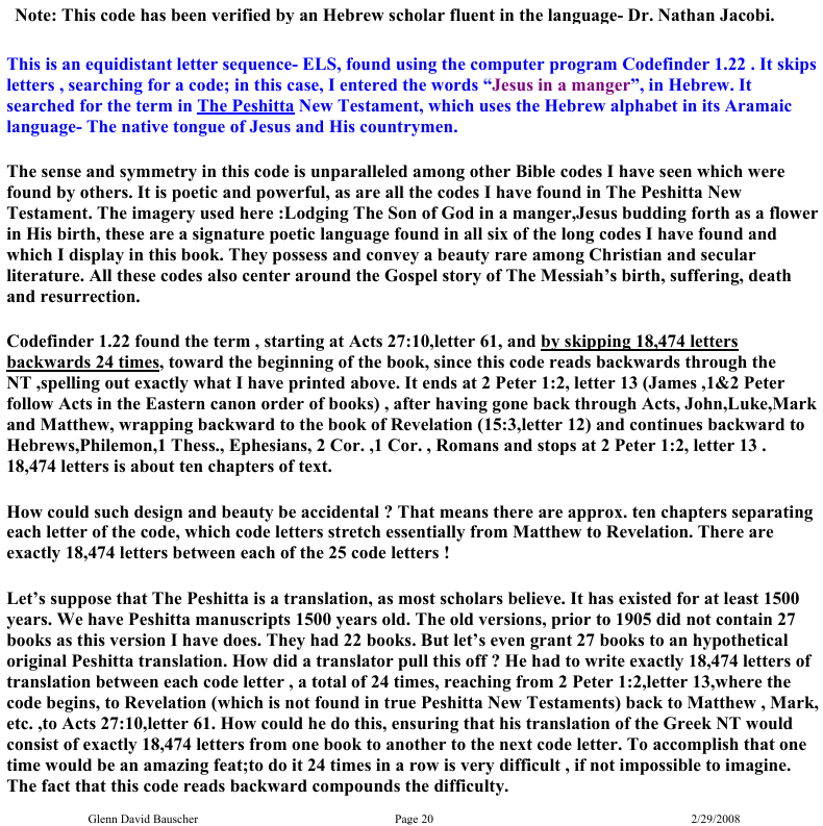
{Ibid. 20.}
First, when he says “This code has been verified by an Hebrew scholar fluent in the language”–verified in what regard? If Bauscher means “verified as to its grammatical validity”, that’s admirable; it shows that Bauscher is at least trying to double-check whether the sentences he’s finding function the way he’s making them out to! However, a Hebrew scholar’s expertise is completely irrelevant to whether the code is statistically-significant, rather than an artifact of statistical noise—he would need statisticians to double-check that! Even the one statistician Bauscher has found to back him up, Ed Sherman {Ibid. 49.}, is considered a hack by other mathematicians, statisticians, and even other Bible Code proponents like Eliyahu Rips (who believes Codes are only valid if found in the Torah–Genesis through Deuteronomy)–not to mention skeptics.
Second, notice that he said he had Codefinder 1.22 look for the Hebrew phrase for “Jesus in a manger”–this reveals that he’s skewing any messages found to pertain to a certain topic right at the start of the search! This drastically increases the likelihood that any sentences found will be relevantly meaningful!
Third, his mention of “The Peshitta New Testament, which uses the Hebrew alphabet in its Aramaic language- The native tongue of Jesus and His countrymen” again conflates Aramaic in general with Syriac in particular. Also notice the following admission: “James, 1&2 Peter [sic] follow Acts in the Eastern canon order of books”. This is rather intriguing, in light of T&BRR’s aforementioned attempts to put the Book of Enoch and one of the Book of Jasher forgeries on par with Scripture–and in light of the view being promoted by some of T&BRR’s fellow conspiracy theorists that the Ethiopian Bible is the true canon of Scripture. If those peers of T&BRR are correct, then he should be using the 35 books of the Ethiopian New Testament, not the 22 books of the Peshitta New Testament (as explained here, “The New Testament of the Peshitta originally excluded 2 Peter, 2 John, 3 John, Jude, and Revelation, but these five excluded books were eventually added in the Harklean Version in 616 A.D. by Thomas of Harqel.”). For that matter, why does Bauscher rely so heavily on the Assyrian Church of the East as accepting the Syriac’s status as the original all along {p. 8}, when he accepts the 5 NT books that they reject? You can see right here that one end of the ELS Bauscher is discussing here started with a letter in 2 Peter! Yet he made a point earlier of emphasizing that he used “The Eastern Version, used by the Church of The East” to extract the ELS in Matthew! So, is Bauscher relying on the Eastern Version that the Church of the East affirms, or the Western Version he actually went out of his way to translate? Make up your mind, Bauscher! Inconsistency on this point undermines his right to claim he’s using an objective method–just like the Bible Code proponents before him.
Moreover, he contradicts himself on this front again on the very next page! “The Peshitta canon of the fifth century did not contain 2 John, 3 John, Jude or Revelation. It is ridiculous to posit a translator putting these codes in The Peshitta edition as it exists in the 27 book edition I have.” {Ibid. 21. Boldface in original.} So, is he saying the Peshitta of the fifth century (the “Eastern Version” he trumpets earlier in his work) is bogus, and the Peshitta of the early 7th century is legit? After all, this “code” wouldn’t work in the earlier, 22-book edition! Pick a version (eastern or western, 22-book or 27-book) and stick with it, Bauscher! This flexibility over which version of the Syriac New Testament he uses on a given search provides even more “wiggle room” for him to find ELSs that come out coherent!
Fourth, his claim that “The fact that this code reads backward compounds the difficulty” is itself backwards! Allowing the software to search for “codes” by going forward or backward doubles the opportunities to find something coherent! This makes the task of finding something seemingly significant easier, not harder!
If one letter of this 96% of The NT were deleted or one letter added to it, this Christmas code about The birth of Christ would not exist!
This particular version as I have it may not have existed in exactly this form, letter for letter, since the original NT manuscripts were written 1950 years ago. The mss. are extremely close in their texts, but there are some differences in many NT books. The critical edition was produced by comparing some 80 manuscripts and selecting the majority readings. Roy Reinhold then made some revision in a few places based on one or another group of mss. which added 50 letters to the total number in the 1905 edition. None of these codes exists in the 1905 version; none of them exists in The Eastern canon Peshitta; none exists in the standard Western edition.It is as if the codes were waiting for the 1905 edition to be edited in the year 2000 and analyzed by computer in the 21st century in order to be found.
{Ibid. 21. Boldface, underlining, blue text, and punctuation in original.}
And Bauscher doesn’t find that the least bit suspicious?! Isn’t this a tacit admission that none of the versions he was citing earlier in his own work was the original?! Also, consider his remark on p. 23: “Remove one letter from this Peshitta NT, and the code disappears ! The number of letters 461,094 in the 27 books is absolutely essential to the existence of this code. Remove one from any of its 27 books, and it all falls apart.” This raises another question: how would Bauscher or his readers react if a new critical edition of the Peshitta was released tomorrow, with one letter more or less?! Bauscher is setting himself and his readers up for spiritual disaster if even one thing in the current critical edition of the Peshitta winds up needing to be corrected! (Sure, it wouldn’t affect any major doctrines; but it would place any Christians who placed their faith on the basis of this seeming evidence that we have the “truly perfect” original in the Peshitta Bauscher’s using on very shaky ground.)
Remember that the difficulty of composing a coded translation like described above increases exponentially when one considers that there are at least six long codes like the one above,and most are much longer than 25 letters. Three of the codes read backward; the longest and most recent finding is written in two languages (approx. half Hebrew & half Aramaic) and 23 letters of a 29 letter Aramaic section spell out a Hebrew code backwards !
{Ibid. Boldface and punctuation errors in original. Underlining mine.}
Oh, so now Code seekers are allowed to change the language the text is written in partway through the ELS?! How very convenient! Is it any wonder this trick wasn’t utilized until “the longest and most recent finding”?! And of course, he goes on to calculate the odds of this second code occurring by chance with the same inappropriate calculation that drastically inflates the actual probability, getting a result of “approximately 1 in 100 million-trillions.” {Ibid. p. 21.}
Are you starting to see how Bauscher’s methodology is SO BLATANTLY RIGGED to make the occurrence of these sorts of “codes” inevitable?!?!
Code #3
On to the next one:
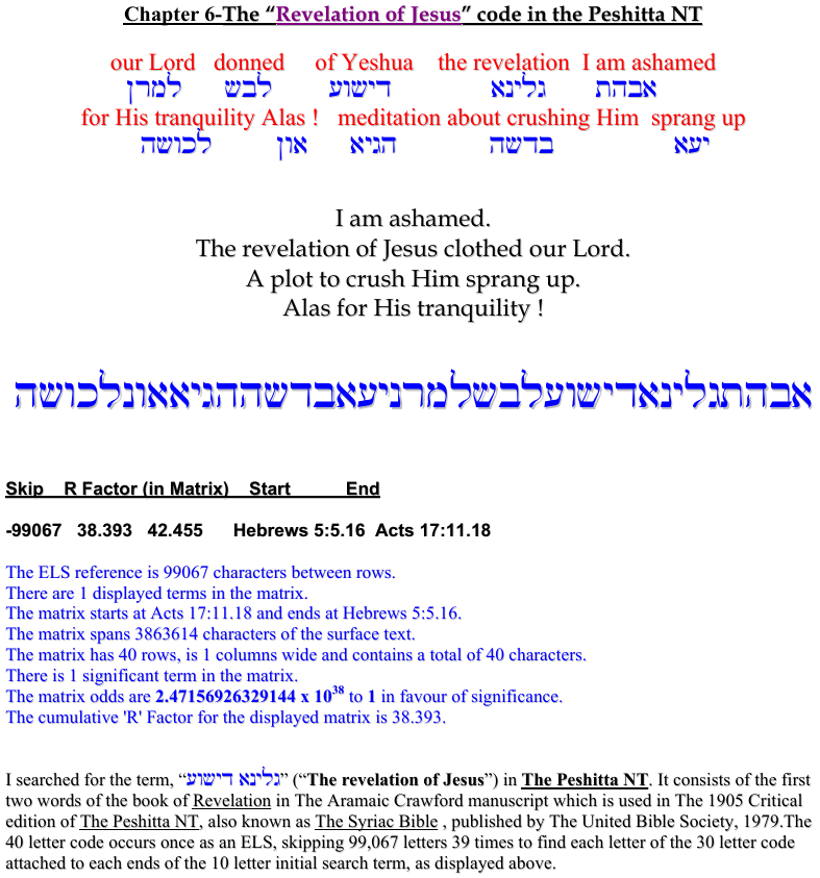
{Ibid. 22.}
I searched for the term, ‘גלינא דישוע’ (‘The revelation of Jesus’) in The Peshitta NT. It consists of the first two words of the book of Revelation in The Aramaic Crawford manuscript which is used in The 1905 Critical edition of The Peshitta NT, also known as The Syriac Bible, published by The United Bible Society, 1979.
{Blue text, boldface, and underlining in original.}
So now Bauscher’s taking his starting search term from the 1905 Critical edition that he just said the previous codes don’t show up in?! How much more blatant can the cherry-picking and methodological inconsistencies get?! The cooked odds Bauscher presents for this code occurring by chance are
2.47 x 1038 to 1 in favour of significance. {Ibid. 23. Boldface and blue text in original.}
Funnily enough, he immediately follows this with the following:
{Ibid.}
Um, that’s the same text he brought up earlier, which also went from Acts 27 to 2 Peter 1 (shortly after Acts in the Peshitta) and had a stated probability of 1 in 1020. Is this an editing error, or is Bauscher trying to claim he found this exact 40-letter sentence from two different searches?

{Ibid.}
Well, of course it’s harder to find these sorts of “codes” in Greek texts—you have to capture the vowels in the same ELS as the consonants! In Semitic languages, the vowels are almost optional.
Speaking of vowels, this is another thing that introduces an obscene amount of “wiggle room” in Bauscher’s methodology to make coherent phrases more likely—variant spellings! Here are all the words I’ve noticed with variant spellings in all the examples we’ve seen so far:
- “He seized a garment… pedestal of travail”: Bauscher used ישוע (Yeshua) instead of יהושוע (Yehoshua, the name typically used for Jesus in the Peshitta), giving him two fewer letters that need to be there; and משיח (Meshiach) instead of משיחא (Meshicha; the more common spelling in the Peshitta, since nouns usually take the emphatic ending א-).
- “Where should the Son of God lodge? Jesus shall bud forth in a manger.”: Bauscher used Yeshua instead of Yehoshua again.
- “I am ashamed. The revelation of Jesus… His tranquility!” Bauscher used דישוע (d’Yeshua; “of Yeshua”) instead of דיהושוע (d’Yeshoshua; “of Yehoshua”). (As an aside, למרן properly means “teacher”, not “Lord”. Mar-Yah, which T&BRR acknowledges as the Syriac equivalent to YHWH, would be מריא. “Teacher” is also an appropriate title for Christians to apply to Jesus, so Bauscher could’ve translated this word accurately and still gotten a coherent message for Christians. The only explanation I can see for Bauscher rendering it “Lord” instead of “Teacher” is that he decided to sacrifice accuracy in his translation to further the effect of this “code” on his readers. Talk about dramatic.)
I’ll bring out more examples as we go through the rest.
Then there’s the fact that Greek is an inflected language, while Hebrew, Aramaic, & Syriac aren’t. This means that any words in a Greek ELS MUST all be inflected in such a way that the sentence winds up being grammatically-coherent! Moreover, if a Greek ELS doesn’t possess a letter combination that can put the word leading up to it in the nominative case, then THERE’S NO WAY to choose starting and stopping points for words that will result in a coherent sentence. (Sure, some Greek sentences in the LXX and Greek NT don’t have a nominative-case word, but they can get away with it because there’s a nominative-case word earlier in the context that’s being harked back to; this workaround isn’t available for an ELS “Code”, which is supposed to be self-contained.) So, on several levels (even more than just these; e.g., even in a simple Subject-Verb-Object Greek sentence, the subject must match the verb’s person and number, and the object must match the verb’s case requirement!), it’s an apples-to-oranges comparison. In fact, check out this chart that was generated when I discussed this in Google’s AI Mode (albeit slightly adapted):
| Feature | Hebrew/Aramaic/Syriac ELSs | Greek ELSs |
| Letter Freedom | High (Consonants only; readers supply vowels) | Low (Vowels are locked in stone) |
| Ambiguity Advantage | A 4-letter root can mean dozens of words | A 4-letter root + suffix means exactly one form |
| Sentence Chance | Higher (Loose syntax, words can string together easily) | Extremely Low (Strict structural and case agreement) |
The Peshitta text has remained unchanged from the first century; all 350 manuscripts are essentially in uniform agreement. The Greek mss. are not nearly as uniform, even among the Byzantine and Textus Receptus traditions.
{“The Discovery of The New Testament that God Wrote”. 23.}
This contradicts what Bauscher said two pages earlier:
This particular version as I have it may not have existed in exactly this form, letter for letter, since the original NT manuscripts were written 1950 years ago. The mss. are extremely close in their texts, but there are some differences in many NT books. The critical edition was produced by comparing some 80 manuscripts and selecting the majority readings. Roy Reinhold then made some revision in a few places based on one or another group of mss. which added 50 letters to the total number in the 1905 edition. None of these codes exists in the 1905 version; none of them exists in The Eastern canon Peshitta; none exists in the standard Western edition.It is as if the codes were waiting for the 1905 edition to be edited in the year 2000 and analyzed by computer in the 21st century in order to be found.
{Ibid. 21. Boldface in original.}
The above implies that he’s using the 2000 Critical edition, which was edited from the 1905 edition, which was based on the majority readings among the western and eastern editions! How can these all be distinct versions if “The Peshitta text has remained unchanged from the first century”?!
Perhaps Bauscher meant that we’ve finally managed to reconstruct the original phrasing for every last passage in the Syriac NT. But if any textual scholar made that claim, the scholarly community could easily respond by borrowing a line from Cortez in “Paper Mario: The Thousand-Year Door”: “You must be very brave or very, VERY foolish…” In fact, I’d personally place it on par with the “discoveries” of Ron Wyatt, who claimed to have found many {scroll to “1) Egyptian Chariot Wheels in the Red Sea”} archaeological sites {scroll to “Ron Wyatt” under “The people involved”} of interest to Christians that had managed to evade professional archaeologists for over a century, despite all his excuses to avoid showing people hard evidence for his finds! Does the recent resurgence in archaeological research at the Durupinar site, the one Wyatt promoted for Noah’s Ark, suggest that Wyatt’s claims should be taken as dogma? Of course not. Christians should resist the urge to claim Wyatt really did find the Ark unless and until the archaeological evidence shifts in his favor. We should never let our judgment be clouded by sensationalism, no matter how much we’d like something to be true. Likewise, no Biblical textual scholar would claim that there’s absolutely nothing in our current critical editions of the Biblical texts that could theoretically be overturned by a future manuscript find. As long as we’re analyzing the different readings as carefully as we can, and not trying to use a questionable reading to overturn clear Apostolic doctrine, we’re not violating God’s commands not to add to or take away from His words (Deuteronomy 4:2, 12:32; Proverbs 30:5-6; Revelation 22:18-19). The evidences and methodologies behind Wyatt’s claims about his archaeological finds were bogus; so are the evidences and methodologies behind Bauscher’s claims about the Syriac NT.
The Critical texts [of the Greek NT] also differ; there is no settled tradition or standard. Every new Nestles or UBS edition has numerous changes from the 26 previous editions.
{Ibid. 23. Content in brackets mine.}
Dude, you acknowledged earlier that this is also true of the Peshitta text you’re using, which differs from at least 3 earlier editions (5 if you count the Curetonian Gospels and Syriac Sinaiticus, both of which are Old Syriac versions that pre-date the Peshitta, according to mainstream scholarship)! I haven’t seen Bauscher attempt to explain the existence of the Old Syriac versions at all, although I may not have looked hard enough… Moreover, the changes in the Critical Text are predominantly due to the discovery of other old manuscripts that give us more evidence to weigh regarding how the text may have read originally. After all, as Bauscher himself acknowledges, the original reading is the one that counts!
And then Bauscher confuses us even more over different versions of the Peshitta before finally telling us which version he thinks should be accepted as the original:
{Ibid. 24.}
“The Western Peshitto [the Western version I mentioned above], in its critical edition, corrected somewhat to the Eastern text of The Peshitta, but containing the 27 books and the Pericope Adultera of John 7:53-8:11, is the original text of The New Testament, very nearly letter perfect!” That’s a mouthful. It also contains a qualifier vague enough to allow for more wiggle room as far as the “codes” are concerned: “corrected somewhat”? However, despite this bold proclamation, he’ll contradict it yet again in a bit…
Code #4
{Ibid. 25.}
Wait, he said on p. 12 that “‘Peshitta’ (“(The Pure One) פשיטתא”) in Aramaic means ‘Straight’”. Granted, both “Straight” and “Pure” are in the word’s range of meanings (as is “Right”, as Bauscher acknowledges on p. 26), so I’ll give Bauscher a pass on that. However, he goes on to mention a couple of “irregularities in the spelling of this Aramaic [there he goes again, saying “Aramaic” instead of “Syriac”!] code.” How convenient for his ability to come up with a coherent sentence:
{Ibid. 25-26.}
DUDE, you just said the 2000 critical edition, with a handful of edits, was the original! Why are you using the 1905 Critical edition with Roy Reinhold’s edits for this example?! YOU’VE CHOSEN WHICH VERSION YOU REGARD AS THE ORIGINAL, NOW STICK WITH IT ALREADY!!
The inappropriately-calculated odds for this one are 1063 to 1.
Code #5
Next up, we’ve got a Hebrew “code”, instead of a Syriac (er, “Aramaic”) one:
{Ibid. 28.}
Wow, way to demonstrate how easily one can find an ELS that you can tack an extra 2.5 words onto the front of to make an even longer sentence! Being able to do this once for every 7 ELSs seems like pretty good odds to me! (See how meaningless the probability becomes when you exclude the failed attempts from the presentation of evidence?)
Also, how convenient that he was able to spell “God” as אל (El) instead of having to look for an ELS that contained אלהים (Elohim)! He goes on to say that the original search term that caused Codefinder to yield this result was “המשיח יהוה -‘Ha Meshiach Yahweh’ – ‘The Messiah of Yahweh’ or ‘The Messiah Yahweh’.” {Ibid. 30.} Does he realize he could’ve gotten this without the definite article at the beginning? I wonder why he doesn’t present the result for משיח יהוה. Could it be because the result from searching that doesn’t seem as impressive? Or, even worse, yields a “code” that totally contradicts what we know from a straightforward reading of the Bible?! Indeed, in the course of my research for this post, I’ve seen someone bring this out in a forum (that I can’t seem to find at the moment) by saying something to the effect of: “If someone found a Torah Code that read ‘Eating pigs is the best!’, would a Jewish Code Proponent attribute that Code to mere coincidence?” If they do (as they just-about-certainly would!), they’ve just admitted that these Codes could just be coincidence!
I don’t have Codefinder software myself, so I don’t know if Meshiach Yahweh without the definite article Ha would yield any results along these lines. Perhaps Bauscher himself is willing to volunteer that information? You know, to give his critics one less avenue for calling him out?
He also presents the overinflated odds of this being attributable to coincidence:
The R Factor 85.867 is the Probability Exponent (1085 to 1) of the odds this string of letters is there by chance. The exponent of the number of electrons in the universe is 81- (1081).
That gives an idea how great the odds are against this being a coincidence.
{Ibid. 30.}
The number of electrons in the universe is actually 2 orders of magnitude larger, from what I’ve seen (1083). But again, he’s assuming the presence of every letter is totally independent of the presence of any other letters, which is completely unwarranted. Hence, the odds of this being a coincidence are much, much better than he’s making them out to be!
Intriguingly, he gives no suggestion as to the meaning of this “code”:
For The Son of God to be contended against by one city
Caused The Messiah of Jehovah to feel His night
He was poor, He was lofty, He proposed a riddle:
“A firebrand of blood was spoken of by Me.
I shall roam the interior,
And an index, religion, and the bitterness of ‘The Stone’
You shall drive out from the isle of Jehovah,
A companion of the mist and isle of mist with it”.
…The grammar is fairly straightforward and the message is in riddle form, even explaining itself to be a riddle. I leave it to the reader to decipher the meaning.
{Ibid. 29-30. Centered lines and capitalization in original.}
Oh, so he’s not even gonna bother giving commentary on this one, like he has with the others? Well, I suppose it’s for the best. This sort of thing is far more akin to Kabbalah than anything else he’s presented so far! However, the quote he concludes that chapter with (each of these codes has gotten a single chapter, by the way!) is something I can easily call out: “Son of man, put forth a riddle, and speak a parable unto the house of Israel. Ezekiel 17:2” {Ibid. 31. Boldface in original.}
In the context of Ezekiel 17, the phrase “Son of man” was spoken to Ezekiel himself, not prophetically of Jesus. The “riddle” and “parable” was explained in verses 3-8, and it has no resemblance whatsoever to what Bauscher has put forth here. And just for the extra kick in the teeth, let’s quote the whole passage from Bauscher’s own interlinear translation of the Peshitta OT:
1 And it was upon me, his answer of LORD JEHOVAH, saying: 2 “Son of man, riddle a riddle and parable a parable upon those of the house of Israel; 3 and say, ‘Thus says THE LORD OF LORDS: an eagle, great of great, his wings and are long, his feathers and are full, his talons and thick, his feathers came to Lebanon and he took choice ones of cedar trees. 4 And he cropped off the top of its growth and brought it to the land of Canaan, and he placed it in a city of merchants. 5 And He took from the seed of the land and cast into the wilderness a plant on waters many, and he placed it for a Watchman. 6 And it sprouted up and it was a vine sickly, short of stature, that would appear its shoots upon it and its roots shall be under it, and it was a vine and it made shoots and it stretched forth its shoots. 7 And behold, eagle another, great of greater, his wings and more, his talons and fine; this, it bent its roots upon him and its shoots it cast upon him, that he would water it from the soil of its planting. 8 In a field beautiful and in waters many it is planted, that it would make leaves and it would bear fruit and there would be a vine glorious.’” 9 Say, “Thus says THE LORD OF LORDS: ‘not it shall prosper, but its roots shall be cut off and its fruit shall rot, and they shall dry up, and all the leaves of its growth they shall dry up, and not by an arm high, and not among the Gentiles, many shall uproot it from its roots. 10 Behold, it is planted, but not it shall prosper, and when has blown on it the wind hot, it dries up in the soil of its growth.’” (Ezekiel 17:1-10)
{All-caps in original. Punctuation and word in italics added by me.}
The “riddle” and “parable” is then explained in verses 11-15. No need to appeal to an “Aramaic Code” to find a hidden meaning.
Code #6
Next up, Bauscher presents that bilingual, bidirectional code he mentioned earlier (he’s really pushing the limits of his arbitrary methodology on this one!):

…
{Ibid. 31.}

{Ibid. 32.}

…

{Ibid. 33.}

…

{Ibid. 34.}
{Ibid. 34-35.}
{Ibid. 35-36.}
Wow, I just noticed something else that I should’ve been paying attention to sooner: He uses two final nuns (ן) in the Aramaic phrase for “He smote us and stirred us”, yet both of them are regular nuns (נ) in the Hebrew phrase for “lamps And epileptics”. If I were looking for codes, I’d feel constrained to make sure the final letters stayed final, and the regular letters stayed at the beginning or middle of a word! Bauscher can’t even appeal to the Syriac text using the same form for both, because Syriac also has different forms for them {scroll to “initial Nun”, “final connected Nun”, and “final unconnected Nun”}! There’s no two ways about it: Bauscher’s treating initial and final forms of letters as interchangeable allows him even more wiggle room to make coherent sentences!
Moreover, did you notice that the poem he gives at the end has the phrases arranged in a different order than the original sequence of letters given at the start of the chapter? Seriously, just look at this mess!
What is Bauscher thinking with how he arranges the phrases in green?! And do you see that solitary Lamed (ל) near the bottom that gets used at the end of a blue phrase, the beginning of a black phrase, and as the third character from the end of the phrase that reads backward? What rhyme or reason can Bauscher offer to justify that?! This freedom to rearrange the letters and pick starting and stopping points for phrases in an order that makes the final poem somewhat coherent is arbitrary, subjective, and all-too-convenient!
Also notice that, once again, Bauscher had “God” represented by the conveniently-shorter Eil (איל) instead of the longer and more-formal Alaha (אלהא) or even Eloi (אלהי, meaning “my God”) in one of the Aramaic (er, Syriac? Seriously, doesn’t Bauscher realize that if these phrases are in Aramaic rather than Syriac, this whole line of reasoning for the Syriac Peshitta as the original New Testament is worthless?!) sentences, and the conveniently-shorter El (אל) instead of the longer and more-formal Elohim (אלהים) in one of the Hebrew sentences.
Just when I think I’ve spotted all the problems with Bauscher’s methodology, I keep finding more!
Oh, and he claims the odds of this happening by chance are “1 chance in 1.37004983905038E177 in favour of significance”, or less than 1 in 10177. Of course, we already know those odds are drastically overstated because the calculation method is completely inappropriate for a base text that wasn’t itself randomly-generated.
Now, you may have noticed that one of the screenshots I gave you from p. 34 had some extra numbers that I haven’t addressed yet. The latter two are the “R-value” and the “R-value (in Matrix)”, both of which we’ve seen are based on a formula that’s inapplicable to a base text written in an actual language (as opposed to having every letter randomly generated). But the first number is extremely relevant to whether or not these “codes” could be coincidence. That’s the skip distance between each letter in the ELS. Remember how I mentioned near the start of this discussion that you can increase the likelihood of a coherent sentence being picked up by an ELS search by increasing the skip distances to ridiculous levels? Here’s the skip that was used to find each of the ELSs Bauscher discusses in chapters 4-9 of his book:
- 17,921 {p. 16}
- -18,474 (negative means you go through the base text backward) {p. 20}
- -99,067 {p. 22}
- -35,348 {p. 25}
- 70,328 {p. 30}
- 74,806 {p. 31}
For perspective, Bauscher admits that the Peshitta he regards to be the divinely-inspired original contains exactly 461,094 Syriac letters: “The number of letters in The original New Testament was and is 461,094.” {Ibid. 47. Boldface in original.} This means a skip length of 461,096 would be equivalent to a skip length of 2, since you’re just skipping the whole Peshitta NT, plus 2 more letters. What’s more, it means that a skip of 230,547 will simply repeat the same two characters over and over, and a skip of 230,548 going forward is equivalent to a skip of 230,546 going backward! Hence, to make the skip lengths in the tens of thousands when the highest skip length that could potentially yield meaningful results is just over 230,000 means that the skip lengths given above are pretty close to the upper limit of being “reasonable”. Wouldn’t we expect God to use much smaller skips that have some Biblical significance? Say, 12 (number of tribes of Israel), or 40 (a day count that’s mentioned 17 times in the Bible, with reference to 9 distinct 40-day periods), or 70 (the total number of descendants of Shem, Ham, & Japheth named in Genesis 10–each of them having 26, 30, & 14, respectively), or 75 (the total number of people who went to Egypt with Jacob when Joseph was already living there; the passages that say 66 or 70 were including and excluding certain people), or even 153 (John 21:11)?
This should also raise a pretty obvious question: What about the tens if not hundreds of thousands of combinations of skip lengths and search terms that yielded no codes whatsoever? If the ELSs in the Peshitta (or the Torah, or the entire Tanakh, or whatever) were divinely-inspired, wouldn’t we expect that ELSs that form meaningful sentences would be the rule, not the exception? This presentation of a handful of successes, while neglecting a mountain of attempts that failed, is one of the biggest statistical problems with Bible Codes, Torah Codes, Aramaic Codes, Peshitta Codes, or whatever you choose to call them to suit your purposes.
It’s known as the “Texas Sharpshooter Fallacy”. The name (albeit without the “Texas” part) comes from the following analogy written by John Venn (yes, the guy that Venn diagrams are named after) in his seminal 1866 book, “The Logic of Chance” (although the same analogy using arrows instead of bullets is much older):
One of the most fertile sources of error and confusion… consists in choosing the class to which to refer an event, and therefore judging of the rarity of the event and the consequent improbability of foretelling it, after it has happened, and then transferring the impressions we experience to a supposed contemplation of the event beforehand. No error need arise in this way if we were careful as to the class which we thus selected; but such carefulness is often neglected.
An illustration may serve to make this plain. A man once pointed to a small target chalked upon a door, the target having a bullet hole through the centre of it, and surprised some spectators by declaring that he had fired that shot from an old fowling-piece at a distance of a hundred yards. His statement was true enough, but he suppressed a rather important fact. The shot had really been aimed in a general way at the barn door, and had hit it; the target was afterwards chalked round the spot where the bullet struck. A deception analogous to this is, I think, often practised unconsciously in other matters. We judge of events on a similar principle, feeling and expressing surprise in an equally unreasonable way, and deciding as to their occurrence on grounds which are really merely a subsequent adjunct of our own.
{“The Logic of Chance”. Venn, J., 1866. London and Cambridge, UK: Macmillan And Company. 259. Italics in original. Boldface mine.}
Had the man in the story made multiple shots in that general direction until one of them hit the door, then plastered over the original wall(s) surrounding the door to hide all the bullet holes from the failed attempts, that would be akin to what Code Proponents are doing by not reporting how many failed attempts they needed before getting each success. A related error that Code proponents make is HARKing (Hypothesizing After the Results are Known), which, as defined by Norbert Kerr, the social psychologist who coined the term, is “presenting a post hoc hypothesis (i.e., one based on or informed by one’s results) in one’s research report as if it were, in fact, an a priori hypotheses.” {scroll to “Abstract”} An example of HARKing is as follows:
A company tests whether its new supplement improves any of 50 different health markers. It finds that one marker shows improvement, ignores the other 49 that showed no effect, and markets the supplement as effective for that one marker — as if that was what they were testing all along. {Boldface added}
This is what Bauscher is doing by only giving us the stats on the ELS searches that happened to yield something meaningful. It’s confirmation bias, plain and simple.3 In fact, consider what Kerr himself identified as “twelve potential costs of HARKing:”
-
- Translating Type I errors [where a true null hypothesis is incorrectly rejected; in this case, the null hypothesis is that the “codes” are in the text by coincidence] into hard-to-eradicate theory.
- Propounding theories that cannot (pending replication) pass Popper’s disconfirmability test.
- Disguising post hoc explanations as a priori explanations (when the former ted [sic; he meant “tend to”] also be more ad hoc, and consequently, less useful).
- Not communicating valuable information about what did not work.
- Taking unjustified statistical licence [sic].
- Presenting an inaccurate model of science [in this case, probability] to students.
- Encouraging “fudging” in other grey areas.
- Making us less receptive to serendipitous findings.
- Encouraging adoption of narrow, context-bound new theory.
- Encouraging retention of too-broad, disconfirmable old theory.
- Inhibiting identification of plausible alternative hypotheses.
- Implicitly violating basic ethical principles.
{Scroll to “In Detail”. Numbering in original. Boldface and content in brackets mine.}
Right off the bat, I can see that Bauscher is guilty of the items I’ve boldfaced here. Maybe I could spot more if I thought about it more, but I’ve got to finish preparations to publish my nonfiction book and would rather not waste too much of my time analyzing nonsense.
Code #7
Finally, we get up to an example that’s more akin to what Bible Code proponents have been presenting all along:
{“The Discovery of The New Testament that God Wrote”. 40.}
No, not that part, although a skip of 45 is far closer to what Bible Code proponents typically use! That mention of a “minimum skip” for a term to occur within an entire work means that this is an example of a “Minimal ELS”. What really makes this example more reminiscent of “old school” Bible Code proponents is that it serves as an anchor for an entire section of text that contains multiple single-term ELSs!
{Ibid. 41.}
Aside from noting that the probability given by Codefinder is hyperinflated and inappropriate once again, how do I respond to this? Simple. Check out the following similar cluster of terms related to Hanukkah.
The phrase that anchors the cluster is the ELS for Ner Chanukah (Chanukah candle) which starts from the lower right (last line) and swings up on a diagonal every fourth line [The leading nun is the only circled letter on the last line and the reish is the only circled letter on the fifth line from the bottom. Now follow the diagonal upwards. See http://cs.anu.edu.au/~bdm/dilugim/candles/ where a more detailed analysis can be found.]. It is a minimal ELS in the entire text from which this picture is a fragment. The other words are all minimal (in the entire text) ELSs of Chanukah related words, for example, Menorah. Chanukah clusters have been a popular topic with codes searchers and none has more words within a short space than this one [The section of text shown in the picture is about 1.3% of the standard test text making this an extremely compact example.].
This example is an impressive cluster that might lead you to suspect that it didn’t occur by chance. However, you should know that it is not a code in the Torah but rather a code in the Hebrew translation of War and Peace [This translation is popular as a text in which to look for ELSs because it was first used by Witztum, Rips and Rosenberg in their famous Rabbis paper as a test document. They used the first 78,064 letters of this Hebrew translation — 78,064 is the number of letters in Bereishit {בְּרֵאשִׁית, the Hebrew name for and opening word of the book of Genesis, generally translated into English as “In the beginning”}.].
{Scroll to “Problems with Word Clusters”. Parentheses, capitalization, and italics in original. Endnote numbers in brackets replaced with the text of the corresponding Endnotes. Boldface, underlining, and content in curly brackets mine.}
THE TEXT DOESN’T NEED TO BE DIVINELY INSPIRED FOR THESE PHENOMENA TO OCCUR. It just needs to be long enough for these phenomena to become statistically inevitable!
Bauscher later tries to counter that names of God occur more often in ELSs of the Peshitta than in ELSs of the Hebrew translation of “War and Peace” {p. 50-56.}. First off, this is just shifting the goalposts, knowing full well that the earlier Bible Code proponents failed to account for such counterexamples to their claims that such ELSs are evidence of divine authorship. Yet this redefinition of what qualifies as “significant enough” to qualify as “evidence for divine authorship” runs into another point that Dr. Simon has brought out: “if HaShem [“The Name”, a title Orthodox Jews use for God to avoid having to say “YHWH”] placed this evidence there, would he do it such an incredibly indirect and imperfect way [e.g., allowing for us to incorrectly choose between tons of spelling variants and requiring us to make subjective judgment calls when executing the methodology]? After all, the Torah represents Truth, not truth in some average statistical sense.” {Scroll to “The Nature of the Famous Rabbis Experiment”. Boldface and content in brackets mine.}
Second, remember how I explained early on in this discussion that the letters in a work written in an actual language aren’t random? Another side effect of this is that ELSs are more likely to contain words that already occur in the “plain text” of the work they’re being searched for in. (This is where all the mentions of “skate”, “skating”, “skater”, “skaters”, “skateboard”, “skateboards”, & “skateboarding” in my novel come back to bite Bauscher; I suspect ELSs of those terms will be easier to find in my novel than in English writings in general!) Since any version of the Bible contains names of God all over the place, we should expect those terms to show up somewhat frequently in ELSs as well (especially considering how few letters have to line up to make them in Semitic languages). But in “War and Peace”, a work of historical fiction (essentially a period piece set in the days of the Napoleonic Wars) written by Russian author Leo Tolstoy, we wouldn’t expect names like YHWH, MARYA, or ALAHA to occur anywhere near as often as names like NAPOLEON, PIERRE, NATASHA, ANDREI, etc.! Basically, Bauscher’s “test” is (whether Bauscher intended it to be or not) pre-calibrated to favor any Bible over any secular work.
However, Bauscher has another twist to this example.
{Ibid. 41-42.}
Bauscher does realize that the “hill” is an artifact of the grid having a width of exactly 45 letters, right? If the grid was just one letter wider or thinner, the hill would be leaning to the right or left, respectively! For that matter, he spelled Moriah as מוריה (including the vowel “o”) instead of מריה (excluding it)! If he’d gone with the shorter spelling (like he’s tended to do in these “codes”!), the hill would’ve had 6 letters on the left side, but only 5 letters on the right! Similarly, in the phrase “My God, why?” he spells the word for “why?” as למא (Lama), rather than the more formal, classical Aramaic form למנא (Lmana). Had he used the longer form here, the hill would’ve had 7 letters on the left side, instead of 6! It sure is convenient for Bauscher that he gets to pick-and-choose his spellings to make the results as impressive-looking as possible!
And granted, the width of the grid seems to be set by the anchor phrase he gave at the start of the chapter, but why did he have to use the minimal ELS for “Yeshua Meshiach”? Why not the minimal ELS for “Yehoshua Meshicho” (“Yehoshua My Messiah”), or “MarYah” (the Syriac equivalent to YWHW), or “Yeshua MarYah” (“The LORD Yeshua”), or “Yeshua Malko D’YudoyeA” (“Yeshua, King Of The Jews”)? Could it be because none of those names gave any decently impressive clusters? Is Bauscher willing to present the data on what happens when you search for these instead? Or how many failures get encountered along the way to finding anything coherent?
Finally, just one more mathematical problem with Bauscher’s methodology (trust me, I’m getting sick of having to point them out, too, and am desperate to draw the line on what to discuss somewhere!): even if he was trying to calculate the odds of these ELSs occurring by chance with equations that were appropriate for text that wasn’t randomly generated letter by letter, they’re still way off because he’s framing them inappropriately for the scope. Even if, for the sake of argument, the calculation correctly answers a question like “What are the odds that the exact name ‘Yeshua’ would appear starting at this exact point in the text of the Peshitta at a skip of exactly 45?” the statistical question that’s actually relevant is “What are the odds that any permutation of letters that amounts to any spelling of any divine name would appear anywhere in this entire 461,094-letter text at any skip distance between 1 and 230,547 (the maximum value before increasing the skip becomes redundant), whether forward or backward?” The probability space for the latter question increases astronomically from the probability space for the former, to the point where the odds for a success are well within the realm of coincidence. Really, Bauscher is running untold thousands (if not millions) of “invisible” statistical trials, but only reporting the one that succeeded, and reporting it as if it’s the only test that was actually conducted. This is known as p-hacking or data snooping; these terms cover “various techniques that researchers can use [see here for another example] to increase the chances of finding statistically significant results in their study, even if the results are not actually meaningful. This is a form of data manipulation that can lead to the publication of false positive results.” {Boldface and content in brackets mine.} “Publication of false positive results” describes Bauscher’s book in a nutshell!
Overall, there’s more than enough problems with the methodology behind Bible Codes to confidently conclude that they haven’t been rigorously proven at all. On the contrary, they’re easily attributable to coincidence in a work as lengthy as the Torah, the Tanakh, the Peshitta New Testament, “War and Peace”, or even “Moby Dick” in the original English! It’s also telling that Bible Codes have also been promoted by people like Grant Jeffrey {scroll to the last paragraph under “Probabilities Before or After the Fact”}, who was willing to lie to his readers about whether patristic writers taught pre-Tribulationism or post-Tribulationism. And just for kicks, let’s consider what Jason Wilson, Professor of Mathematics at Biola University, suggested in 2019 as a scientifically-rigorous way for Code Proponents to test their legitimacy once and for all (notice that Bauscher says absolutely nothing about the 5th rule in the first section below, downright violates the 4th, and abuses the heck out of the clause in the middle of the 3rd!):
The rules for ELSs differ among code researchers, but are generally as follows:
-
- An ELS may begin with any letter.
- An ELS can go forwards or backwards.
- An ELS can have a spacing of one to hundreds of letters; there is no theoretical upper limit, although some protocols have been developed which impose limits.
- The spelling of words should follow an independent convention (e.g., dictionary).
- There should be a method for discriminating between author-encoded ELSs and random ELSs. [It is this fifth rule which separates the nonmathematician code proponents from the mathematical code proponents. After the professional academic criticism became known, the latter group has largely disappeared.]
{Scroll to p. 2 in the PDF. Indentation in original. Content in brackets replace the Endnote indicated at that point in the text with the contents of said Endnote.}
The approach of Rips’s group… is the kind of scientific approach which could be used to discover such a code, if it existed. It begins with a seven-step protocol:
-
- Select key word sets a priori.
- Fix the ELS skip size range.
- Determine the size of the window (cylinder) within which the search is conducted.
- Prespecify the alternative text to be searched.
- Select a measure of the minimum window (cylinder) for comparison.
- Hypothesis test: “Null hypothesis of no Torah Code effect against an alternative hypothesis that the observed table in the Torah text (D = design) is significantly more compact than what would be expected to be observed by chance if there were no Torah Code effect (M = monkey/ random).”
- Statistical Analysis Method: For the method, let E = evidence. We want to know the probability that the key word set appears by design, given the evidence, P(D|E). Compute P(D|E) using Bayes’s Theorem.
[A handful of strengths and weaknesses to the approach are mentioned]
…Despite the above critiques, Rips has created the technical apparatus to produce a convincing experiment, or better, a series of public experiments, to test the Bible code hypothesis. Such a series of experiments should use Rips’s seven-step protocol. The key would be to assemble a small group of code proponents and opponents and have them agree on a list of word pairs, their spelling, their order, and the control texts. The word pairs should not have been knowingly searched previously. One way to do this could be to use a random procedure for word selection, subject to rational criteria agreed upon by all experimenters. A series of several experiments could be determined, and the a priori details carefully documented. From there, conducting the experiment would be routine. If such experiments were conducted, I believe that they would show that the Bible code phenomenon is not real. However, if the results showed clear statistical significance after scrutiny, I would follow Harold Gans and Edwin Sherman and become a believer. In fact, Barry Simon called for such an experiment, but the opposing sides never agreed upon the details; instead, each produced their own version with results equivalent to the Witztum, Rips, and Rosenberg 1994 paper.
{Scroll to p. 5-7 in the PDF. Italics and indentation in original. Boldface and content in brackets mine.}
If such an experiment (or series of public experiments) ever is conducted, you are free to bring it to my attention, dear reader!
Additional Linguistic Considerations
As Bauscher himself admits on p. 13 of his book, “Hebrew and Aramaic have the same alphabet and use the same letters”–as does Syriac, if you count the different scripts as being the same alphabet. This is why the “Codes” for the Hebrew OT & for the Peshitta NT have most if not all of the same problems. What’s more, while these 22-letter alphabets are almost completely restricted to consonants–although aleph, he, waw, & yodh (א, ה, ו, & י) can be used as vowels; in fact, waw and yodh are used as vowels more often than they’re used as consonants!–the 24-letter Greek alphabet contains 17 consonants and 7 vowels! This inherently makes it harder to form coherent words in Greek compared to Semitic languages; so when Bauscher “challenge[s] anyone to find such a code in The Greek NT or any other version of The NT” {Ibid. 31. Underlining and capitalization in original.}, he is trying to make his opponents play a dice game with dice that are loaded in his favor! The same goes for so many of the other “tests” he uses in the latter two thirds of his book to show that the Greek isn’t the original–all of them utilize linguistic features in a way that’s inherently rigged against any non-Semitic language (such as Greek), and all of them are equally irrelevant to proving the language of original composition. It’s an apples-to-oranges comparison on so many levels!
Nonetheless, such “Codes” can be created in Indo-European languages if the author wishes, and in fact, can come out looking even more impressive than any examples that any Bible Code proponents have managed to find in the Bible! For example, consider this example written by Dr. Brendan McKay:
My aim in writing an ELS example for TCODE is simple. You say it is very hard, but I know that it isn’t. To encode arbitrary phrases in text, put all those phrases in first then write the rest of the text around them. Language is loose in structure, allowing plenty of alternative forms to make a suitable passage from.
Notice what the boldfaced letters (which form an ELS of skip 14) spell out: Mary had a little lamb!
| M | Y | A | I | M | I | N | W | R | I | T | I | N | G |
| A | N | E | L | S | E | X | A | M | P | L | E | F | O |
| R | T | C | O | D | E | I | S | S | I | M | P | L | E |
| Y | O | U | S | A | Y | I | T | I | S | V | E | R | Y |
| H | A | R | D | B | U | T | I | K | N | O | W | T | H |
| A | T | I | T | I | S | N | T | T | O | E | N | C | O |
| D | E | A | R | B | I | T | R | A | R | Y | P | H | R |
| A | S | E | S | I | N | T | E | X | T | P | U | T | A |
| L | L | T | H | O | S | E | P | H | R | A | S | E | S |
| I | N | F | I | R | S | T | T | H | E | N | W | R | I |
| T | E | T | H | E | R | E | S | T | O | F | T | H | E |
| T | E | X | T | A | R | O | U | N | D | T | H | E | M |
| L | A | N | G | U | A | G | E | I | S | L | O | O | S |
| E | I | N | S | T | R | U | C | T | U | R | E | A | L |
| L | O | W | I | N | G | P | L | E | N | T | Y | O | F |
| A | L | T | E | R | N | A | T | I | V | E | F | O | R |
| M | S | T | O | M | A | K | E | A | S | U | I | T | A |
| B | L | E | P | A | S | S | A | G | E | F | R | O | M |
And McKay is quick to bring out another important point with this example: “the passage explains how its own construction was achieved.” Where in the Bible itself do we see an explanation that Codes are to be searched for in it like this?!
(Also, I distinctly recall doing something similar with my Spanish class in my Junior year of high school. I made 4 wordsearches for the class featuring some of the words we were learning, and I arranged it so that once all the words were found, the leftover letters would spell out a message! I even realized after the 2nd one that it’d be sneakier to make sure the message didn’t include any letters that weren’t also in the words, just to make it less obvious which ones weren’t included in a word! In fact, just for kicks, here’s the second one; I’ve also got the other three, if you’re interested!)
Consider also this letter that was signed by 55 PhD holders and/or faculty members in mathematics and/or statistics. Sorry if I’m stooping to an “argument from authority” here, but when I read the list of signatories, the name “Terence Tao” immediately jumped out at me. Tao is one of the greatest mathematicians alive, if not the greatest. His IQ is in the upper-220s. He collaborates on open problems in mathematics with mathematicians of just about every specialty. While teaching students as a full professor at the University of California, Los Angeles, he wrote 5 books on mathematics–in 2006 alone. I suspect that before signing this letter, Tao read all the available articles on these “codes”, had all the logical and mathematical problems with them fly by in his head, and was able to articulate them all in minutes.
If you’d like to read even more about these “codes” and the problems with them, go to this page on Dr. Brendan McKay’s website and read the articles linked there to your heart’s content.
Back to T&BRR…
Now comes the post on the topic that introduced me to T&BRR to begin with (to be clear, I didn’t learn about the topic through said post):
“The Little Season Connection”
In his 21st post, he alludes to what just might be the most comprehensive conspiracy theory I’ve ever heard (although you’d never be able to guess that from this post).
As was said in the introduction: “It’s often said that the bible was written ‘for us’, not ‘to us’, however, with these points we aim to present that which was truly written ‘for us'”.
We are living in a time no other generation has ever known. In our hands we carry tools that dwarf the Library of Alexandria. A single phone holds the texts of whole civilizations, the writings of many prophets and skeptics, maps of the heavens, archives of the earth, and the words of a billion voices. At a single touch of a screen, anyone can release a document, claim it to be as the language of holiness, and call it “the word of God”.
{Italics in original.}
Indeed–which is why we need to be on alert for those who proclaim false teachings. Like Glenn David Bauscher and his parrot, Tartaria & Biblical Research RELOADED. We need to be able to recognize the problems with their arguments and counter them (if only for our own sakes; after all, some people already buying into this stuff may be too far gone to be brought back to pasture), lest we be deceived by them.
However, God warned us of a Little Season, a brief window of time, after the Millennial Reign of Yeshua, when deception would once again find room. It’s in this very age, with every opinion only a keystroke away, that the Lord Yah left us something unforgeable by man inside the trusted pages already given. He knew the measure of claims that would come… Indeed, He foresaw a world where counterfeit gospels and endless “new revelations” would compete for attention. And so, long before computers existed, He placed sentences within the letters of His written words that no man could fabricate, and that only a generation with the means to search could uncover.
{Italics in original.}
Notice the assumption that the Millennium has already happened. He tries to argue for this on his YouTube channel, and I intend to do a short series critiquing the claims that the Bible actually touches on (he incorporates a lot of conspiracy theories and other extrabiblical ideas to make it sound more plausible).
As Bauscher remarks, “There were no computers when the New Testament was written, yet computer technology is required to find these codes.”
And thus, the same Spirit who inspired the words also ordered their letters. They were not made to replace the plain record or to stir curiosity for its own sake, but to stand as witnesses hidden until the appointed time… a quiet seal for those who would live in an age of countless counterfeit texts.
{Italics in original.}
Of course, I just explained in exhausting detail (not a typo–I actually mean “exhausting”, not “exhaustive”!) why these codes aren’t legitimate evidence for anything other than the fact that some people have way too much time on their hands!
We, who are in the Little Season, are truly the first to hold this capacity. The Israelites of old preserved manuscripts with much care, copying each line by lamplight. And even the great libraries of history could not place a searchable concordance in every hand. But now, anyone with a mobile device can compare ancient witnesses, scan for errors, publish, and proclaim many things. While it is beautiful if it’s used for good, that same gift comes with much danger also: a world where a fabricated scroll or a cleverly designed website can masquerade as divine truth.
{Italics in original.}
I agree with everything in this paragraph except the first sentence. T&BRR is ignoring the fact that, while he claims the deception spoken of in Revelation 20:8 pertains to just about everything about modern societies all over the world and is the cause for over 1500 years of history having been totally fabricated, that deception is clearly said to be for one specific purpose: to trick those outside the Kingdom into thinking they can conquer it!
And he will go forth to seduce all the nations in the four corners of The Earth, Gog and Magog, to gather them to war, those whose number is as the sand of the sea. And they went to war upon an open place of The Earth, and surrounded The City of the camp of the holy people and The City Beloved, and descended fire from Heaven, from God, and consumed them. (Revelation 20:8-9 Bauscher’s interlinear translation; italicized word, boldface, and punctuation added by me)
Why would Satan need to waste so much time rewriting history just to deceive these people into thinking they stand a chance of conquering Jerusalem? After all, the parallel account in Ezekiel 38 tells us these people will view the seat of Jesus’ empire as a sitting duck!
‘And you shall say “I shall ascend against the land wealthy, and I shall go against those dwelling in quietness without walls and no bars and no doors are to them.” … And you shall come up against my people Israel like a cloud that covers the land, at the end of days you shall come and I shall bring you to my land, that they shall know me the nations when ever I have been hallowed in you in their sight.’ Thus says THE LORD OF LORDS, ‘You are he whom I said about you in days former, by the hand of my Servants the Prophets of Israel, who prophesying were in days those and in years these that I would bring you against them. In it, in day that, that will come Gog on the land of Israel,’ says THE LORD OF LORDS, ‘it will burn my passion in my anger.’ (Ezekiel 38:11,16-18 Bauscher’s interlinear translation; capitalization in original, boldface and punctuation added by me)
Notice that I’ve quoted all these passages from Bauscher’s own translation of the Peshitta, so T&BRR can’t appeal to it reading differently than the usual ones!
The equidistant sequences within the Scriptures do not invite us to chase strange things, or to hunt for new doctrine. God forbid, but instead they are meant as a quiet affirmation that the foundation is complete. The cross, the covenant, the betrayal and the triumph, truly all that Christ accomplished, remained exactly where and how the Spirit filled apostles wrote them. The lines beneath the surface simply whisper that the Divine Author, Our God, has signed His work in a way no human forger could ever reach.
For us readers in the Little Season, this should be seen as steadying news. God has not left us alone in the midst of a sea of deceitful voices. He already foresaw the time when deceptive information would multiply at incredible rates, and discernment would grow thin, and He left a mark inside the text itself, so that those who love the truth might know which writings truly carry His breath.
No third testament is needed… Everything was truthfully and faithfully set and sealed when the work was finished.
{Italics in original.}
How ironic that T&BRR tries to use the Peshitta in conjunction with the idea that we’re already in “Satan’s Little Season” to teach “strange things” and “new doctrine”! I advocate for discernment in the hopes that my readers won’t be deceived. If anything, these ideas pose a direct threat to Christians remaining steadfast, as I’ll explain when covering T&BRR’s next post.
“Conclusion”
Sorry, we’re not up to my Conclusion quite yet! In his conclusion, T&BRR rehashes what he’s already covered in his one-sided analysis, while showing total ignorance of the points I’ve brought out throughout this post. However, he does say one thing he doesn’t bring up elsewhere:
And so, we close off this series with gratitude… for the plain record that calls us to faith, for the care by which it has been preserved, and for the quiet marks of authorship that bring peace to our hearts. We hope this stand [sic] as an anchor in the Little Season, far from speculation or striving, but as true confidence in what has been given to us already, and is finally able to be seen.
{Italics in original. Boldface mine.}
Actually, the Bible gives no indication that this is the “anchor” we’re intended to have. Instead, it teaches about a very different anchor:
For to Abraham God, having made promise, seeing He was able to swear by no greater, did swear by Himself, saying, ‘Blessing indeed I will bless thee, and multiplying I will multiply thee;’ and so, having patiently endured, he did obtain the promise; for men indeed do swear by the greater, and an end of all controversy to them for confirmation is the oath, in which God, more abundantly willing to shew to the heirs of the promise the immutability of his counsel, did interpose by an oath, that through two immutable things [the first is mentioned in Genesis 15:7-21 and the second in Genesis 22:1-19], in which it is impossible for God to lie, a strong comfort we may have who did flee for refuge to lay hold on the hope set before us, which we have, as an anchor of the soul, both sure and stedfast, and entering into that within the vail, whither a forerunner for us did enter — Jesus, after [better, “according to”] the order of Melchisedek chief priest having become — to the age. (Hebrews 6:13-20 YLT, boldface added)
This is why the Bible contains so many vivid, detailed descriptions of the Kingdom (e.g., Isaiah 65-66, Ezekiel 40-48, Revelation 21:1-22:5; plus shorter passages littered elsewhere, like Isaiah 35:3-10, Joel 3:18-21, and the ones I covered in this post—my only post, as of this writing, that’s even longer than the present one, if only barely!): God knows it’s easier for us to press on if we have something concrete to press on towards! If the “hope” spoken of here (the eternal inheritance of the land promised to Abraham and his Seed, which would be the seat of the Messiah’s Kingdom) has already arrived, yet we’re not participating in it, then what else do we have? T&BRR’s apparent answer of “these codes” isn’t taught in Scripture itself, so doesn’t advocating for them as such amount to an example of the “speculation” he’s claiming to advocate against?
Indeed, the fact that the Bible gives no explicit “anchor” for Satan’s Little Season seems to imply that the faithful will have absolutely nothing to worry about during that “Season”! So why does so much still seem up in the air for the faithful at present? The most reasonable answer is that the Curse hasn’t been lifted yet–because Jesus hasn’t returned yet!
“It is the glory of God to conceal a thing: but the honour of kings is to search out a matter.”
PROVERBS 25:2
{Italics, boldface, and all-caps in original.}
Nice try, but that “searching out” is meant to be done with discernment. And I’ve given the discerning reader plenty of logical, mathematical, and linguistic reasons to think that these “codes” are bogus.
Addenda (For Lack of a Better Term)
He closes out his series with 3 pages that are apparently supposed to link to PDFs (the latter two of which I’ve already linked you to myself!), but apparently you need the Telegram app for the links to work properly.
He then gives a meme based on the movie “The Matrix”, portraying the KJV as the blue pill and the Peshitta as the red pill. Like the other meme post, this adds nothing of substance. At least the meme I used in this post gave an actual example of something I was in the process of explaining that isn’t otherwise mentioned in the body text!
He also gives “A Response To The Low Effort Attempt To ‘Debunk’ The Peshitta”, where the post he’s responding to was clearly written by a KJV-Onlyist. I won’t bother responding to the earlier post; that KJV-Onlyist has dug their grave, and I’ll let them lie in it. What’s really interesting here is that T&BRR counters them using some of the very arguments I’ve brought to bear against him (thereby admitting that my responses along those lines are legitimate)! For example:
If you begin by declaring the King James Bible correct, then of course anything that doesn’t match it will appear “corrupt.” Yet the translators of the 1611 never claimed perfection, only that they built on earlier English Bibles (like Tyndale and Geneva) and the limited manuscripts available to them. Measuring every text against the KJV is not honest testing; it is enforcing tradition.
…many of the other so-called “errors” listed are simply differences of translation or manuscript tradition:
Sheol vs Hell: “Sheol” is the Hebrew word for the grave or underworld. Rendering it accurately is not “removing hell.”
1 Timothy 3:16: “He” versus “God” reflects ancient manuscript differences; it is not a corruption, but a textual reality that predates the KJV.
These are not proofs that the Peshitta is false. They show the presence of different textual lineages. In more than one case, the Peshitta is closer to the earliest witness than the KJV, which sometimes follows later traditions.
{Boldface in original.}
The irony is palpable!
The real question is not “does the Peshitta match the KJV?”
But instead, the real question is “which text best reflects the inspired words as they were originally given?”
When that question is asked faithfully and honestly, the Peshitta stands strong and does not need late additions to prove the divinity of Christ or the Spirit.
{Boldface and italics in original.}
Um, in the absence of the textual criticism methods (including ages of manuscripts, like a 2nd-century Greek papyrus versus a 3rd-century Old Syriac text in a 6th-century palimpsest) that both T&BRR and this KJV-Onlyist seem to brush aside, how are we supposed to know “the inspired words as they were originally given” so we can determine “which text best reflects” them? After all, I established above that ELSs aren’t evidence that any work containing them is divinely-inspired–the examples in “War and Peace”, “Moby Dick”, and that one paragraph from Brendan McKay I quoted above prove that beyond a shadow of a doubt! Do we just read a chapter or two and pray for God to reveal to us that it’s the real deal, like a couple of Mormons told me to do with the Book of Mormon when I was a teenager?
Once again, this is how a KJVO-minded reader approaches the evidence: the conclusion is fixed before the discussion even begins.
All in the meanwhile, they still have not produced a careful rebuttal that engages the real issues within their book they call “perfect”, such as the mistranslations and textual problems, from Matthew’s repeated misquotes, and nonexistent prophecies, to the genealogy tangle over whether Joseph was the son of Heli or of Jacob.
Until they face those points honestly and faithfully, with clear evidence instead of tradition, the Peshitta stands unshaken.
{Italics in original.}
Sure, a KJV-Onlyist may only offer a low-effort Telegram post that doesn’t actually engage the relevant issues. But let’s see T&BRR reply to the present, vastly-higher-effort blog post written by someone who’s not a KJV-Onlyist and who’s actually well-versed in textual criticism, reconciling apparent Biblical problems, Ancient Near-Eastern history, Jewish tradition, linguistics, and mathematics!
Finally, he gives a post that just links back to the list of posts in the series I reached it from. Seems rather pointless, if you ask me.
Conclusion
So, in summary, here’s how T&BRR’s arguments (and others brought up in the course of discussing them) hold up:
| Arguments | Legitimacy of Argument |
| Introduction | No substantial arguments |
| Part 1: Greek stumbles compared to Syriac; “I AM”; Syriac contains more instances of “Yeshua” & “MarYah”; Syriac has lower word count than Greek. | No supporting evidence provided in this part, but comparing the Greek NT with the LXX shows how problematic the claim is; Bogus and actually argues against Peshitta Primacy; Inconclusive; Inconclusive |
| Part 2: Greek text gives Aramaic loanwords and translates them | Ignores Mark 15:34 having the translation given even in the Peshitta, and cases where the Aramaic text includes Greek loanwords, ultimately argues against Peshitta Primacy |
| Part 3: “Jews & Aramaeans” instead of “Jews & Greeks”; Every nation represented in Jerusalem at Pentecost A.D. 30 spoke Aramaic | Inconclusive; Bogus |
| Part 4: Essentially a repeat of what was said in Part 3 | Inconclusive; Bogus |
| Part 5: Apparent problems with Genealogies in Matthew & Luke; Peshitta Version of Matthew 1 | Solid answers exist, so Inconclusive; Relies on redefining a Syriac word, so Bogus |
| Part 6: A meme summarizing Part 5 | No substantial arguments |
| Part 7: Matthew 27:9; Matthew 2:23 | Inconclusive; Same Bogus answer given by most Greek Primacists who speak on it |
| Part 8: Jesus appearing to Luke personally in Syriac of Luke 1:3, but not Greek | Bogus |
| Part 9: Yeshua means something in Aramaic but not Greek | Bogus; in fact, the historical evidence is overwhelmingly against Syriac (Classical or Old) being a language Jesus, his earthly parents, his disciples, or the masses of Judea spoke, wrote, or even understood! |
| Part 10: 2 Timothy 2:4-5 giving an escape clause in the Greek that’s absent from the Syriac; Should be rendered as a rhetorical question, rather than a simple statement of fact. | Bogus; Bogus |
| Part 11: A repeat of the “Syriac contains more instances of ‘Yeshua’” argument, but with a breakdown by NT book. | Inconclusive, just like the first time around |
| Part 12: Introduces the next topic and the process utilized for it, but gives no examples or arguments that it’s a legit phenomenon. | No supporting evidence provided |
| Parts 13-20 & Bauscher’s Book on Peshitta Codes that all the material comes from. | Tons of Inconsistent Methodology, Bogus Statistics, Arbitrary Judgment Calls, Wiggle Room for Forming Coherent Sentences, and Rigged Comparison Tests |
| “The Little Season Connection” | Claims we’re in the Little Season, but gives no support for the claim beyond deception abounding—which it pretty much always has! |
| Conclusion: Portrays the Codes as an Anchor for getting through Satan’s Little Season | Biblical Silence on such an anchor for that period renders this Inconclusive |
| “Take The Peshitta Pill…” | A meme that adds nothing of substance |
| “A Response To The Low Effort Attempt To ‘Debunk’ The Peshitta” | Uses some of the very arguments I’ve used to show his claims are Inconclusive and/or Bogus! |
Not a single one of his arguments is conclusive.
As for Bauscher… I’m at a loss for words to describe just how bad his methodology and scholarship is! For crying out loud, he makes Richard Carrier look competent at history and probability! That’s right, Richard Carrier—someone who made up a whole new mathematical system to apply to history, just to give seeming mathematical rigor to the idea that Jesus of Nazareth never existed—and then has the audacity to claim that every mathematics, probability, and/or statistics textbook in existence gets it wrong when called out!
Now, I know I may have sounded harsh throughout this post, but the Church Fathers called out false teachers even more harshly! Consider, for instance, this snippet from Tertullian’s work “Against Marcion”:
The Euxine Sea, as it is called, is self-contradictory in its nature, and deceptive in its name. As you would not account it hospitable from its situation, so is it severed from our more civilised waters by a certain stigma which attaches to its barbarous character. The fiercest nations inhabit it, if indeed it can be called habitation, when life is passed in waggons. They have no fixed abode; their life has no germ of civilization; they indulge their libidinous desires without restraint, and for the most part naked. Moreover, when they gratify secret lust, they hang up their quivers on their car-yokes, to warn off the curious and rash observer. Thus without a blush do they prostitute their weapons of war. The dead bodies of their parents they cut up with their sheep, and devour at their feasts. They who have not died so as to become food for others, are thought to have died an accursed death. Their women are not by their sex softened to modesty. They uncover the breast, from which they suspend their battle-axes, and prefer warfare to marriage. In their climate, too, there is the same rude nature. The day-time is never clear, the sun never cheerful; the sky is uniformly cloudy; the whole year is wintry; the only wind that blows is the angry North. Waters melt only by fires; their rivers flow not by reason of the ice; their mountains are covered with heaps of snow. All things are torpid, all stiff with cold. Nothing there has the glow of life, but that ferocity which has given to scenic plays their stories of the sacrifices of the Taurians, and the loves of the Colchians, and the torments of the Caucasus. Nothing, however, in Pontus is so barbarous and sad as the fact that Marcion was born there, fouler than any Scythian, more roving than the waggon-life of the Sarmatian, more inhuman than the Massagete, more audacious than an Amazon, darker than the cloud, (of Pontus) colder than its winter, more brittle than its ice, more deceitful than the Ister, more craggy than Caucasus. Nay more, the true Prometheus, Almighty God, is mangled by Marcion’s blasphemies. Marcion is more savage than even the beasts of that barbarous region. For what beaver was ever a greater emasculator than he who has abolished the nuptial bond? What Pontic mouse ever had such gnawing powers as he who has gnawed the Gospels to pieces? Verily, O Euxine, you have produced a monster more credible to philosophers than to Christians.
{Tertullian, “Against Marcion”. Chapter 1, Section 2. Italics by Holmes. Boldface mine.}
Yeah. At least I don’t go so far as to give a litany of bad things about Bauscher’s or T&BRR’s birthplaces, and then conclude the list by saying “but the very worst thing about it is that you were born there!” Or consider this snippet Jerome wrote that reminds me of the comment sections of some articles, videos, and Facebook posts!
What, I ask, is the meaning of these portentous words and of this grotesque description? Would you not think he was in a feverish dream, or that he was seized with madness and ought to be put into the strait jacket which Hippocrates prescribed? However often I read him, even till my heart sinks within me, I am still in uncertainty of his meaning. Everything starts from, everything depends upon, something else. It is impossible to make out any connection; and, excepting the proofs from Scripture which he has not dared to exchange for his own lovely flowers of rhetoric, his words suit all matter equally well, because they suit no matter at all.
{Jerome, “Against Jovinianus”. Book 1, Chapter 3.}
Yep: in A.D. 393, Jerome was already referring to some of his opponents’ ideas as fever dreams!
Now, I’d like to offer some hope for T&BRR. He seems to be sincerely seeking the truth, but is starting from a place of being very ill-informed. Bauscher, on the other hand, seems to know full well about (at least some of) the statistical problems with Bible Codes, and is trying to make the same claims with ELSs of longer skips, as if that’s enough to overcome the statistical problems. He also seems to be aware of the different versions of the Peshitta that have been used over the centuries, yet he keeps flip-flopping to use whichever one produces the Code he’s fixating on in the moment. That sort of flip-flopping between trials isn’t something that happens on accident. I know how to help someone who’s ill-informed and open to being better-informed, but I don’t know how to help someone who deliberately misleads their audience and engages in intellectual dishonesty.
Also, as many conspiracy theories as T&BRR accepts, there’s something I’ve noticed about conspiracy theorists: once they abandon a falsehood that provides a foundation for accepting other conspiracy theories, they tend to catch on rather quickly to the implications that idea being wrong has for the other ideas they accept. I’m sure that can be overwhelming if it all comes crashing down, so I’d like to invite T&BRR to read the rest of the articles on my website to evaluate whether what I’m saying makes more sense than what he’s offering. As the late Robert L. Wolke wrote, “you can’t pursue the road to truth if somebody starts you off in the wrong direction.” {“What Einstein Told His Barber: More Scientific Answers to Everyday Questions”. Wolke, Robert L. 2000. New York, NY: Dell Publishing, a division of Random House, Inc. 54.} So I’d like to help set T&BRR on the right track. I’m rooting for him to come around to the truth (and Bauscher, and their audiences, if possible). Especially in light of how little time we have left before Daniel’s 70th “seven” is underway.
- As a tangential example of what I mean by this, Trypho, the Rabbi-trained Jew who Justin Martyr debated, was willing to concede {Justin Martyr. “Dialogue with Trypho”, Chapter 63.} that Justin had sufficiently demonstrated that there are two persons that the Old Testament refers to as “God” and “LORD” {Ibid. Chapters 58-62.}. This shows that as late as the mid-2nd century A.D., the ancient Jewish understanding of monotheism as articulated in the Shema (“Hear, O Israel: The LORD our God, the LORD is one.”–Deuteronomy 6:4 ESV) didn’t rule out the possibility of there being two persons in the Godhead/Divine Monarchy; rather, it was fully able to absorb that idea. This stands in stark contrast with the way Socinian Unitarians use the Shema to argue to the contrary {scroll to p. 12-14 in the PDF}; clearly, Socinian Unitarians have some incorrect assumptions about what range of possibilities the Shema allows for. ↩︎
- To see that I’m not kidding, here’s what I get when I just copy & press CTRL+V:

And here’s what I get when I try “Paste as plain text” instead:
Greek Version of the LXX ↩︎ - If you’re wondering what’s wrong with the company in the quoted example going ahead with marketing the supplement as effective for that one marker (it did pass the test, right?), consider how p-values work. When these sorts of studies are done, the researchers usually aim for a 95% confidence level (at least, 95% is the most common threshold used; you’re about to see that this example illustrates the point even better if the confidence level the company used was 98%). The p-value of a result is the probability of seeing data as extreme as seen in that result, or more extreme, purely by random chance, IF the null hypothesis is correct. This means that, if we test at the 95% confidence level, and we observe a result with a p-value below 0.05 and reject the null hypothesis on that basis, there is a 5% chance that we were wrong to reject the null hypothesis. So if the company tested the supplement for improvement of 50 health markers, and if the null hypothesis (i.e., that it doesn’t improve any of them) is correct, then they can expect the statistical tests to yield a false positive result for 2 or 3 of those markers (corresponding to 4% or 6% of them, respectively). If the company in this example used a 98% confidence level, this would explain why they got a significant result on exactly 1 of the 50 markers (2% of them). For a famous internet comic poking fun at this, along with a more thorough explanation of what I just said (and of how researchers can account for this when they need to test that many things in a single study), click here. ↩︎
All very well stated. I’m curious, what’s driving the Syriac train? What’s the agenda here? I like how you morph from “bogus” to “no supporting evidence…!” in your chart.